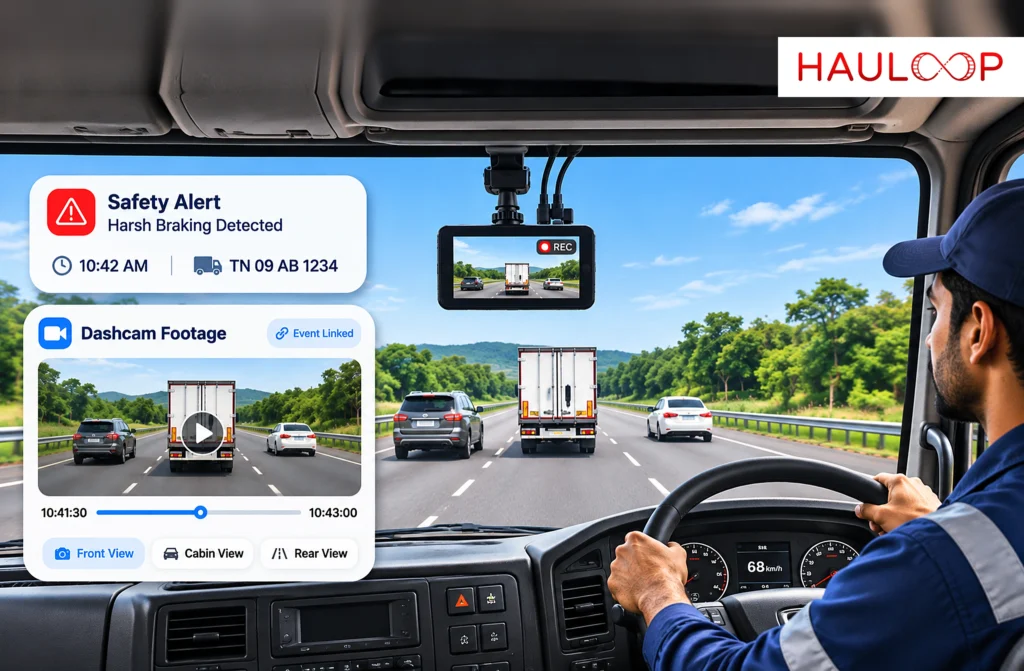
A delivery truck is travelling through a busy intersection when a car suddenly moves into its lane. The truck driver brakes sharply to avoid a collision.
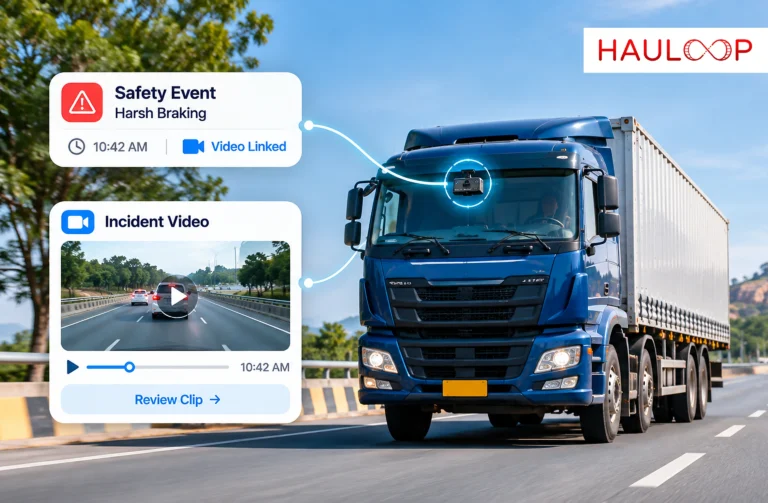
The fleet management system records a harsh braking event.
Later, a complaint is raised against the truck driver for allegedly driving recklessly.
From the recorded data, the fleet manager can confirm that the vehicle experienced sudden braking. But that information alone cannot explain what caused the driver to react.
Was the driver following another vehicle too closely? Did a car enter the lane unexpectedly? Was someone crossing the road?
This is where dashcam footage becomes valuable.
Video recorded around the incident can show the surrounding road conditions, nearby vehicles, and visible driver responses. When connected with driving event data, it helps fleet managers investigate what happened rather than relying entirely on alerts and conflicting explanations.
However, video evidence has its own limitations. Understanding what dashcam footage can establish, and what it cannot, is essential when reviewing fleet safety disputes.
Why is Driving Event Data Alone Not Enough to Explain an Incident?
Fleet telematics systems can record driving events such as harsh braking, sudden acceleration, and other monitored vehicle movements.
These records help fleet managers identify situations that deserve attention.
But an event does not always explain its cause.
For example, a harsh braking alert may indicate aggressive driving. It may also reflect an appropriate emergency response to an unexpected road hazard.
Without additional context, the manager may not know which explanation is more likely.
A speed record may show how fast the vehicle was travelling, but it does not necessarily show the traffic conditions surrounding it.
Similarly, a sudden movement alert cannot independently establish whether the driver was avoiding another vehicle or reacting to an obstacle.
Fleet dashcam integration adds visual context to these recorded events.
Instead of evaluating an isolated data point, the manager can examine what the camera captured around the same time.
What can Dashcam Footage Show During a Fleet Safety Dispute?
Dashcam footage can provide a visual record of the road environment and activities captured within the camera’s field of view.
Depending on camera placement and recording quality, it may show:
- Vehicle positions and visible traffic movements
- Road signs, lane markings, and traffic signals
- Events leading up to a collision or near miss
- Visible hazards or obstacles
- Driver actions captured by an inward-facing camera
- The sequence of events immediately before and after an incident
Consider a truck that is accused of changing lanes without warning.
A forward-facing camera may show the road ahead, while an additional side or rear camera may provide more information about surrounding vehicles.
The footage can help investigators compare the complaint with the visible sequence of events.
However, dashcam footage does not automatically establish legal responsibility.
Camera angles, visibility, missing footage, and events outside the recorded frame can all affect the interpretation.
The footage should be reviewed alongside other available evidence.
How does Dashcam Footage Help Verify Driver Behaviour?
Driver behaviour monitoring is useful for identifying potentially unsafe driving patterns.
However, recorded alerts need to be interpreted fairly.
Suppose a driver receives several harsh braking alerts during a delivery route.
A manager reviewing only the event count may assume that the driver needs corrective training.
But video footage may show that some braking events were responses to unpredictable traffic conditions.
Other clips may reveal that the driver was following vehicles too closely or reacting late to visible hazards.
These situations require different responses.
The first may call for a review of route conditions. The second may indicate an opportunity for driver coaching.
Hauloop’s Driver Safety capabilities can provide a broader operational context for reviewing driving events.
When driving data is connected with relevant video footage, fleet managers can distinguish between recorded behaviour and the circumstances surrounding it.
This supports more informed conversations with drivers rather than treating every alert as evidence of misconduct.
Why does Footage Before and After an Incident Matter?
A short video showing only the moment of impact may leave important questions unanswered.
The events leading up to the incident can be equally important.
For example, a collision clip may show a truck braking suddenly.
But the preceding footage could reveal that another vehicle entered its lane moments earlier.
Footage following the event may show where the vehicles stopped and what happened immediately afterwards.
This is why contextual playback matters.
Hauloop’s Dashcam Integration includes event-linked video clips and contextual review, allowing fleet managers to examine available footage around recorded driving events.
The objective is to understand the sequence rather than judge an isolated moment.
However, the available recording window depends on the camera system, storage configuration, and footage retention settings.
Can Multiple Camera Angles Provide Better Incident Evidence?
A forward-facing camera captures only part of the road environment.
Some incidents involve activity outside that view.
For example, a side collision may occur while a truck is turning, or another vehicle may approach from behind.
A single front camera may not capture the complete sequence.
Hauloop’s Dashcam Integration supports multiple camera angles, including front, rear, and cabin views, where compatible cameras are installed.
These views can provide additional context.
A front camera may show the road ahead. A rear camera may capture following traffic. A cabin-facing camera may show certain driver actions.
The usefulness of each view depends on camera positioning, visibility, and the incident itself.
More cameras can improve coverage, but they do not eliminate every blind spot.
How can Dashcam Footage Help Resolve Conflicting Incident Accounts?
Safety disputes often involve different descriptions of the same event.
A driver may report that another vehicle caused the incident.
A customer or third party may provide a different explanation.
Without visual evidence, the fleet operator may have to rely heavily on statements, photographs, and available vehicle data.
Dashcam footage can provide an additional source of information.
Consider a truck involved in a minor collision while entering a delivery location.
The driver reports that another vehicle reversed unexpectedly.
If the relevant camera captured the movement, the footage may help verify the sequence.
The manager can review the clip, compare it with the driver’s statement, and identify whether further investigation is required.
This does not mean video automatically settles every disagreement.
The recording may be incomplete, unclear, or limited to one perspective.
Its value lies in providing recorded visual information that can be examined alongside other evidence.
What Role does Dashcam Footage Play in Insurance Claims?
Commercial vehicle incidents can lead to insurance claims involving vehicle damage, third-party property, or other losses.
Insurers may request supporting information about the circumstances of an incident.
Relevant dashcam footage can help document visible events and support the investigation.
For example, footage may show traffic conditions, vehicle movements, or the sequence leading to a collision.
When available, the recording can be considered alongside photographs, incident reports, GPS information, and witness statements.
However, dashcam footage does not guarantee claim approval or determine liability by itself.
Insurers evaluate evidence according to policy terms, applicable law, and the circumstances of the claim.
Fleet operators should preserve relevant footage promptly and follow appropriate procedures for sharing it with authorized parties.
What are the Limitations of Dashcam Evidence?
Video footage can improve incident visibility, but it should not be treated as a complete or infallible record.
| What dashcam footage can support | What it cannot guarantee |
| Review of visible road conditions | Visibility of everything around the vehicle |
| Examination of recorded driver actions | Complete understanding of driver intentions |
| Reconstruction of captured incident sequences | Coverage of events outside the camera view |
| Comparison with driving event alerts | Automatic determination of legal fault |
| Supporting evidence for disputes | Guaranteed insurance claim outcomes |
| Historical incident review | Availability of footage beyond retention limits |
Recording quality, lighting, weather, camera placement, and technical interruptions can all affect what is visible.
A camera may capture an event clearly during daylight but provide limited detail in heavy rain or darkness.
Fleet managers should also consider whether the footage is complete and whether its timestamp corresponds accurately with the relevant incident.
How should Fleet Managers Review Dashcam Evidence?
An effective incident review should follow a consistent process.
First, identify the vehicle, driver, and incident time.
Next, retrieve the relevant footage and associated driving event information.
Review the sequence before, during, and after the event, including additional camera angles where available.
Compare the footage with GPS records, driver statements, and other supporting information.
If the incident involves a serious safety concern, follow the company’s established escalation and investigation procedures.
Relevant footage should be preserved securely, with access limited to authorized personnel.
This is particularly important when cabin-facing cameras capture personal information.
The objective is to investigate incidents fairly, protect evidence, and make decisions based on the available facts.
How can Dashcam Evidence Support Better Driver Safety?
Dashcam footage is useful not only after collisions but also when reviewing near misses and recurring driving events.
For example, a manager may identify repeated situations where a vehicle approaches intersections too quickly.
Video clips can help explain the circumstances and support targeted coaching.
They may also show that particular routes expose drivers to recurring hazards.
This creates an opportunity to discuss driving practices, route conditions, and operational expectations.
However, the purpose of video monitoring should not be to penalize drivers for every alert.
A fair safety program considers the circumstances and distinguishes unavoidable events from behaviours that can be improved.
When used responsibly, video evidence can support more constructive driver feedback and more consistent incident reviews.
Conclusion
Dashcam footage adds an important layer of context to fleet safety investigations.
Driving data can identify when a monitored event occurred, while video can help explain the visible circumstances surrounding it.
Together, they allow fleet managers to review incidents, investigate conflicting accounts, and assess driver behaviour using more than isolated alerts.
The footage does not automatically establish fault or guarantee the outcome of a dispute.
Its value lies in helping teams understand the available evidence and make more informed decisions.
Hauloop’s AI Fleet Management Software connects dashcam footage with driving events to support clearer incident investigations and safety reviews. Book a demo to explore how Dashcam Integration can strengthen your fleet’s approach to on-road visibility.
Frequently Asked Questions
What can dashcam footage prove in a fleet safety dispute?
Dashcam footage can provide visual evidence of recorded road conditions, vehicle movements, and events captured by the camera. Its ability to establish specific facts depends on recording quality, camera angle, and the available context.
Can dashcam footage prove that a truck driver was not at fault?
Footage may support a driver's account or show relevant circumstances, but it does not automatically establish legal responsibility. Liability depends on the complete evidence and applicable legal requirements.
How does dashcam footage help verify harsh braking alerts?
Event-linked footage allows fleet managers to review visible circumstances surrounding a harsh braking event, helping them determine whether it may have resulted from traffic hazards, driver actions, or other conditions.
Can fleet dashcams record multiple camera angles?
Compatible systems may support front, rear, and cabin-facing cameras. The available views depend on the installed hardware and integration configuration.
Is dashcam footage useful for insurance claims?
Yes. Relevant footage can support an insurance investigation by documenting visible events and vehicle movements. It does not guarantee claim acceptance or determine liability on its own.
How should fleet managers store dashcam evidence?
Relevant footage should be preserved securely, protected from unauthorized changes, and made accessible only to appropriate personnel. Retention and sharing should follow applicable privacy, legal, and company requirements.