A transport company assigns two drivers to the same truck on alternate days.
Both travel the same delivery route, carry comparable loads, and cover approximately the same distance.
At the end of the week, the fleet manager notices a difference in fuel consumption.
One driver’s trips consistently require more fuel than the other’s.
The obvious assumption is that the second driver is less fuel-efficient.
But is that necessarily true?
One driver may have travelled during heavier traffic. Another may have spent more time waiting at delivery locations. Their acceleration, braking, speed, and engine idling patterns may also differ.
Understanding driver fuel consumption requires more than ranking drivers by litres used.
Fleet managers need to examine how driving practices interact with route conditions before deciding where improvements are possible.
Why does Fuel Consumption Vary Between Drivers?
Two drivers operating similar vehicles on the same route can achieve different fuel consumption results.
Driving behaviour is one possible reason.
Frequent acceleration, harsh braking, unnecessary idling, and inconsistent speed can increase fuel demand.
However, these are not the only explanations.
A driver travelling during peak congestion may use more fuel than someone completing the same route during lighter traffic.
Vehicle load, tyre condition, road conditions, and delivery schedules can also influence the result.
This is why driver fuel performance should be evaluated in context.
A fair comparison considers both the driver’s actions and the conditions under which the journey was completed.
How do Acceleration and Braking Affect Fuel Consumption?
Driving style influences how efficiently a vehicle uses fuel.
Repeated acceleration requires additional energy, particularly when moving a heavy commercial vehicle.
When a driver accelerates aggressively and then brakes frequently, some of that energy is lost rather than being used to maintain steady movement.
Consider two drivers approaching a series of traffic signals.
One maintains a more consistent speed and anticipates slowing traffic.
The other accelerates toward each signal and brakes sharply when vehicles begin stopping.
Over repeated journeys, these different patterns can contribute to differences in fuel consumption.
However, braking events should not automatically be treated as poor driving.
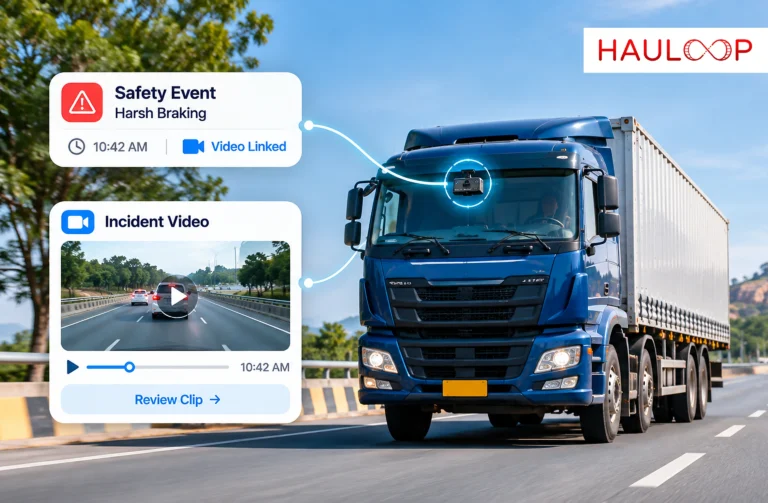
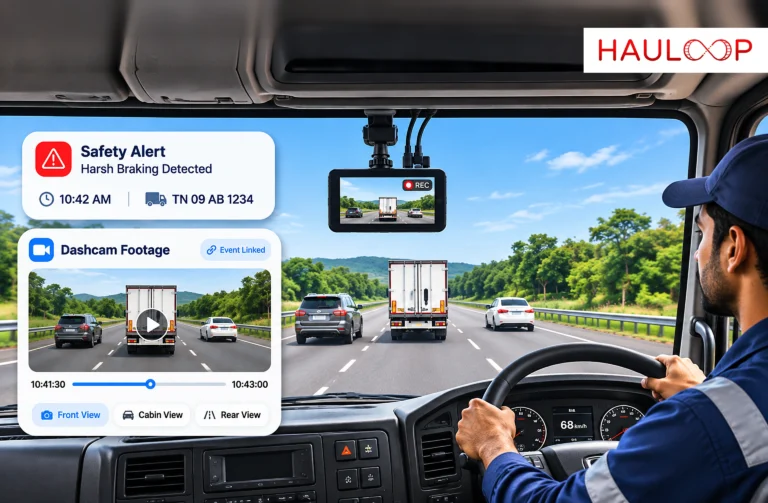
Emergency braking may be necessary for safety, and frequent braking may result from congested roads.
A useful driver performance review should examine the circumstances surrounding the event.
Does Driving Speed Influence Fuel Efficiency?
Vehicle speed can affect fuel consumption, particularly during highway transportation.
At higher speeds, aerodynamic resistance generally increases, requiring more energy to maintain movement.
The relationship also depends on vehicle design, engine characteristics, load, road gradient, and other conditions.
For heavy commercial vehicles, maintaining an appropriate and consistent speed can support fuel-efficient operation.
However, the objective should never be to reduce fuel consumption at the expense of safety or legal compliance.
Fleet managers should evaluate driving speed within applicable speed limits, road conditions, and operational requirements.
When supported by driver safety monitoring, speed-related information can provide useful context for reviewing driving practices.
Why is Driver Idling Important in Fuel Performance Reviews?
Engine idling can contribute to fuel consumption without adding distance to the journey.
Drivers may leave engines running during waiting periods, loading activities, or short stops.
Some idling may be necessary for vehicle operation, cabin conditions, or equipment requirements.
Other periods may be avoidable.
For example, consider two drivers completing similar delivery routes.
One spends 30 minutes idling during stops, while the other records 90 minutes.
The additional engine-running time may contribute to higher fuel consumption.
But the manager should first determine whether the drivers faced comparable operating conditions.
If one driver waited longer because a customer delayed unloading, the issue may be operational rather than behavioural.
This is why idling should be examined alongside stop locations, trip schedules, and delivery conditions.
How can Fleet Managers Compare Driver Fuel Consumption Fairly?
Comparing drivers solely by total litres consumed can produce misleading conclusions.
A driver covering 450 kilometres will generally consume more fuel than someone covering 250 kilometres.
Even when the distance is similar, vehicle load and traffic may differ.
A more useful comparison includes normalized fuel efficiency and relevant operating conditions.
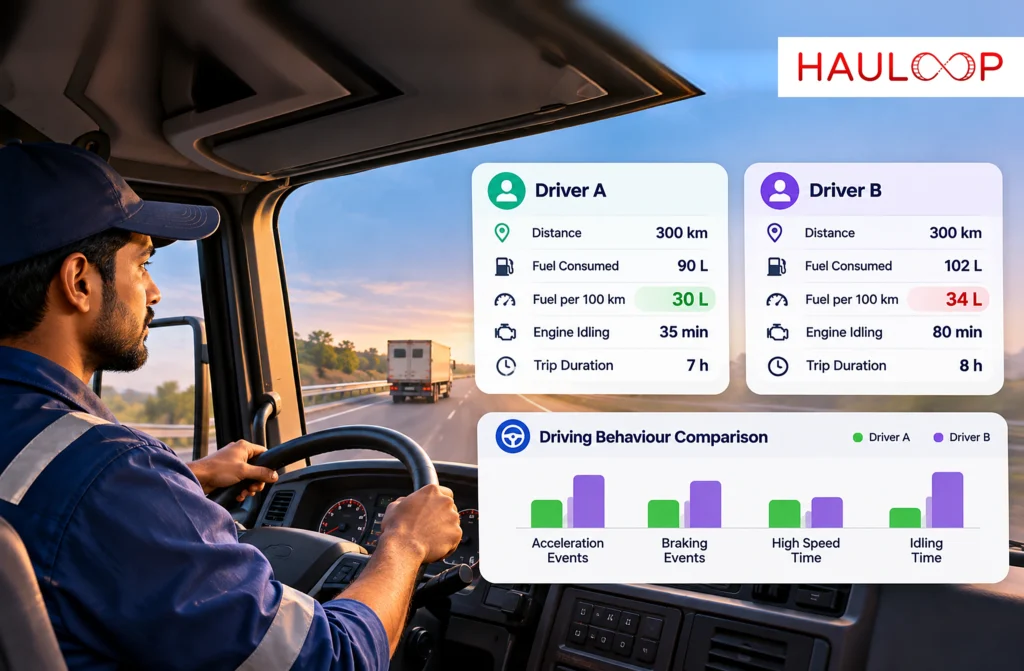
Consider this illustrative example:
| Performance measure | Driver A | Driver B |
| Distance | 300 km | 300 km |
| Fuel consumed | 90 L | 102 L |
| Fuel per 100 km | 30 L | 34 L |
| Engine idling | 35 minutes | 80 minutes |
| Trip duration | 7 hours | 8 hours |
Driver B consumed 12 litres more fuel.
The additional idling and longer journey may help explain the difference, but they do not establish the entire cause.
The fleet manager should examine whether the drivers encountered similar traffic, loads, vehicle conditions, and delivery requirements.
A fair review looks for consistent patterns across multiple comparable trips rather than judging a driver based on one journey.
How does Route-Level Data Change Driver Fuel Analysis?
Driver fuel performance becomes more meaningful when it is connected to the route being travelled.
Suppose a fleet manager notices that one driver regularly consumes more fuel.
Without route information, the manager may assume that the driver needs additional training.
But historical trip data may show that this driver is frequently assigned to a route with more congestion and longer delivery waiting times.
Another driver may be operating on less demanding roads.
Comparing the two without accounting for route conditions would be misleading.
Route-level data helps establish the context behind fuel consumption.
It allows managers to distinguish between differences associated with operating conditions and those that may relate to driving practices.
This does not require every driver to achieve identical fuel results.
It requires the comparison to reflect the conditions under which the fuel was used.
How can Route and Driver Data Work Together to Identify Fuel Savings?
Route information explains where and under what conditions a journey took place.
Driver information helps explain how the vehicle was operated.
Combining the two creates a more useful basis for fuel analysis.
For example, a fleet manager may notice that fuel consumption is consistently higher on a particular route.
The next step is to compare journeys completed by different drivers under similar conditions.
If fuel consumption remains high regardless of the driver, route congestion, waiting time, or other operating conditions may deserve attention.
If one driver’s trips repeatedly show higher consumption under comparable conditions, the manager can investigate driving practices or other relevant factors.
This creates two different improvement paths.
Route-related issue: Review dispatch timing, waiting periods, route selection, or delivery scheduling.
Driver-related issue: Review acceleration, braking, speed consistency, and avoidable idling where supported by the available data.
The distinction helps prevent fleet managers from applying the wrong solution to the problem.
What can Historical Trip Records Reveal About Driver Fuel Performance?
A fuel consumption figure tells the fleet manager how much fuel was used.
Historical trip information can help explain what happened during the journey.
For example, a completed trip record may show that a vehicle spent an unusually long period stationary or travelled through an unexpected route section.
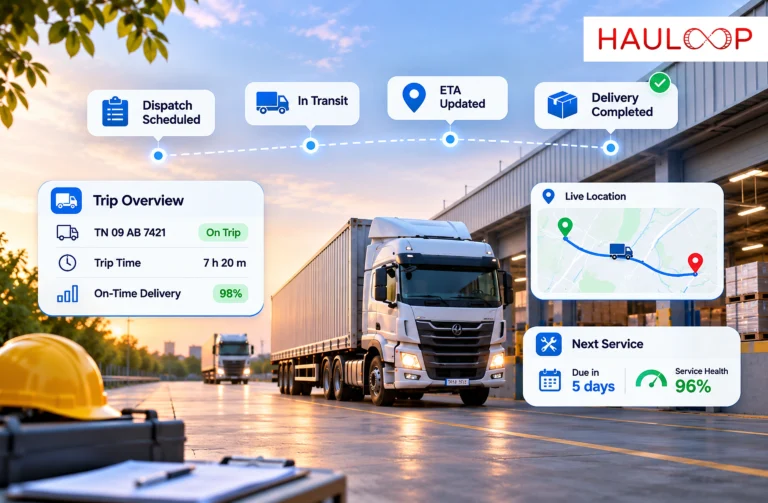
Hauloop’s Trip History & Replay allows operators to review recorded movement, stops, speed, and timing from completed journeys.
These details can support investigations into differences in fuel performance.
However, a recorded stop does not automatically establish that the engine was idling.
Confirming engine-running time requires suitable vehicle or telematics data.
Similarly, a trip replay does not independently measure fuel consumption unless it is combined with an appropriate fuel data source.
The strongest analysis uses the relevant datasets together rather than assuming that GPS movement alone explains fuel usage.
How can Fleet Managers Use Driver Fuel Data for Coaching?
Driver performance information can support practical coaching when it is reviewed fairly.
For example, if repeated comparable trips indicate frequent unnecessary acceleration or avoidable idling, the manager can discuss those patterns with the driver.
The conversation should focus on specific operating situations rather than broad accusations about poor performance.
A useful approach involves reviewing the data, understanding the driver’s explanation, identifying realistic improvements, and checking later journeys for changes.
For example, a driver may be encouraged to anticipate traffic conditions, maintain appropriate speeds, and reduce unnecessary engine running where safe and practical.
Coaching should also recognise operational constraints.
A driver cannot control every traffic delay, customer waiting period, or road condition.
The objective is to improve controllable driving practices while maintaining safety and delivery performance.
How can Combined Fuel Data Support Trip Profitability?
Fuel efficiency matters because fuel is a significant operating expense for transport businesses.
However, reducing litres consumed is not the only consideration.
Fleet managers also need to understand the cost of completing each journey.
For example, a driver may achieve better fuel efficiency on a particular route, but the trip could involve additional travel time or other expenses.
Another trip may consume more fuel while carrying a larger load or completing more deliveries.
Combining route and driver information with fuel cost data helps managers examine fuel expenditure in the context of completed work.
Useful measures may include fuel cost per kilometre, fuel cost per trip, and fuel cost relative to the shipment or delivery.
This helps transport businesses connect fuel management with the profitability of individual operations.
Why should Fleets Review Fuel Performance Over Multiple Trips?
One trip rarely provides enough information to evaluate a driver’s fuel efficiency.
A journey may involve unusual congestion, a different load, or unexpected delays.
These conditions can temporarily change fuel consumption.
Reviewing several comparable trips helps fleet managers identify whether a difference is recurring.
For example, if a driver consistently records higher fuel consumption across similar vehicles, routes, and loads, the pattern may justify further investigation.
If the difference disappears when the operating conditions are comparable, the original conclusion may need to be reconsidered.
Historical comparisons are therefore more useful when they account for the variables that affect fuel consumption.
The goal is to identify repeatable opportunities for improvement rather than react to isolated figures.
Conclusion
Different drivers can consume different amounts of fuel on the same route, but driving behaviour is only one part of the explanation.
Traffic, vehicle load, journey timing, idling, speed, and route conditions all influence fuel performance.
For fleet managers, the most useful approach is to examine driver information alongside the conditions of each completed journey.
This makes it easier to identify whether higher fuel consumption is associated with controllable driving practices, recurring route problems, or other operational factors.
Hauloop’s AI Fleet Management Software helps fleet operators bring vehicle, trip, and performance information into a connected operational view. Book a demo to explore how route and driver insights can support more informed fuel cost decisions.
Frequently Asked Questions
Why do different drivers consume different amounts of fuel on the same route?
Differences in acceleration, braking, speed, idling, traffic, vehicle load, and operating conditions can affect fuel consumption, even when drivers travel similar distances.
How can fleet managers measure driver fuel efficiency?
Fuel efficiency can be measured using litres per 100 kilometres or similar normalized metrics. Managers should also consider route conditions, payload, vehicle type, and trip duration.
Does harsh braking increase fuel consumption?
Frequent acceleration followed by braking can contribute to inefficient fuel use. However, braking may be necessary for safety, so individual events should be evaluated in context.
Can GPS tracking alone measure driver fuel consumption?
No. GPS tracking provides movement and location information. Reliable fuel consumption measurement requires an appropriate fuel data source, such as compatible vehicle data or fuel monitoring equipment.
How can driver coaching reduce fleet fuel costs?
Coaching can help drivers identify potentially inefficient practices, including unnecessary idling, aggressive acceleration, and inconsistent speed, while maintaining safe driving standards.
Why should route and driver data be analyzed together?
Route data provides context about traffic, stops, and journey conditions, while driver data can help explain operating practices. Combining them supports fairer comparisons and more targeted fuel efficiency improvements.