
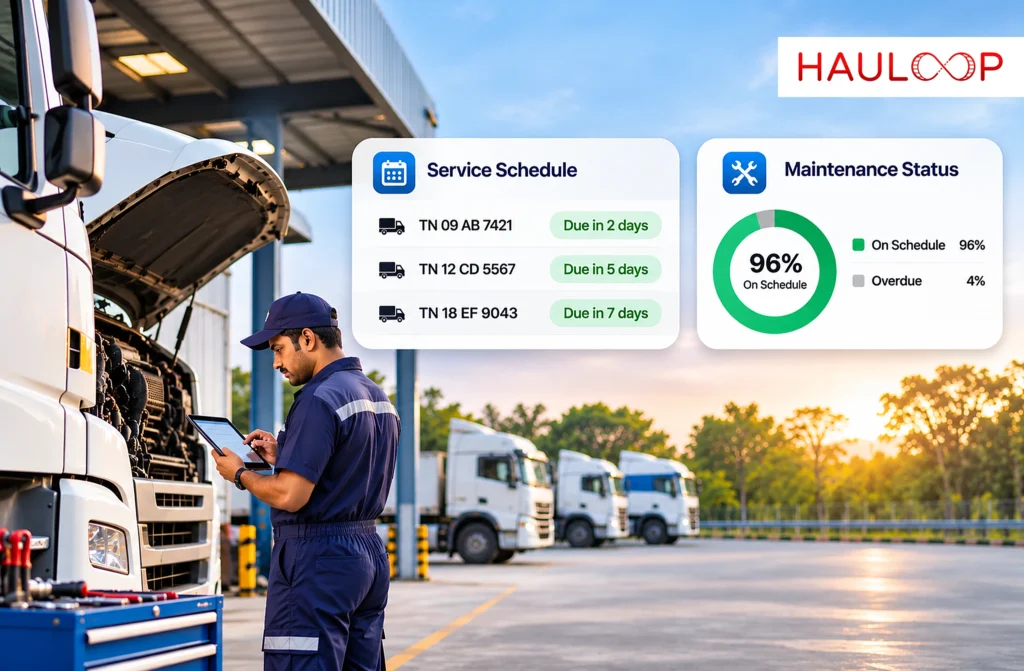
The service board says Truck TN-52 is due next Friday. Its odometer suggests it will cross the service interval tomorrow. Its engine-hour reading shows that the vehicle may already require attention.
Three measurements point to three different moments.
Following only the calendar could let TN-52 cross its usage limit. Removing it immediately without checking assignments could disrupt a confirmed delivery.
There is no dramatic warning here only an ordinary scheduling conflict that can quietly become overdue maintenance or avoidable disruption.
Choosing the best fleet maintenance software in India requires more than reminders. It must calculate the service point, provide planning time and move the requirement into recorded work.
Let’s examine what fleets should verify before relying on the software.
Fleet Maintenance Software Must Connect the Complete Service Cycle
Fleet maintenance software should set the service rule, monitor usage, warn the team, assign the task, record the work and reset the interval.
A reminder without execution is another alert to manage manually. A repair without an updated schedule can calculate the next service from the wrong starting point.
Hauloop’s maintenance overview connects preventive schedules with inspections, diagnostics, work orders and vehicle records. When reviewing software, fleets should look for this complete workflow rather than treating the calendar as the entire maintenance system.
The Service Trigger Must Match How the Vehicle Works
Not every vehicle reaches maintenance at the same rate or through the same measurement.
Calendar-based service suits tasks that must occur after a defined period, even when the vehicle covers little distance. Mileage works for components whose wear broadly follows road use. Engine hours matter when the engine continues working while the vehicle is stationary.
A construction tipper or utility vehicle may accumulate engine hours through stationary equipment use without adding equivalent kilometres. A standby vehicle may reach a date-based inspection before its mileage limit.
The software should support the rule that matches the task:
- Every 10,000 kilometres
- Every 500 engine hours
- Every six months
- Whichever threshold occurs first
- A manufacturer or fleet-defined interval
Fleet telematics shows why mileage and engine hours can describe different types of vehicle use. The data still depends on compatible devices, correct vehicle mapping and reliable reporting.
The system should also show the current reading, previous service reading and remaining interval. A due date without its underlying usage data is difficult to verify.
A Reminder Must Create Enough Time to Plan
An alert generated at the exact service limit may already be too late.
The team may need to arrange parts, reserve a workshop bay and remove the vehicle from upcoming assignments. The reminder should arrive early enough for those decisions.
Hauloop’s service scheduling can monitor mileage, time or engine-hour rules and show vehicles that are approaching, due or overdue for service.
Lead time should reflect the work. A routine inspection needs less preparation than a major service involving specialised parts or an external workshop.
The system should help distinguish:
- Approaching: Planning should begin.
- Due: The service window has been reached.
- Overdue: The vehicle has passed the defined limit.
- Critical: A separate safety or condition issue requires immediate review.
A reminder indicates that an interval has been reached; it does not diagnose the vehicle or guarantee safe operation until the booking.
Every Approved Service Must Become Owned Work
TN-52 can appear on the due list and still miss service if nobody owns the next step.
Once the maintenance requirement is approved, it should become a work order containing the vehicle, task, priority, assigned technician or vendor, required parts and planned completion time.
Hauloop’s work orders can track whether maintenance is planned, waiting for parts, in progress, completed or overdue. Labour, parts, notes and technician findings can remain attached to the vehicle record.
This matters when work passes between operations, an internal workshop and an external provider. A verbal instruction does not show whether the vehicle was booked, inspected or released.
Planned repairs explains why a maintenance signal creates value only when the vehicle, workshop, people and parts are coordinated at the right time.
Software should therefore show responsibility and status, not merely the original reminder.
Maintenance Must Be Planned Around Vehicle Availability
Immediate servicing can disrupt operations, while postponing every task until convenient creates another risk.
The maintenance and dispatch teams need a shared view of vehicle commitments. Before confirming the workshop slot, they should review:
- Current and upcoming trips
- Expected depot return
- Replacement-vehicle availability
- Workshop and technician capacity
- Parts availability
- Severity of the maintenance requirement
- The consequence of extending operation
The objective is the earliest safe opportunity with manageable operational disruption.
Condition information may change the priority. A routine interval approaching in five days differs from rising coolant temperature or an active safety defect. Predictive maintenance can identify developing risk, but not a guaranteed failure date. The team must still review the evidence.
The maintenance screen should also make vehicle status visible to dispatch. A truck waiting for parts should not appear as available for another load.
Completed Work Must Improve the Next Service Decision
Closing a work order should create more than a “completed” status.
The record should include the date, usage reading, work performed, parts, labour, cost and findings. If work responded to a defect, the team should confirm whether it was resolved.
The next service interval should then reset from the correct date or usage reading. This prevents an old reminder from remaining open or the next cycle from starting from an estimated value.
Service history can reveal repeated repairs, rising cost and longer periods of vehicle unavailability. Complete records also support warranty, audit and replacement reviews.
Before choosing software, test a vehicle approaching a mileage limit, one accumulating stationary engine hours, one with a date-based inspection and one carrying an open defect.
Check whether the software:
- Calculates the correct due point
- Gives adequate planning notice
- Creates and assigns the required work
- Shows the vehicle as unavailable when appropriate
- Records completion details
- Resets the next interval correctly
This test reveals whether the platform manages maintenance or merely displays reminders.
Conclusion: Choose Software That Moves Service from Due to Done
Return to TN-52. The calendar said next Friday, while mileage and engine hours indicated that attention was required sooner.
Reliable software should apply the correct rule, expose the approaching limit and give the team time to coordinate the vehicle, workshop and parts. It should then preserve responsibility, status and completion evidence before resetting the interval.
That is how software supports reliable service scheduling. It cannot prevent every breakdown or replace technician judgement, but it can reduce the chance that maintenance is missed because the due point, owner or completion record was unclear.
An AI-powered AI-Powered Fleet Management Software can connect service schedules, vehicle usage, maintenance tasks and repair history within one operational view. Book a Demo to test the workflow using your own vehicles and service rules.
Frequently Asked Questions
Should a highway truck use mileage or date-based service reminders?
A highway truck usually accumulates mileage quickly, so distance may be the main trigger for oil, filter and inspection intervals. Date-based rules may still apply to inspections, fluids or components that age. The system can use whichever threshold occurs first.
When should engine hours be used instead of kilometres?
Engine hours are useful when the engine operates while the vehicle remains stationary. A refrigerated truck running its cooling equipment or a utility vehicle using power take-off may reach an engine-hour limit before its mileage suggests service is due.
How early should a maintenance reminder appear?
Lead time should match the preparation required. A routine inspection may need a short warning, while a major service requiring imported parts and an external workshop may need several days. The fleet should configure separate notice periods for different tasks.
What should happen when a due vehicle is assigned to a delivery?
Maintenance and dispatch should review the task, remaining interval, issue severity, trip duration and replacement availability. The appropriate decision may be servicing first, reallocating the load or selecting another safe maintenance window. Software should expose the conflict rather than decide it automatically.
Should every maintenance alert create a work order?
No. A routine due reminder may create a scheduled task, while a diagnostic or predictive alert may require inspection before repair is approved. Once the required work is defined, a work order should record its owner, priority and completion process.
How can a fleet test maintenance software before purchasing it?
Use vehicles with different service triggers and one open defect. Confirm the system calculates each due point correctly, sends notice at the configured time, assigns work, records completion and resets the next interval from the correct reading.