Your driver has been driving for 14 Hours. He doesn’t know he’s falling asleep. Your dashcam does.
It is 3 am on the NH-44 bypass south of Krishnagiri.
Your driver left the depot at 11 pm. He has been behind the wheel for four hours. He slept for six hours before departure, which felt like enough. The truck is loaded. The road is clear. He is doing 72 km/h on a four-lane divided highway.
For the last eight minutes, his eyes have been closing for 1–2 seconds at irregular intervals. He does not know this is happening.
This is what microsleep looks like from the inside: nothing.
There is no sensation of falling asleep. One moment you are awake. The next moment, several seconds have passed, and you cannot account for them.
In those 1–2 seconds at 72kmph, the truck travels 40 metres without a driver.
Your AI dashcam’s Driver Monitoring System has been tracking his eye closure frequency, head position, and blink rate for the last eight minutes. It has already classified his state as early-stage fatigue.
At the second nine of the current microsleep, still below the threshold of what he would notice himself, the in-cab speaker activates with a loud, sharp audio alert.
He snaps awake. He pulls over at the next safe spot, drinks water, walks around the truck, and continues after twenty minutes.
He delivers on time.
He arrives home.
His family does not receive a phone call.
That is what a fleet dashcam does.
Not surveillance. Not catching drivers doing something wrong. Catching the thing that drivers cannot catch about themselves.
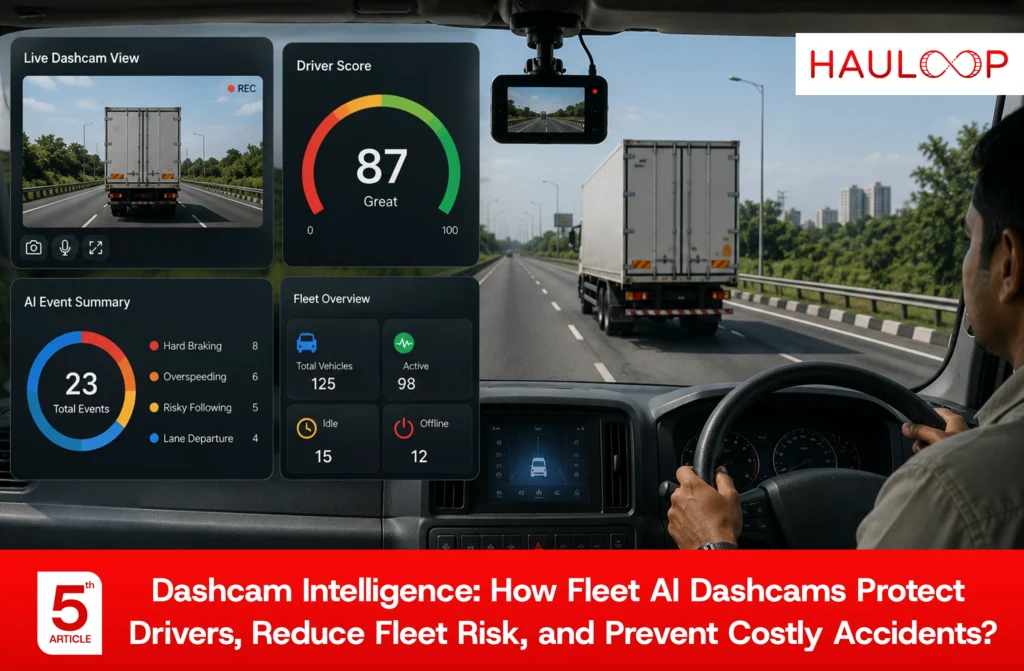
This is where fleet dashcam intelligence becomes important. For fleet operators, a fleet AI dashcam is not just a video recorder. It is a real-time fleet driver management system that helps detect fatigue, distraction, unsafe behaviour, lane departures, following distance risks, and forward collision threats before they become accidents.
The Problem Your Drivers are Already Living With
Before anything about the technology, something needs to be said about the people operating the trucks.
Indian truck drivers work in conditions that would be considered unsafe in every country that publishes labour statistics on the subject.
The average Indian truck driver drives 14 to 16 hours a day, a figure cited by the Ministry of Road Transport and Highways itself.
They operate in cabin temperatures of 43 to 47 degrees Celsius before the AC cabin mandate that came into effect for new vehicles in 2025.
A 2020 study by SaveLIFE Foundation found that 52.5% of drivers surveyed in Bengaluru said they continue driving even when they feel fatigued or sleepy. Across the country, that figure was 49%.
These drivers are not careless people.
They are people in a system that does not give them enough time to rest, does not pay them enough to refuse a load, and does not give them a mechanism to flag their own condition before it becomes dangerous.
The Scale of the Problem — MoRTH 2024 Provisional Data
| Risk Factor | What it Means for Fleet Operators |
| Human error | Speeding, distraction, and fatigue contribute to approximately 70% of road accidents in India |
| Road deaths | India recorded 1.70 lakh road deaths in 2024, based on provisional official figures |
| Highway risk | More than 60% of road fatalities occur on National and State Highways |
| Truck driver exposure | Truck drivers are disproportionately represented in both accident causes and casualties |
A fleet dashcam does not fix the structural problem.
It catches the specific moment the structural problem becomes lethal, and gives the driver a chance to respond before it does.
The Surveillance Question — And Why it is the Wrong Question
When most fleet operators hear “dashcam,” the first thought is:
My drivers will hate this.
They are not wrong that this is a risk.
A dashcam framed as a monitoring tool will generate resistance from experienced drivers, friction in WhatsApp groups, and in organised fleets, union conversations.
That framing is also exactly what makes a dashcam less useful.
A driver who knows he is being watched for compliance will drive differently while the camera is running and differently when he thinks no one is watching.
The coaching frame is not just more ethical. It is more effective.
| Surveillance | Coaching |
| Answers: “What did the driver do wrong?” | Answers: “What is the driver about to do that will hurt him?” |
| Looks backward, after an event | Looks forward, before an event |
| Generates compliance data used in disciplinary conversations | Generates safety data used in driver development conversations |
The device is identical.
The culture around it determines what it produces.
What a Dashcam Actually Sees — DMS and ADAS Explained?
A fleet dashcam has two cameras working simultaneously.
One watches the driver.
One watches the road.
Together, they create a safety picture that GPS tracking alone cannot provide.
DMS — Driver Monitoring System
The DMS camera is the in-cab camera facing the driver.
It uses infrared imaging to track the driver’s face regardless of lighting conditions. This is important because fatigue and distraction often happen at night, during low-light highway runs, or in cabin conditions where a normal camera may not work reliably.
DMS monitors continuously.
1. Fatigue Indicators
The system tracks eye closure duration, blink rate, head nodding, and microsleep events.
It builds a baseline for each individual driver and tracks deviation from that baseline throughout the journey.
This matters because fatigue does not always appear suddenly.
It builds gradually.
The driver may not feel it clearly, but the system can detect changes in eye movement and head position before the driver fully loses awareness.
2. Distraction Indicators
The system monitors head position, gaze direction, and face orientation away from the road.
This can include texting, eating, adjusting controls, extended conversations, or looking away from the road for too long.
For a heavy vehicle moving at highway speed, even a few seconds of distraction can become dangerous.
3. Unsafe Behaviours
The in-cab camera can detect behaviours such as phone use, smoking, and seatbelt absence.
These can be flagged in real time or reviewed later as part of a structured driver coaching programme.
ADAS — Advanced Driver Assistance System
The ADAS camera is the forward-facing camera watching the road ahead.
It uses computer vision to monitor the driving environment and detect road-facing risks.
1. Lane Departure
The system detects when the vehicle drifts across lane markings without an indicator.
This is one of the most reliable early indicators of fatigue in long-haul driving.
A driver may not realise that the vehicle is slowly drifting. The camera does.
2. Following Distance
The system tracks the gap between your truck and the vehicle ahead.
Tailgating at highway speeds is one of the leading precursors to rear-end collisions, especially with fully loaded vehicles that require longer stopping distances.
3. Forward Collision Warning
The system detects when the gap ahead closes at a rate that indicates insufficient braking time at the current speed.
This gives the driver an opportunity to react earlier.
4. Traffic Sign Recognition
The system can help identify overspeeding relative to posted limits and detect risky road approaches, including signals or speed-restricted areas.
Why DMS and ADAS Work Better Together?
A fatigued driver on a nighttime run will usually show more than one signal.
DMS may detect drooping eyelids, head nods, or slow blink patterns.
ADAS may detect subtle lane departures, shorter following distances, or delayed reactions to road movement.
These two data streams together are significantly more reliable than either one alone.
This is why fleet AI dashcams are not just cameras.
They are driver safety intelligence systems.
The Four Things Dashcam Footage does that no Other Device can
1. It Protects Your Driver When an Accident is not His Fault
This is the argument for dashcams that resonates most powerfully with drivers themselves, and it is the one most fleet operators forget to make.
On Indian roads, after an accident, the truck driver is frequently assumed to be at fault.
The truck is large. The truck is commercial. The driver is alone against potentially multiple witnesses who may not be independent, in a jurisdiction where false accident claims are documented and common.
Without video evidence, your driver’s account of events, however accurate, is one version against another version.
Dashcam footage taken from the forward-facing camera shows exactly what happened in the seconds before an accident.
If a two-wheeler changed lanes without warning, if a pedestrian stepped from a blind spot, if another vehicle ran a red light, the footage shows it.
This is not surveillance of your driver.
This is evidence that defends your driver.
2. It Creates the Evidence that Defeats False Claims
Staged accidents, where another vehicle deliberately collides with a truck to generate an insurance claim, are a documented problem on Indian highways.
The mechanics of a staged collision are designed to produce ambiguity.
The truck is always larger. The damage is always real. The claimant has a ready-made narrative.
A forward-facing dashcam captures the seconds before impact.
It captures the driving pattern of the vehicle that approached and made contact. It captures whether the collision was initiated by the other vehicle’s movement.
This footage is what makes a staged accident claim unsustainable.
3. It Provides Coaching Data that Improves Driver Performance Over Time
A dashcam generates a weekly safety score for every driver based on harsh braking events, harsh acceleration, lane discipline, fatigue indicator frequency, and phone use.
The fleet manager who reviews this score every Monday knows which three drivers in the fleet are operating at the highest risk, on which routes, and at what times.
The fleet operators who extract value from this data do not use it in disciplinary conversations.
They use it in coaching conversations:
“Your fatigue indicator fired four times between 2 am and 4 am on Thursday’s Hosur run. Let’s talk about rest timing on that corridor.”
That is a different conversation from:
“The camera caught you being careless.”
Industry data from AI dashcam deployments reports up to 40% reduction in fatigue-related incidents within six months of implementing structured coaching programmes.
When drivers know their fatigue patterns are visible and discussed, they become more proactive about rest, not because they are being watched, but because the data gives them a language for something they have always felt but never been able to measure.
4. It Reduces the Time and Cost of Insurance Claim Disputes
An insurance claim without evidence can take months.
An insurance claim with timestamp-verified, GPS-correlated video footage can move much faster.
For a fleet running 20 trucks on Indian NH corridors, the annual number of insurance claim interactions is not zero.
Every claim that resolves faster and more accurately because of dashcam footage is value that does not appear on any trip sheet but is very real to the CFO who approves legal and settlement costs.
The Conversation to have with Your Drivers Before Deploying a Dashcam
The most common deployment failure is not technical.
It is the conversation that did not happen before the first device was installed.
If your drivers find out about dashcams through gossip, or through a WhatsApp message that starts with “management is putting cameras in the trucks,” you have lost the coaching frame before you started.
The conversation that needs to happen, in person, before installation, with a senior driver present, covers four things.
| Conversation Point | What to Explain |
| What the device sees | In-cab camera facing the driver, forward camera facing the road. Records continuously. In normal operation, footage is stored locally and only uploaded when an event is detected. |
| What triggers an upload | A safety event such as harsh braking, lane departure, fatigue alert, or harsh acceleration. Not continuous upload. Not management watching a live feed of the driver’s face. |
| What the data is used for | Safety coaching, not disciplinary records. Footage from normal driving is not reviewed. Footage from events is reviewed to understand what happened, not to find fault. |
| What it does for the driver | If another vehicle causes an accident and the truck driver is blamed, the footage can clear him. If a staged claim is filed, the footage can defeat it. If fatigue builds to a dangerous level on a night run, the alert tells the driver before he falls asleep at 72kmph. |
That last point, said simply and directly, changes the room.
Most experienced drivers have had a 3 am moment on a highway when they knew they were not safe.
When you tell them the camera exists to catch that moment and alert them before something happens, not to catch them doing something wrong after, the conversation changes.
What to do this Week?
1. Decide on the Framing First
Every communication to drivers about the dashcam should use the word “coaching,” not “monitoring.”
It should emphasise the evidence protection angle.
It should be clear that normal driving footage is not reviewed.
2. Start with Your Nighttime Runs
Routes involving driving between 11 pm and 5 am are the highest-risk hours on your fleet’s schedule.
Deploy on those vehicles first for the fastest safety return.
3. Build the Safety Event Review Into Monday Morning
The fleet manager who reviews last week’s events every Monday, which corridors, which drivers, which event types, is building a picture of where risk is concentrated.
That is what turns dashcam data from footage storage into operational intelligence.
4. One Conversation Before One Installation
Do not install across the fleet and send a memo.
Install on one vehicle, with the driver’s knowledge and involvement, and let that driver’s experience be the reference point for every other conversation.
The driver who understands the system from the inside is the most effective advocate for it in the fleet.
The Number that Matters
GPS tracking alone reduces fleet incidents by 8–12%, according to ABI Research’s 2024 fleet telematics study.
AI-integrated dashcam systems with driver behaviour monitoring reduce fleet incidents by 25–40%.
The gap, roughly 20 to 30 percentage points, represents incidents that GPS alone does not prevent but that driver coaching and real-time fatigue detection do.
In a 20-truck fleet running 300km per day on Indian National Highways, even a conservative interpretation of that gap means multiple avoided incidents per year.
What does One Avoided Truck Accident Cost?
| Cost Area | Impact |
| Medical expenses | Can become significant depending on injury severity |
| Vehicle repair | Includes truck damage, third-party vehicle damage, and towing |
| Cargo loss | Damaged or delayed cargo can create direct and indirect losses |
| Driver downtime | Lost working time, recovery time, and replacement planning |
| Insurance claim management | Legal, documentation, settlement, and administrative time |
| Legal proceedings | Possible Motor Accident Claims Tribunal involvement |
The cost range can start around ₹5 lakh for a minor incident and rise significantly for serious accidents.
A dashcam and its annual operating cost are recovered in full the first time it prevents one of those events.
Everything after that is value that does not appear on any invoice because the accident never happened.
That is the number that matters.
Not what the dashcam costs.
What the accident it prevents would have cost.
Conclusion
Your driver may not know he is falling asleep.
Your operations team may not know which route has the highest fatigue risk.
Your insurance team may not know which claims could have been resolved faster with video evidence.
But the dashcam can see the moment before risk becomes damage.
Dashcam intelligence helps fleets move beyond video recording. It combines DMS fatigue detection, ADAS road-facing intelligence, driver coaching, safety event review, and evidence protection into one practical safety system.
When deployed correctly, it protects drivers, reduces liability, improves coaching, and helps fleets prevent accidents before they happen.
Hauloop’s dashcam integration combines DMS fatigue detection, ADAS road-facing intelligence, and real-time WhatsApp alerts to your operations team, all in a single platform alongside your GPS, fuel monitoring, and OBD data.
Book a demo with Hauloop to see how dashcam intelligence can help your fleet improve driver safety and reduce avoidable road risk.
In the next blog, we will explore Digital Lock / Cargo Custody and explain how cargo security, tamper alerts, and custody visibility help fleets protect goods in transit.
Stay tuned for the final blog in this series.
Frequently Asked Questions
What is dashcam intelligence in fleet management?
Dashcam intelligence uses AI dashcams, driver monitoring systems, and road-facing cameras to detect fatigue, distraction, unsafe driving behaviour, lane departure, following distance risks, and collision threats.
How does an AI dashcam help prevent accidents?
An AI dashcam can detect early signs of fatigue, distraction, harsh driving, or road-facing collision risk and alert the driver in real time before the situation becomes dangerous.
What is the difference between DMS and ADAS?
DMS, or Driver Monitoring System, watches the driver for fatigue, distraction, and unsafe behaviour. ADAS, or Advanced Driver Assistance System, watches the road for lane departure, following distance, and collision risks.
Do drivers see dashcams as surveillance?
Drivers may resist dashcams if they are introduced as monitoring tools. Adoption improves when dashcams are positioned as coaching and protection systems that defend drivers during false claims and warn them during fatigue risk.
Can dashcam footage help with insurance claims?
Yes. Dashcam footage provides timestamped video evidence that can show what happened before an accident, reduce claim disputes, support driver statements, and help resolve false claims faster.
Which vehicles should get dashcams first?
Start with vehicles running high-risk routes, especially nighttime runs between 11pm and 5am, long-haul corridors, accident-prone routes, and vehicles carrying high-value cargo.