Fuel theft detection sounds straightforward.
A fleet tracking system monitors tank levels, compares fuel consumption against the vehicle’s normal pattern, and sends an alert when it detects an unusual drop.
In theory, that should help fleet operators identify fuel theft quickly.
In practice, many systems generate so many false alerts that operations teams eventually stop trusting them.
A truck may show a sudden fuel drop because the sensor reading shifted. An offline device may upload several hours of data at once. A refuelling event may be interpreted incorrectly. GPS, CAN bus, and fuel sensor timestamps may not align. A timezone error can make hundreds of normal readings appear suspicious at the same time.
The problem is not that fuel theft detection is impossible.
The problem is that many platforms evaluate fuel data without first validating whether the data and its operational context are reliable.
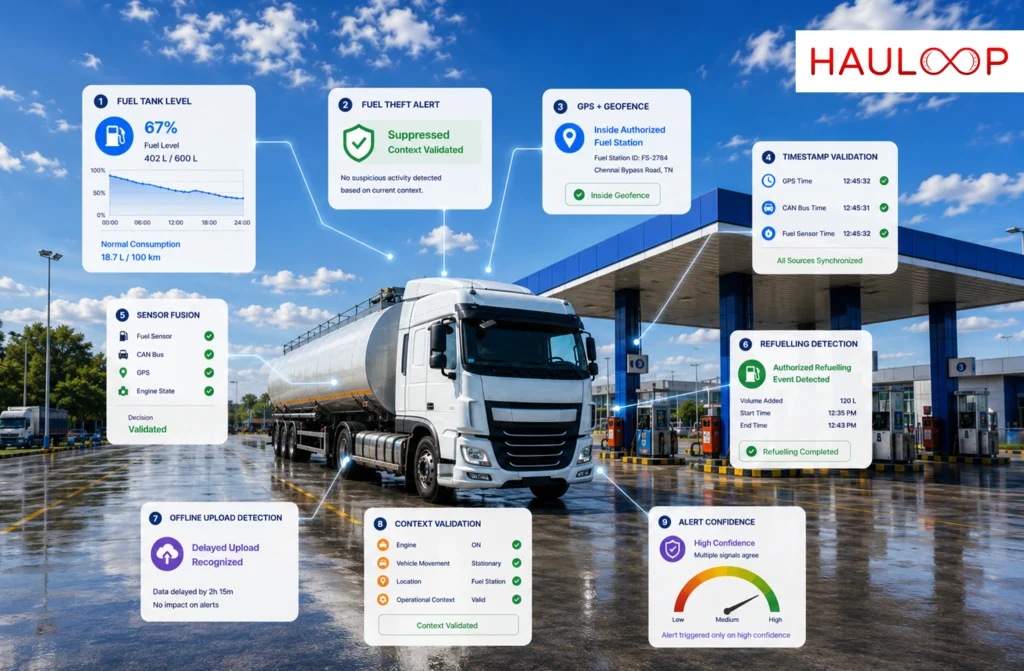
A dependable fleet fuel management system needs more than a statistical anomaly detector. It needs sensor fusion, timestamp validation, contextual baselines, alert suppression, and corroborating evidence before notifying the fleet team.
That is how fuel theft detection moves from noisy guesswork to a trustworthy operational tool.
Why Basic Fuel Theft Detection Creates False Positives
Many fuel monitoring platforms follow a simple process:
- Collect fuel sensor readings.
- Calculate litres consumed per hour.
- Compare the result with the vehicle’s historical average.
- Trigger an alert when consumption exceeds a fixed threshold.
A typical rule may look like this:
If actual fuel consumption is greater than
the historical baseline plus two standard deviations:
Trigger a fuel theft alert
This can work in a controlled test environment. However, real fleet operations are far more complicated.
Fuel data may come from sensors reporting every 30 seconds. CAN bus data may arrive every five seconds. GPS location may update once per minute. These systems do not always use the same clocks, timestamps, or upload schedules.
A statistical detector may therefore identify an anomaly without understanding whether the vehicle was moving, parked, refuelling, idling, offline, or inside a secure depot.
The result is a system that produces alerts faster than the operations team can validate them.
What Causes False Fuel Theft Alerts?
False alerts usually come from a combination of sensor, timing, and operational factors rather than one obvious problem.
Fuel Sensor Variations
Fuel gauges are not perfectly accurate. Normal readings may vary by approximately 2% to 5%, depending on the sensor, tank shape, vehicle age, road conditions, and calibration.
Several conditions can temporarily change the reading:
- Fuel is moving inside the tank during braking or cornering
- Temperature-related expansion and contraction
- Vehicle parking on a slope
- Cold engine starts
- Sensor ageing
- Tank-shape irregularities
- Differences between new and older vehicle sensors
A two-litre or three-litre shift may be entirely normal. A system that treats every small change as suspicious will quickly lose credibility.
Unsynchronised Data Sources
Fleet fuel intelligence usually depends on more than one data stream.
| Data Source | Typical Reporting Frequency |
| Fuel sensor | Every 10–30 seconds |
| CAN bus | Every 5 seconds |
| GPS device | Every 30–60 seconds |
| Mobile or gateway data | Varies by connectivity |
Each stream may use a different clock.
The fuel sensor may report using device time. GPS may report in UTC. A mobile application may use local time. The cloud server may process information in another region.
Even small timing differences can cause the system to compare the wrong readings.
Offline Data Uploads
A vehicle that loses connectivity may store data locally and upload several hours of records once the network returns.
If the platform processes that backlog as though it happened at the upload time, normal consumption may appear as a sudden fuel drain.
Without proper timestamp correlation, the system can mistake delayed data for immediate theft.
Refuelling and Operational Consumption
A refuelling event can look like unusual negative consumption if the platform does not recognise the vehicle’s location and stop status.
Fuel may also be consumed while the vehicle is stationary because of:
- Air conditioning
- Refrigeration equipment
- Power take-off systems
- Engine block heaters
- Auxiliary equipment
- Long operational idling
A vehicle at zero speed does not necessarily mean fuel consumption should also be zero.
Why Timestamp Errors can Trigger Alert Storms?
Timezone and timestamp issues are particularly dangerous because one error can affect many vehicles at once.
Consider a nightly reconciliation process that uses an old hardcoded timezone offset.
A reading recorded at 4:47 a.m. UTC may be compared with another reading using the wrong local-time conversion. The system calculates the time interval incorrectly, making normal fuel consumption appear extremely high.
For example:
| Measurement | Value |
| Expected parked consumption | 0.0 L/h |
| Incorrectly calculated rate | 18.5 L/h |
| Anomaly result | Critical fuel theft |
Once that incorrect value enters the next baseline calculation, it can affect subsequent readings. The error then cascades across several hours of data and hundreds of vehicles.
A conventional system may respond by sending every alert to the operations team.
A context-aware system should recognise that hundreds of simultaneous fuel theft events at the same processing time are more likely to indicate a data-quality or timestamp problem than coordinated theft across the entire fleet.
Why Context Must Come Before Detection
Fuel consumption data has different meanings under different operating conditions.
A fuel-level drop while the vehicle is driving on a loaded route may be normal consumption.
The same drop while the engine is off, the truck is stationary, and the vehicle is outside a secure geofence may require investigation.
The detector should therefore ask several questions before calculating an anomaly:
- Is the engine running?
- Is the vehicle moving?
- Is the truck currently refuelling?
- Is the vehicle inside a secure depot?
- Are the GPS, CAN, and fuel timestamps aligned?
- Is the sensor data recent or batch-uploaded?
- Is there enough historical data for this operating context?
- Are there other independent signals supporting the theft suspicion?
When the context cannot be validated, the safest action is often to suppress the alert and mark the data for review.
Silence is more useful than a false alarm that damages trust.
Four Layers of Reliable Fuel Theft Detection
A dependable fuel theft detection system can be built through four defensive layers.
Layer 1: Sensor Fusion and Context Validation
Before running anomaly detection, the platform confirms whether the fuel reading is suitable for analysis.
The system may suppress the detector when:
- The engine is off
- The vehicle is in a known refuelling zone
- Fuel and GPS timestamps differ significantly
- The reading was uploaded after a long offline period
- The vehicle is inside a secure yard
- Sensor quality is below the required level
For example, a fuel fluctuation while the engine is off may be classified as natural gauge drift rather than theft.
A fuel increase inside a recognised filling station should be classified as a refuelling event.
If GPS and fuel readings are more than five minutes apart, the data may be marked as unreliable until the streams are correctly aligned.
Layer 2: Timezone-Agnostic Timestamp Correlation
A reliable platform should not depend on one timestamp or a fixed timezone offset.
Instead, it should correlate readings across independent data sources.
For every fuel reading, the system can locate the nearest:
- CAN bus reading
- GPS position
- Engine-state update
- Vehicle-speed record
If the readings align within an acceptable time range, the platform can proceed.
If the time differences are consistently large, the system should flag timestamp drift rather than generating theft alerts.
This protects the detector from:
- Hardcoded timezone errors
- Daylight-saving transitions
- Device clock drift
- Regional cloud-server differences
- Delayed data uploads
Timestamps should be validated against each other, not blindly treated as ground truth.
Layer 3: State-Based Fuel Consumption Baselines
One universal fuel baseline cannot accurately represent every operating condition.
Expected fuel consumption changes according to:
- Vehicle type
- Engine status
- Load percentage
- Road and terrain type
- Ambient temperature
- City or highway operation
- Auxiliary equipment use
- Vehicle age and sensor condition
A heavy truck carrying a full load uphill should not be compared with an empty delivery van parked overnight.
Context-aware fuel monitoring uses separate baselines for different vehicle states.
| Context | Appropriate Baseline |
| Engine off in depot | Near-zero operational consumption |
| Vehicle idling with A/C | Expected idle fuel rate |
| Loaded highway operation | Vehicle- and load-specific rate |
| Urban stop-start route | City-driving baseline |
| Refrigerated vehicle parked | Engine and refrigeration consumption |
| No historical match | Insufficient confidence; skip detection |
If the platform does not have enough reliable historical data for a specific context, it should avoid making a high-confidence theft decision.
Layer 4: Alert Suppression and Verification
Even after the detector identifies a fuel anomaly, one final validation should happen before the alert reaches operations.
The system can check:
- Is this a known sensor pattern?
- Has the same alert already been sent recently?
- Is the vehicle inside a secure geofence?
- Is there supporting evidence from other systems?
- Is the engine or tank access state suspicious?
- Is the vehicle moving unexpectedly?
- Is the fuel change sustained across several readings?
A high-confidence fuel theft alert may require at least two supporting signals, such as:
- Vehicle outside a secure area
- The engine state is inconsistent with the consumption
- Tank or door access event
- Unplanned vehicle movement
- Sustained fuel-level drop
- GPS position away from a fuel station
This prevents a single noisy sensor from triggering a critical incident.
Alert Suppression should be Transparent
Suppressing false alerts should not mean hiding decisions from fleet managers.
Every detection and suppression event should be logged with:
- Vehicle identification
- Timestamp
- Decision made
- Alert or suppression reason
- Confidence level
- Supporting signals
- Data-quality status
Common suppression reasons may include:
| Suppression Reason | Meaning |
| Engine off | Consumption reading is contextually invalid |
| Timestamp drift | Data streams are not synchronised |
| Refuelling event | Fuel increase or movement occurred at a known filling point |
| Secure geofence | Theft is less likely inside a controlled location |
| Duplicate alert | The same event was already reported |
| Insufficient historical data | Baseline confidence is too low |
| Insufficient corroboration | Only one sensor indicates a possible issue |
This provides an audit trail and helps technical teams improve thresholds without overwhelming dispatchers.
Real-World Comparison: Noisy Detection vs Context-Aware Detection
Consider a timezone error affecting 847 vehicles during a nightly data process.
| Outcome | Basic Detection System | Context-Aware System |
| Fuel alerts generated | 847 false critical alerts | No customer-facing false alerts |
| Operations impact | Team receives an alert storm | Issue contained automatically |
| Cause identified | Manual investigation | Timestamp drift flagged in logs |
| Customer confidence | Damaged | Protected |
| System response | Alert first, investigate later | Validate context before alerting |
The difference is not a more complicated theft algorithm.
It is a stronger validation process surrounding the algorithm.
Five Principles for Trustworthy Fuel Theft Detection
1. Timestamps are not the Absolute Truth
Every data source may use a different clock. Correlating timestamps across GPS, CAN bus, and fuel sensors is safer than relying on hardcoded offsets.
2. Fewer Accurate Alerts are Better than Many Uncertain Alerts
A fleet team that receives constant false positives will eventually ignore all notifications. Alert quality matters more than alert volume.
3. Context Changes the Meaning of Fuel Data
Fuel consumption while driving, idling, refuelling, or parked should not be evaluated using the same rules.
4. Multiple Validation Layers Beat One Complex Detector
A sophisticated algorithm cannot compensate for unreliable timestamps, missing context, or noisy sensors. Detecting bad data before it enters the model is often more effective.
5. Human Review Still Matters for Critical Events
High-risk alerts may benefit from human approval before being shared with customers or escalated across the business.
Human review should be reserved for meaningful edge cases, not every normal sensor fluctuation.
How to Deploy Fuel Theft Detection Safely?
Fuel theft monitoring should be introduced gradually rather than activated across the entire fleet at once.
A practical rollout may follow three stages:
| Phase | Fleet Coverage | Objective |
| Week 1 | 5% of vehicles | Measure false-positive rate and test logic |
| Week 2 | 25% of vehicles | Validate performance across more vehicle types |
| Week 3 | 100% of vehicles | Complete rollout with monitoring and rollback controls |
A feature flag should remain available so the new logic can be paused quickly if unexpected behaviour appears.
During each phase, teams should review:
- Alert accuracy
- Suppression reasons
- Vehicle and sensor differences
- Geofence sensitivity
- Timestamp alignment
- Detection confidence
- Confirmed theft incidents
- False-positive trends
This ensures that the system is tuned using real fleet conditions rather than laboratory assumptions.
Why Reliable Fuel Theft Detection Matters?
Fuel theft detection is valuable only when operations teams trust the alerts.
A reliable system helps fleets:
- Detect genuine fuel losses earlier
- Reduce manual investigation
- Avoid alert fatigue
- Protect fuel budgets
- Improve driver and vehicle accountability
- Separate theft from sensor drift
- Identify refuelling inconsistencies
- Maintain accurate fuel-consumption baselines
- Investigate incidents with contextual evidence
A noisy system creates the opposite result.
Teams disable alerts, rely on spreadsheets, manually reconcile fuel records, and risk missing genuine theft because it is hidden among false positives.
How to Evaluate a Fleet Fuel Theft Detection System?
Fleet operators comparing fuel monitoring platforms should ask:
- Does the platform validate the engine and movement context?
- Does it identify authorised refuelling events?
- Are timestamps correlated across GPS, CAN, and fuel data?
- Can it recognise offline batch uploads?
- Are baselines adjusted by vehicle and operating condition?
- Does it account for sensor ageing and normal tank movement?
- Are duplicate alerts suppressed?
- Is a secure geofence included in the decision?
- Are multiple supporting signals required?
- Can managers review why an alert was generated or suppressed?
- Is critical-alert human verification supported?
- Can the system be rolled out gradually through feature flags?
These questions reveal whether the platform simply detects statistical changes or understands the real operational situation surrounding them.
Conclusion: Alert Less, but Mean it More
Fuel theft detection should not create hundreds of alerts and leave operations teams to decide which ones are real.
A dependable system validates the data first.
It checks whether sensors are synchronised, whether the engine is running, whether the vehicle is refuelling, whether the truck is inside a secure location, and whether other signals support the suspected theft.
Only then should an alert be sent.
By combining sensor fusion, timestamp correlation, contextual baselines, geofence awareness, alert suppression, and multi-signal verification, fleets can reduce false positives without losing visibility into genuine fuel loss.
Hauloop is designed around a context-first approach to fleet fuel intelligence. Instead of treating every fuel fluctuation as theft, it evaluates what the vehicle was doing, where it was located, whether the data was reliable, and how confident the system should be.
The objective is not to generate more alerts.
It is to make every alert worth acting on.
Book a demo to see how Hauloop supports context-aware fuel monitoring, fuel theft detection, and reliable fleet alerts at scale.
Frequently Asked Questions
Why do fuel theft detection systems generate false alerts?
False alerts often come from sensor variation, fuel movement inside the tank, timestamp differences, offline uploads, refuelling events, and operating conditions that the detector does not understand.
What is context-aware fuel theft detection?
It evaluates fuel data together with engine status, GPS location, vehicle movement, geofences, timestamps, refuelling activity, and historical operating conditions before generating an alert.
Why is timestamp correlation important?
GPS, CAN bus, and fuel sensors may report at different frequencies and use different clocks. Correlating the streams prevents normal data from being compared across incorrect time intervals.
Should a fuel anomaly be detected while the engine is off?
A fuel-level change while the engine is off may require review, but the system should first rule out sensor drift, temperature changes, delayed data, and tank movement before calling it theft.
How does geofencing improve fuel theft detection?
Geofencing helps the platform understand whether the vehicle is inside a secure yard, at an approved filling station, or in an unexpected location where a fuel loss is more suspicious.
Why should fuel theft alerts require multiple signals?
One sensor can be noisy or inaccurate. Supporting signals such as location, engine status, tank access, movement, and sustained fuel loss increase confidence and reduce false positives.