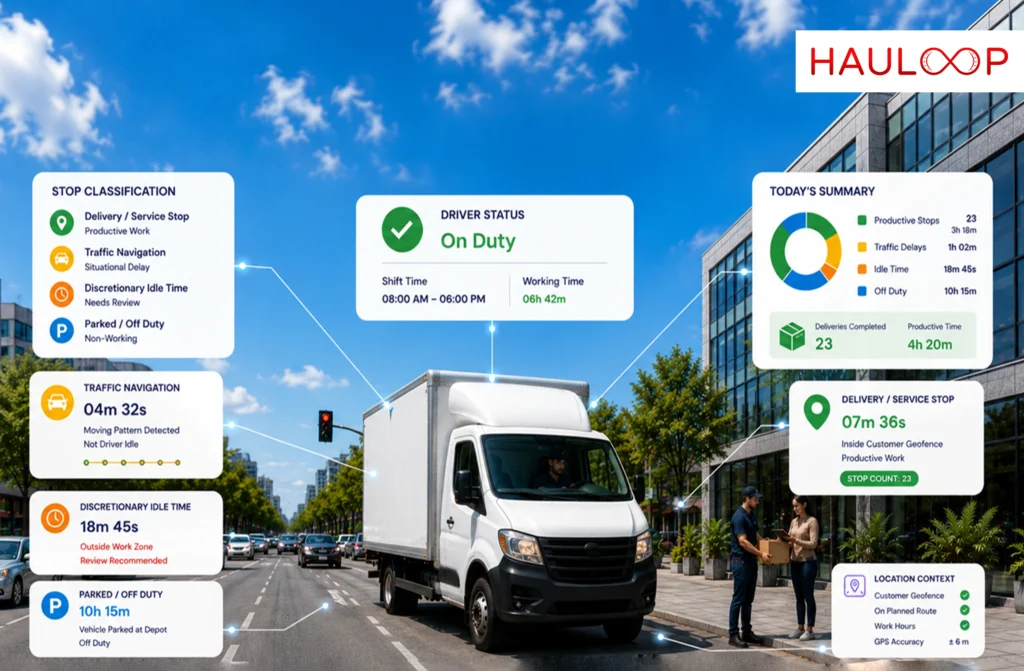
A driver completes 23 deliveries in a busy city, navigates traffic, waits at customer locations, handles handovers, and keeps the route moving throughout the day.
Yet the fleet management system reports two hours of “idle time.”
Another driver completes eight deliveries on a long-distance route and spends most of the day moving continuously. The system gives that driver a higher productivity score simply because the vehicle spent more time in motion.
The first driver loses a performance bonus, even though she completed nearly three times as many deliveries.
This is not a driver-performance problem. It is a measurement problem.
Many fleet management systems still calculate driver productivity using one basic assumption:
If the vehicle is moving, the driver is productive. If the vehicle is stationary, the driver is idle.
That logic may work for simple vehicle tracking, but it fails in real delivery and service operations. Drivers stop because they are completing jobs, waiting at traffic lights, loading freight, obtaining signatures, helping customers, or working inside geofenced service locations.
Intelligent stop recognition adds the missing context. It distinguishes productive stops, traffic delays, discretionary idle time, and off-duty parking so fleets can measure what drivers are actually doing, not just whether the wheels are turning.
Why Movement-Based Driver Productivity Metrics Fail?
A traditional GPS fleet tracking system often uses simple speed thresholds:
If vehicle speed is below 5 km/h for more than 60 seconds:
Mark the vehicle as idle
Otherwise:
Mark the vehicle as moving
The calculation is easy, but operationally, it is incomplete.
Under this logic, all of the following can be classified as idle:
- A driver completing a delivery inside a customer geofence
- A van is waiting at a traffic signal
- A service technician working at a customer site
- A truck waiting in a warehouse queue
- A driver taking an unnecessary 30-minute stop
- A vehicle was parked at the depot after the shift
The GPS sees zero speed in every example. However, the business meaning is completely different.
When a fleet management system treats every stop equally, it can penalize drivers operating high-stop urban routes while rewarding drivers whose routes involve long periods of uninterrupted movement.
That creates misleading driver performance metrics, unfair bonus decisions, and poor coaching conversations.
What Intelligent Stop Recognition Measures Instead?
Intelligent stop recognition classifies each stop according to its operational context.
Rather than looking only at speed, the system combines information such as:
- GPS location
- Stop duration
- Engine status
- Geofence status
- Route position
- Time of day
- Speed history
- Vehicle type
- Shift status
- GPS accuracy
This allows the platform to separate four important driver states.
| Stop Classification | Typical Conditions | Operational Meaning |
| Delivery or service stop | Vehicle is inside a work geofence for an expected duration | Productive work |
| Traffic navigation | Speed moves between 0 and 30 km/h while the vehicle remains on route | Situational delay outside the driver’s control |
| Discretionary idle time | Vehicle remains stationary outside work zones for an extended period | Potential inefficiency requiring review |
| Parked or off duty | The engine is off, and the vehicle remains at a depot or secure location | Normal non-working status |
This distinction changes the entire driver-performance picture.
A delivery stop is no longer treated as wasted time. Traffic is not automatically blamed on the driver. Parked time is excluded from active-shift productivity. Only genuine discretionary downtime is highlighted for coaching.
Productive Delivery Stops
A delivery driver may stop dozens of times during one shift. Those stops are the work.
A productive delivery stop may include:
- Engine running or recently switched off
- Vehicle inside a customer, warehouse, or service geofence
- Stop lasting between approximately 30 seconds and 15 minutes
- Activity taking place during scheduled work hours
- Vehicle remaining on the planned route
For a service vehicle, the expected stop may be longer. A technician could remain at a customer site for 20 or 30 minutes while completing a repair.
An AI fleet management system adjusts the expected duration according to the vehicle and operation type.
For example:
| Vehicle Type | Typical Productive Stop |
| Delivery van | Under 10–15 minutes |
| Service truck | Up to approximately 30 minutes |
| Bulk freight vehicle | Longer loading or unloading period |
| Urban courier vehicle | Multiple short, frequent stops |
The point is not to apply one universal stop threshold. It is to understand what normal productive work looks like for that operation.
Traffic is Not Driver Idle Time
Urban fleets regularly operate in stop-and-go conditions.
A vehicle may remain stationary at a traffic signal, move 50 metres, stop again, and continue this pattern for several minutes. A basic fleet tracking system may accumulate these moments as idle time.
Intelligent stop recognition looks at the pattern.
Traffic navigation may be identified when:
- Speed repeatedly changes between zero and low movement
- The vehicle remains on the planned route
- Stops are short and repetitive
- GPS data shows continued route progression
- The vehicle is located on a recognised road rather than at an unplanned stop
This prevents drivers from being penalized for congestion, traffic lights, toll queues, or road conditions outside their control.
It also improves route analysis because the fleet can separate traffic-related delay from driver-created downtime.
What Counts as Actual Idle Time?
Not every stop is productive.
Fleets still need to identify genuine discretionary idle time, such as a vehicle remaining stationary outside a work location for an extended period without an operational reason.
Possible indicators include:
- Engine running or recently running
- Vehicle outside a recognised delivery or service geofence
- Stop lasting more than 15 minutes
- Vehicle not progressing along the assigned route
- No scheduled customer or operational activity
- Repeated patterns associated with the same driver or location
This is the time fleet managers should review.
The difference is important.
“Reduce all stops” is poor coaching because many stops are required for the job.
“Reduce discretionary idle time outside scheduled work locations” is specific, fair, and actionable.
How Context-Aware Stop Classification Works?
A reliable driver performance system can be understood through four connected layers.
Layer 1: Data Fusion
The platform combines multiple data sources for every stop:
- Vehicle speed
- Engine status
- Current GPS position
- Geofence location
- Stop duration
- Time and day
- Route alignment
- Vehicle type
- GPS accuracy
One data point rarely tells the full story.
Speed alone says the vehicle stopped. Speed plus geofence, engine, route, and duration explain why it stopped.
Layer 2: State-Machine Logic
The system applies a sequence of contextual rules.
For example:
- If the engine is off for a long period, classify the vehicle as parked.
- If the vehicle is inside a work geofence for an expected duration, classify it as a delivery or service stop.
- If speed is oscillating while the vehicle remains on route, classify it as traffic navigation.
- If a short stop occurs on the planned route, classify it as a route or traffic stop.
- If the vehicle remains stationary outside operational zones for more than 15 minutes, classify it as idle time.
This state-based approach is more accurate than relying on a single speed threshold.
Layer 3: Vehicle and Operational Refinement
The base classification is adjusted according to the fleet’s operating model.
For a delivery van, a ten-minute geofenced stop may be completely normal.
For a service vehicle, a 30-minute customer stop may represent productive technical work.
A stop under two minutes on a tracked route may be classified as a traffic signal rather than driver idle time.
This refinement allows the same fleet management system to support different vehicle categories without measuring them all by the same standard.
Layer 4: Fair Driver Performance Metrics
Once stops are classified, the system can calculate performance using meaningful measures such as:
- Productive delivery or service time
- Number of completed productive stops
- Traffic-adjusted route efficiency
- Discretionary idle minutes
- On-time completion
- Route adherence
- Work completed during the shift
The result is a driver score based on actual operational contribution rather than raw movement.
Real-World Comparison: Two Drivers, One Fairer Measurement
Consider two drivers working nine-hour shifts.
| Metric | Driver A: Urban Delivery | Driver B: Long-Route Delivery |
| Deliveries completed | 23 | 8 |
| Time inside delivery geofences | 156 minutes | 120 minutes |
| Traffic navigation | 85 minutes | Limited |
| Discretionary stops | 45 minutes | 20 minutes |
| Driving pattern | Frequent stops and city traffic | Longer continuous movement |
Under a basic speed-based system, Driver A may appear less productive because the vehicle spends more time stationary.
The old system could show:
| Driver | Movement-Based Result |
| Driver A | 23% productive, with most stop time marked as idle |
| Driver B | 45% productive because of longer continuous movement |
This result rewards motion rather than work.
Under context-aware stop recognition, the picture changes.
| Driver | Context-Aware Result |
| Driver A | High efficiency because of 23 completed deliveries, productive stop time, traffic navigation, and limited discretionary idle time |
| Driver B | Strong but lower relative score based on fewer completed jobs and route context |
Driver A is finally recognised for the work actually completed.
This improves more than a dashboard score. It affects bonuses, coaching, recognition, and driver trust.
Why Fair Driver Metrics Matter for Fleet Operations?
Driver productivity measurement influences how people experience the business.
When the metrics are inaccurate, fleets may:
- Penalize drivers assigned to complex urban routes
- Reward movement instead of completed work
- Create bonus programs that feel arbitrary
- Coach drivers are based on misleading idle-time reports
- Lose strong drivers who feel undervalued
- Compare fundamentally different route types unfairly
When stop recognition is accurate, fleet managers can:
- Reward productive drivers fairly
- Separate operational delays from driver behaviour
- Coach’s actual discretionary idle time
- Design clearer incentive programs
- Improve workforce trust
- Compare performance within the correct operational context
A driver who believes the system measures fairly is more likely to trust coaching and performance feedback.
How Better Stop Recognition Improves Coaching?
Traditional reports might tell a driver:
“You had two hours of idle time.”
That statement is rarely useful if it combines delivery stops, traffic signals, customer waiting, and true downtime.
An intelligent report can say:
- 156 minutes were spent completing deliveries.
- 85 minutes were spent on navigation.
- 45 minutes were classified as discretionary idle.
- Most unnecessary idling occurred at two locations.
- The driver completed 23 stops within the planned shift.
This leads to a better coaching conversation.
The manager can focus on specific behaviour without questioning legitimate work.
How it Supports Better Driver Incentives?
Bonus programs work best when the driver understands how the score is calculated.
Context-aware metrics can support goals such as:
- Complete 20 or more scheduled deliveries
- Maintain on-time performance above target
- Keep discretionary idle below an agreed threshold
- Follow the planned route
- Avoid harsh driving events
- Complete productive stops within expected service windows
These goals are clearer and more achievable than simply rewarding the driver who records the most movement.
They also align the driver’s interests with the fleet’s operational goals.
What Fleet Operators should Look for?
When evaluating driver performance software, fleet operators should ask:
- Does the platform distinguish delivery stops from idle time?
- Does it use geofence context?
- Can it identify traffic patterns?
- Does it include engine state and stop duration?
- Can the rules adapt by vehicle type?
- Does it exclude parked and off-duty time?
- Can managers see productive and discretionary time separately?
- Are driver scores based on work completed, not only movement?
- Can the metrics support coaching and bonus programs?
- Can operators review unclear classifications?
These questions help distinguish a basic vehicle movement report from an intelligent driver performance system.
Conclusion: Measure Work, Not Just Movement
Driver performance cannot be measured fairly by asking whether the vehicle was moving.
Delivery fleets, service fleets, and urban transport operations depend on stops. Those stops may represent customer service, loading, unloading, traffic navigation, or job completion.
Intelligent stop recognition adds the context needed to separate productive work from genuine downtime.
By combining GPS data, geofences, engine status, route position, stop duration, vehicle type, and operational patterns, fleets can create driver metrics that are more accurate, fair, and useful.
The result is better coaching, clearer incentives, stronger driver trust, and performance reports that reflect what actually happened during the shift.
Your strongest driver should not lose recognition because the system mistakes deliveries for idle time.
Hauloop uses context-aware stop classification to help fleets measure productive work, identify true discretionary idle time, and build driver performance metrics that teams can trust.
Book a demo to see how Hauloop turns vehicle telemetry into fair, operationally meaningful driver performance insights.
Frequently Asked Questions
Why do fleet systems classify delivery stops as idle time?
Many systems use speed-based logic. When vehicle speed reaches zero, the platform marks the stop as idle without checking whether the vehicle is at a customer or work location.
What is intelligent stop recognition?
It classifies stops using speed, location, geofence status, engine state, route position, stop duration, vehicle type, and other operational context.
How does the system identify traffic stops?
It looks for repeated low-speed movement, short stop durations, route alignment, and patterns consistent with traffic signals or congestion.
What is discretionary idle time?
It is extended stationary time outside recognised work zones without a clear operational reason, making it more relevant for coaching than total stationary time.
Can stop recognition rules differ by vehicle type?
Yes. Delivery vans, service trucks, and long-haul vehicles have different normal stop patterns, so the classification should adapt accordingly.
How can fairer driver metrics improve retention?
Drivers are more likely to trust performance reviews, coaching, and incentive programs when the system recognises productive work and does not penalize them for required stops.