Most truck tyre failures don’t happen suddenly, they build silently over weeks of undetected under-inflation. A tyre losing pressure slowly looks completely normal to a driver, yet it burns extra fuel, wears out 30% faster, and eventually blows out on the highway. This guide breaks down what a tyre pressure monitoring system (TPMS) actually does for a commercial fleet, the real fuel, tyre-life and blowout costs of ignoring it, and how the numbers stack up for owners, fleet managers, and CFOs deciding whether to invest.
The ₹45,000 Morning that Started Normally
Harinder Singh’s driver left the yard at 5:30 AM. Eight trucks, loaded to 28 tonnes each, were heading out on the Delhi–Ludhiana corridor. Standard day. Pre-trip walkaround done. Tyres kicked. Nothing looked flat. Nothing felt wrong.
By the time the fourth truck called in, Harinder already knew what had happened. A rear-axle blowout. Tyre debris on the highway. Cargo delayed six hours. Recovery, replacement, lost trip, ₹45,000 gone before noon.
The tyre that blew had been running 6 PSI below recommended pressure for weeks. No one knew, because the pressure loss was silent. The tyre looked normal. The driver had no way to tell. The gauge was in the maintenance bay, not on the road.
This blog explains what TPMS actually does and does not do for a fleet, and the numbers behind the purchase decision.
What a Tyre Loses Without Anyone Noticing?
A properly inflated tyre naturally loses approximately 1 PSI per month through normal permeation, air passing through the rubber compound without any puncture. On a heavy commercial vehicle rated for 100–110 PSI, that means a tyre can be 6–8 PSI below target within two months of its last check, with no visible indication.
The Society of Automotive Engineers has documented the pressure-failure relationship in commercial tyres:
- Around 87% of all flat tyres had a history of under-inflation before the failure event
- Approximately 85% of pressure loss incidents are gradual, a nail or object in the tread, leaking slowly over days or weeks
- Only around 15% of incidents are sudden, a sharp object at highway speed causing immediate rupture
That 85% figure is the operational insight. Most tyre failures give you warning time measured in days, not seconds. TPMS exists to use that window.
The problem is not driver negligence. It is the physical limits of what the eye can see. A tyre requiring 32 PSI can look completely normal with only 16 PSI inside. For an HCV tyre at 100 PSI, the visible difference between correct pressure and 90 PSI is imperceptible without a gauge.
Fleet inspection reality (Fleet News UK industry poll):
• 29.4% of fleet managers did not know how often their drivers checked tyre pressure
• Only 8.8% believed drivers checked weekly
• Most HGV drivers assumed pressure had already been verified at depot clearance, an assumption, not a check
What Under-inflation does to Your Fleet Economics?
Under-inflation works on three separate cost lines simultaneously. Each is traceable. Together they change the purchase decision calculus.
1. Rolling Resistance and Fuel
An under-inflated tyre flexes more with each rotation. That flex converts engine energy into heat in the rubber rather than forward motion, increasing rolling resistance and fuel consumption.
NACFE (North American Council for Freight Efficiency) has established that tyres under-inflated by 10 PSI increase fuel consumption by 0.5–1.0%. At 70 PSI versus a 100 PSI baseline, Meritor’s controlled lab testing showed a 3.8% reduction in fuel efficiency.
Applied to a 28T HCV on Hauloop baseline constants:
| Item | Calculation | Result |
| Daily fuel consumption | 300 km ÷ 4 kmpl | 75 litres/day |
| Daily fuel cost | 75L × ₹99.66/L | ₹7,474.50/day |
| Fuel penalty at 1% (10 PSI low) | ₹7,474.50 × 1% | ₹74.75/day extra |
| Monthly excess (22 working days) | ₹74.75 × 22 | ₹1,644/month per vehicle |
| 10-vehicle fleet monthly impact | ₹1,644 × 10 | ₹16,440/month |
Conservative figures using the NACFE mid-point for 10 PSI under-inflation. Vehicles with multiple tyres under-inflated, which NACFE data shows affects approximately 1 in 5 trucks, will see compounding fuel penalties.
2. Tyre Life Reduction
Under-inflation causes uneven tread wear and accelerates sidewall fatigue. The TMC S.2 Tyre and Wheel Study, the primary commercial vehicle tyre research benchmark, has established that 20% under-inflation reduces tyre life by 30%. Michelin and Goodyear confirm this figure.
A tyre running 10% below recommended pressure operates approximately 11°C hotter. This causes irreversible internal casing degradation, damage that does not reverse even after pressure is corrected (Michelin fleet guidance).
Tyre life cost calculation, per vehicle, per year:
| Item | Basis | Value |
| HCV tyre cost (10.00R20, MRF/Apollo) | IndiaMART 2025–26 market data | ₹23,750–₹28,000 |
| Average tyre cost used in calculation | Mid-point | ₹25,000/tyre |
| Tyres per 28T HCV | Standard fitment | 10 tyres |
| Cost of one full replacement set | 10 × ₹25,000 | ₹2,50,000/set |
| Life reduction at 20% under-inflation | TMC S.2 Study | 30% shorter life |
| Equivalent extra replacement cost/year | 30% of ₹2,50,000 | ₹75,000/vehicle/year |
| 10-vehicle fleet annual tyre over-spend | 10 × ₹75,000 | ₹7,50,000/year |
Note: The ₹75,000/vehicle/year figure represents the cost of replacing tyres 30% earlier than necessary. It does not overlap with the fuel saving calculation above, these are two separate mechanisms.
3. Blowout and Incident Cost
The third cost line is non-linear. Harinder Singh’s documented cost: ₹45,000 per blowout, recovery, tyre replacement, lost trip revenue, cargo delay. Six incidents in six months: ₹2.7 lakh. This excludes cargo shortfall claims for FMCG or perishable loads and customer relationship cost.
Indian Summer vs. UAE Summer: Different Severity, Same Mechanism
For every 10°C rise in ambient temperature, tyre pressure increases approximately 1–2 PSI. A tyre inflated correctly at 6 AM in a covered depot carries a different pressure state by 2 PM on a highway, and an under-inflated tyre’s internal temperature builds faster as road surface heat compounds the flex-generated heat from within.
India — peak summer (May–June)
Ambient temperatures reach 40–45°C. Black asphalt road surfaces run 20–30°C hotter than ambient air due to solar radiation absorption, placing road surface temperatures at 60–70°C during peak hours. A tyre with a slow, undetected puncture accumulates heat damage faster in these conditions than in cooler months.
UAE — peak summer (June–August)
Ambient temperatures reach 45–50°C. Road surface temperatures in UAE summer have been documented at 70–80°C. Industry sources citing UAE Roads and Transport Authority data report that tyre-related maintenance issues contribute to approximately 15% of road accidents in the summer months. UAE authorities reported 20 fatalities attributed to tyre blowouts in 2024. UAE tyre specialists recommend replacement intervals of 40,000–50,000 km, against a global expectation of 75,000–80,000 km, reflecting heat acceleration in rubber service life.
For fleets operating across both India and UAE, TPMS alert thresholds calibrated for Indian conditions may need tightening for UAE summer operations.
India regulatory acknowledgement: AIS-154 (India’s TPMS standard, aligned with UN R141) tests at 0–50°C ambient, wider than the global 0–40°C range, recognising that Indian operating conditions demand broader thermal performance from tyre monitoring systems.
What TPMS does — and What it does not?
A tyre pressure monitoring system is a real-time sensing and alerting tool. Honest capability framing matters more than a broad safety claim.
| TPMS Detects | TPMS Does NOT Detect |
| Slow punctures (nail/object in tread — 85% of incidents) | Sudden blowout from road debris at speed (15% of incidents) |
| Dual-tyre pressure mismatch on tandem axles | Tread depth and sidewall condition |
| Temperature anomaly — early casing damage warning | Damage from a prior under-inflation event already done |
| Fleet-level pressure pattern analysis via platform | Wheel alignment and load distribution issues |
The left column, what TPMS detects, covers approximately 85% of tyre pressure loss scenarios. The right column reflects factors that only visual inspection or maintenance review can surface.
TPMS does not replace the driver walkaround. It closes the gap between walkarounds.
The Inspection Gap Manual Checks Cannot Close
For a fleet running 300 km/day, 22 days/month, each truck covers 6,600 km in a month. A slow puncture losing 2 PSI per week means the vehicle completes 3,000–6,000 km before the pressure drop reaches a dangerous threshold. Without TPMS, those kilometres pass with no alert.
A visual pre-trip walkaround identifies an obviously flat tyre, a 40–50% pressure loss before deflation becomes visually apparent. At 10% under-inflation (90 PSI instead of 100 PSI), the tyre looks indistinguishable from a correctly inflated one. By the time the driver notices changed handling, the casing has accumulated irreversible heat damage across hundreds of kilometres.
TPMS fills this visibility gap: per-tyre, real-time data, continuously monitored, surfaced to the driver and fleet manager without requiring a manual gauge or scheduled check.
Three Perspectives on the Same Decision
Before a fleet deploys TPMS, three people in every organisation ask three different questions. Here is what the data says to each of them.
MD / Owner — “What does ignoring this cost me per month?”
If one tyre per vehicle is running 10 PSI low, the condition NACFE documents for approximately 1 in 5 commercial vehicles, you are spending ₹1,644/month per vehicle in additional fuel alone. On a 10-vehicle fleet, that is ₹16,440/month, leaving the business silently every operating month, before a single blowout occurs. One blowout adds ₹45,000. Six blowouts in six months, as in Harinder Singh’s case, cost ₹2.7 lakh, more than the cost of TPMS across the entire fleet.
Fleet Manager — “Which vehicles, which routes, which pattern?”
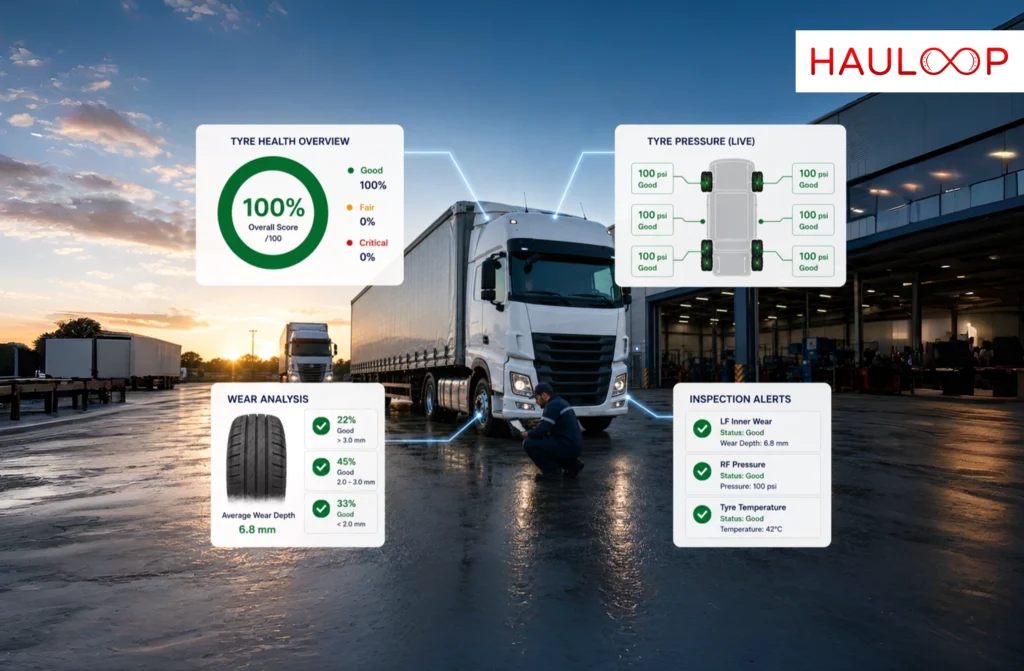
TPMS integrated with Hauloop’s platform shows every tyre’s pressure and temperature across all vehicles, updated in real time. You can see which vehicle is consistently running low on a specific axle position (possible alignment issue), which route correlates with pressure events (road surface quality), and whether pre-trip checks are happening at the right time. You move from reactive, responding to highway breakdowns, to proactive: directing the driver to a tyre shop at the next stop before the slow leak becomes a blowout.
CFO — “What is the payback period on the device investment?”
The recoverable value comes from three sources: fuel savings (₹1,644/month per vehicle at 10 PSI low), tyre life extension (30% life reduction prevented, worth ₹75,000/vehicle/year in avoided premature replacement), and incident avoidance (₹45,000 per blowout). TPMS installation cost varies by vendor, sensor specification, and fleet size. A fleet that prevents one blowout per vehicle per year recovers significant payback on incident savings alone, before fuel or tyre life are counted. Hauloop’s platform gives you the per-vehicle data to calculate exact payback against your own fleet costs.
What Changed for Harinder Singh’s Fleet?
After TPMS deployment across eight trucks, the operational change was not dramatic. What changed was the information.
Each tyre’s pressure was now visible across all eight vehicles throughout the operating day. Drivers received in-cab alerts when a tyre dropped below the configured threshold. The maintenance team could see which vehicle needed attention before it left the yard.
The 6 PSI deficit that had gone undetected for weeks was now a dashboard alert within 24 hours of the pressure dropping. Vehicles were directed to tyre checks. Pressures corrected. Operations continued without highway disruption.
Zero blowouts in the period since deployment. Six incidents avoided. ₹2.7 lakh that stayed in the business. The tyres were not different. The roads were not safer. The information gap closed.
Conclusion
TPMS is a monitoring and early-warning system for the 85% of tyre failures that give advance warning.
It does not eliminate tyre risk. A fleet deploying TPMS still needs visual tyre inspections, correct tyre specification, proper wheel alignment, and driver awareness training. It works best alongside broader OBD-based fault monitoring and tyre lifecycle management.
What it provides is the continuous pressure visibility that no manual process can match at fleet scale, so the majority of pressure loss events that give warning time can be intercepted before they escalate.
On India’s highways in May, or the UAE’s motorways in July, that early warning window is the difference between a scheduled tyre shop visit and a ₹45,000 recovery call on the side of the road.
Book a demo today to see how intelligent TPMS solutions help your fleet detect tyre risks early, improve safety, and reduce unexpected roadside costs.
Frequently Asked Questions
What does TPMS do for a commercial fleet?
A tyre pressure monitoring system provides real-time, per-tyre pressure and temperature data, alerting drivers and fleet managers to slow punctures and under-inflation, the roughly 85% of tyre failures that give advance warning before a blowout.
Does TPMS prevent all tyre blowouts?
No. TPMS detects the ~85% of pressure loss incidents that develop gradually. It does not detect sudden blowouts from road debris at speed (~15% of incidents), tread depth, sidewall condition, or alignment issues, those still require visual inspection. TPMS closes the gap between walkarounds; it does not replace them.
How much does under-inflation actually cost a fleet?
At 10 PSI low, a 28T HCV loses about ₹1,644/month per vehicle in fuel alone. Under-inflation of 20% also cuts tyre life by 30% (~₹75,000/vehicle/year in premature replacement), and a single blowout costs around ₹45,000 in recovery, tyre replacement and lost trip revenue.
Why can't a driver just spot an under-inflated tyre during the pre-trip check?
Because the eye cannot see it. A tyre needing 32 PSI can look normal at 16 PSI, and an HCV tyre at 90 PSI is visually indistinguishable from one at 100 PSI. A visual walkaround only catches a 40–50% pressure loss, by which point the casing has already taken irreversible heat damage.
Is TPMS more important in Indian or UAE summer conditions?
Both, but severity differs. UAE road surfaces reach 70–80°C in summer versus 60–70°C in India, accelerating heat damage. Fleets operating across both regions may need to tighten TPMS alert thresholds for UAE operations. India's AIS-154 standard already tests to a wider 0–50°C range, reflecting these harsher conditions.
What is the payback period on a TPMS investment?
Recoverable value comes from three sources: fuel savings (₹1,644/month per vehicle at 10 PSI low), tyre life extension (worth ₹75,000/vehicle/year), and incident avoidance (₹45,000 per blowout). A fleet that prevents just one blowout per vehicle per year typically recovers significant payback on incident savings alone, before fuel or tyre life are counted.