
A customer contacts the transport company on Monday morning with a complaint.
The delivery scheduled for Friday was allegedly never attempted.
The driver disagrees. According to him, the truck reached the customer’s location, waited for access, and eventually continued to the next stop.
The customer says nobody saw the vehicle.
Now the operations manager has two conflicting accounts of the same delivery.
Calling the driver again may not resolve the disagreement. The customer may also have incomplete information about what happened.
This is where GPS trip history becomes useful.
A recorded journey can help fleet operators check whether the vehicle travelled to the relevant area, when it arrived, how long it remained there, and what happened next.
It does not automatically prove that goods were delivered. But it provides objective movement information that can help separate a vehicle visit dispute from a delivery completion dispute.
Why are Delivery Disputes Difficult to Investigate?
Delivery disputes often involve events that happened several hours or days earlier.
A customer may question the arrival time, claim that the vehicle never visited the premises, or challenge how long the driver waited.
The transport operator may have a trip sheet, delivery schedule, and driver account.
However, those records may not fully establish the vehicle’s actual movement.
For example, a scheduled arrival time does not prove that the vehicle reached the destination.
Similarly, a driver’s statement that the truck was waiting outside a warehouse may be difficult to verify without supporting information.
GPS trip history adds a recorded account of vehicle movement to the investigation.
That helps the fleet manager begin with what the tracking data shows rather than deciding which account sounds more convincing.
Can GPS Trip History Show Whether a Truck Visited a Customer Location?
One of the first questions in a delivery dispute is whether the vehicle reached the relevant destination.
A recorded trip can help answer that question.
For example, suppose a customer claims that a truck never arrived at its warehouse.
The fleet manager retrieves the completed journey and examines the recorded route.
The trip history may show that the vehicle travelled to the warehouse area at 11:20 AM and remained nearby until 11:55 AM.
This information supports the claim that the vehicle was present in the area.
However, GPS location alone does not prove that the driver entered the premises, contacted the receiving team, or completed the delivery.
Those details may require gate records, driver communication, or proof of delivery.
The distinction matters because vehicle presence and successful delivery are not the same thing.
How can Recorded Arrival and Departure Times Help Resolve Disagreements?
Delivery disputes frequently involve disagreements about timing.
A customer may say the vehicle arrived late. The driver may say the truck was waiting before the scheduled appointment.
GPS trip history can provide recorded movement and stop information around the relevant location.
Consider an illustrative delivery:
| Event | Recorded time |
| Vehicle reaches the warehouse area | 10:42 AM |
| Vehicle becomes stationary | 10:46 AM |
| Vehicle resumes movement | 11:31 AM |
| Scheduled delivery appointment | 11:00 AM |
The recorded movement suggests that the vehicle was in the area before the appointment and remained stationary for approximately 45 minutes.
That information can help the operations manager investigate the disagreement.
However, the records do not independently establish whether the warehouse gate was open, whether unloading was permitted, or why the vehicle remained stationary.
The manager can use the timing information alongside other records to establish a more complete account.
What can Stop Duration Reveal About a Delivery Complaint?
A customer may claim that the driver did not wait long enough for unloading.
The driver may report that the receiving location caused a substantial delay.
Recorded stop duration can help examine these claims.
For example, if the trip history shows that the vehicle remained stationary near the delivery point for an extended period, the operator has a documented time window to investigate.
The fleet manager can compare that information with the appointment schedule, driver communications, and any available gate-entry records.
This may help determine whether the complaint relates to waiting time, access restrictions, or another operational issue.
But stop duration must be interpreted carefully.
A stationary vehicle near a warehouse does not necessarily mean it was waiting for that warehouse.
The location and trip context need to be reviewed before drawing conclusions.
How does Trip Replay Reconstruct a Disputed Delivery?
A dispute is easier to investigate when the relevant journey can be reviewed in chronological order.
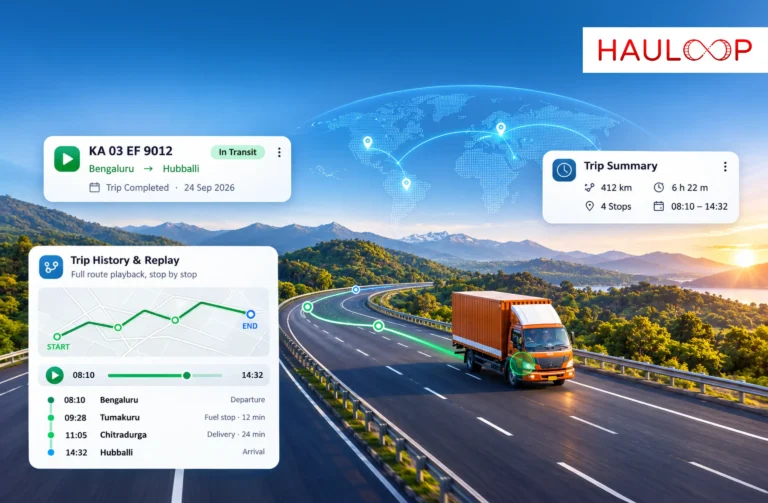
Hauloop’s Trip History & Replay allows operators to retrieve a completed journey and examine its recorded movement, stops, speed, and timing.
A fleet manager can use a structured investigation process.
Retrieve the journey. Select the vehicle and completed trip associated with the disputed delivery.
Review the route. Examine whether the recorded movement reached the relevant destination area.
Inspect the timing. Check the recorded arrival, stationary periods, and departure.
Review the sequence. Understand what happened before and after the disputed stop.
Compare supporting records. Review the GPS information alongside delivery documents, communications, and other available evidence.
This approach helps establish a documented sequence rather than relying entirely on statements collected after the event.
Can GPS Trip History Prove that Goods Were Delivered?
Not by itself.
GPS trip history primarily records vehicle movement and associated journey details.
It may show that a truck reached a delivery location and remained there for a particular period.
However, that does not establish that the correct goods were unloaded, accepted, or signed for.
For example, a vehicle could reach the customer premises but leave without completing the delivery.
Alternatively, the driver may complete the delivery while the receiving documentation contains an error.
To verify delivery completion, operators generally need supporting records such as digital proof of delivery, signed delivery documents, or relevant receiving information.
GPS trip history provides movement evidence.
Proof of delivery provides information about the handover.
Using both gives the operations team a more complete basis for investigating the complaint.
What Happens When a Customer Raises a Dispute Weeks Later?
Some delivery complaints appear long after the trip has been completed.
By that time, the driver may have completed many other journeys.
The dispatcher may not remember the exact route, and the original messages may be difficult to locate.
Historical trip search helps address this challenge.
Instead of reconstructing the journey entirely from recollection, the fleet manager can locate the relevant vehicle and completed trip within the available records.
The manager can then review the recorded route, stops, and timing.
This provides a starting point for investigating older complaints.
The ability to retrieve a specific journey depends on the platform’s historical data availability and retention settings.
How can Trip History Support Insurance and Internal Investigations?
Delivery disputes are not the only situations where historical vehicle movement matters.
An insurer may request information about a journey associated with a reported incident.
An internal investigation may require the team to establish where a vehicle travelled or when it stopped.
GPS trip history can provide supporting operational records for these enquiries.
For example, the recorded journey may help establish the vehicle’s route and movement around the time of an incident.
Speed and stop information may provide additional context.
However, GPS records do not automatically establish liability, prove cargo condition, or determine the outcome of an insurance claim.
Their evidentiary value depends on data quality, completeness, and the requirements of the investigation.
Fleet operators should preserve relevant records and compare them with other available evidence.
What are the Limitations of GPS Trip History in Delivery Disputes?
Historical tracking records are useful, but they need to be interpreted correctly.
| What GPS trip history can help establish | What it cannot prove on its own |
| The recorded route travelled | That the correct goods were loaded |
| Vehicle presence near a delivery location | That the customer accepted the delivery |
| Recorded stop times and durations | Why the vehicle stopped |
| Movement before and after a disputed visit | Whether unloading was completed |
| Available speed and journey timing | Responsibility for every delay |
GPS accuracy, connectivity interruptions, and recording intervals may also affect the completeness of the journey record.
For this reason, fleet managers should avoid treating every GPS point as conclusive proof.
The strongest investigations combine recorded vehicle movement with shipment documents and operational context.
How can Fleet Managers Use Dispute Records to Improve Delivery Operations?
A completed investigation can provide more than an answer to one customer complaint.
It may reveal an operational issue that deserves attention.
For example, repeated disputes at the same delivery location could indicate unclear appointment procedures.
Frequent disagreements about waiting time may suggest that arrival and departure records need to be reviewed more consistently.
Repeated route-related complaints may prompt a closer examination of delivery planning.
By reviewing historical journeys alongside complaint records, fleet managers can identify questions that deserve further investigation.
The purpose is not simply to defend the transport company.
It is to establish a more reliable account of delivery activity and identify where operational processes may need improvement.
Conclusion
Delivery disputes become difficult when the transport operator and customer have different accounts of the same journey.
GPS trip history provides a recorded view of vehicle movement, including where the truck travelled, when it reached relevant locations, and how long it remained stationary.
That information helps fleet managers investigate vehicle visit claims, arrival-time disagreements, and questions about completed journeys.
However, vehicle tracking does not replace proof of delivery or establish every detail of the cargo handover.
Its value comes from providing reliable movement context that can be examined alongside other operational records.
With AI Fleet Management Software, transport operators can bring historical journey information into their fleet investigation process. Book a demo with Hauloop to explore how Trip History & Replay can help your team investigate delivery disputes using recorded trip data.
Frequently Asked Questions
Can GPS trip history prove that a truck visited a delivery location?
GPS trip history can show recorded vehicle movement and presence near a location. However, it may not independently prove that the vehicle entered the premises or completed the delivery.
How does GPS trip history help resolve delivery disputes?
It allows fleet managers to review recorded routes, stop locations, journey timing, and vehicle movement associated with a disputed delivery. These details can be compared with delivery documents and other evidence.
Can GPS trip history show how long a driver waited at a warehouse?
It can show recorded stationary periods and stop durations near the relevant location. Additional information may be needed to confirm that the vehicle was waiting for that warehouse.
Is GPS trip history the same as proof of delivery?
No. GPS trip history records vehicle movement. Proof of delivery documents the shipment handover or receipt. Both can support an investigation, but they provide different types of evidence.
Can old GPS trip records be used for insurance claims?
Historical trip information may support insurance investigations by documenting available vehicle movement and timing. Whether it is accepted or sufficient depends on the insurer's requirements and the other evidence available.
What if GPS tracking data is missing during part of the journey?
Connectivity issues, device problems, or positioning limitations can create gaps in recorded information. Fleet managers should identify those gaps and avoid drawing conclusions that the available records cannot support.