A dispatcher has 26 deliveries, four available vehicles and one morning to complete the plan.
The system arranges the addresses into the shortest possible sequence. On the map, the route looks efficient.
But one vehicle cannot enter a restricted city road. Another does not have enough capacity for its assigned orders. Two customers accept deliveries only during fixed time windows, and one driver does not have enough available working time to complete the proposed route.
The shortest route has reduced kilometres without creating a journey the fleet can actually complete.
This is the difference between drawing a route and planning an operation. The best route optimisation software in India should consider orders, customers, vehicles, drivers and complete movement cost before dispatch.
Let’s examine why distance alone cannot create a practical route.
Route Optimisation Must Solve the Work, Not Just the Distance
Basic navigation finds a path between locations. Route optimisation has a broader job: it decides how multiple orders should be distributed and sequenced across the available fleet.
A practical plan should identify:
- Which vehicle will complete each order
- The order in which stops should be served
- The expected travel and service time
- Whether customer commitments can be met
- Whether the assigned driver can complete the work
- What the complete route is likely to cost
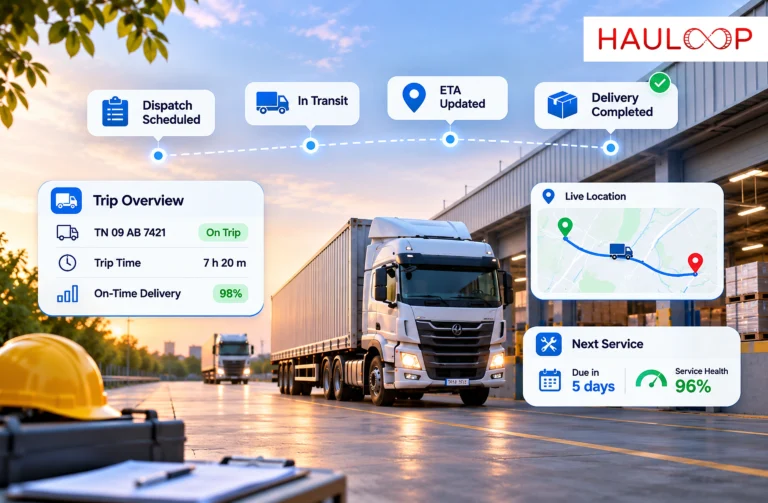
Hauloop’s route planning helps dispatch organise multiple stops, review distance and duration, preview the journey and connect the approved route with a vehicle.
The output should not simply be an attractive line on a map. It should be a dispatch-ready plan that the operations team can explain and the driver can execute.
Customer Commitments Should Decide the Stop Sequence
The closest customer is not always the customer who should be served first.
Consider six deliveries within the same operating area. The nearest customer opens receiving at 11:00, while another customer 18 kilometres farther away stops accepting goods at 10:30. Routing by proximity alone sends the vehicle to the wrong stop first.
The order data should therefore include more than an address. Dispatch may need:
- Order priority
- Cargo quantity, weight or volume
- Promised delivery window
- Loading or unloading requirement
- Expected service time
- Site-access instructions
- Collection-before-delivery dependencies
Service time matters as much as driving time. A vehicle may reach a warehouse in 25 minutes and spend another 55 minutes waiting, checking documents and unloading. If the plan allows only 15 minutes at that stop, every later arrival estimate becomes unreliable.
Historical trip records can help establish a more realistic allowance. When a customer regularly takes 40–50 minutes, that pattern should influence the next plan instead of being treated as a new delay every day.
The Closest Vehicle May Be the Wrong Vehicle
A vehicle appearing close to the collection point does not mean it is suitable for the assignment.
Vehicle route assignment should consider payload, available capacity, body type, cargo compatibility, road-access limits, specialist equipment and current operating status.
For example, a larger truck may carry all eight orders in one movement, while two smaller vehicles would need separate trips. However, if the delivery area restricts the larger vehicle, assigning it would create a route that cannot reach the customer.
The driver must also fit the plan. Dispatch should consider travel, loading, waiting, unloading, required breaks and access to a suitable stopping point—not only the estimated driving time.
HOS tracking explains why a nearby vehicle can still be unavailable when its driver lacks sufficient legal time for the complete assignment. Applicable limits differ by jurisdiction and operation, so software can support the decision without guaranteeing compliance.
If the work does not fit, dispatch may need another vehicle, a different driver, fewer stops, a relay or a revised customer commitment before departure.
Route Cost Continues After the Final Delivery
The route with the fewest kilometres is not automatically the least expensive.
Fuel, tolls, congestion, vehicle efficiency, driver time, waiting and empty running can change the commercial result. A congested 210-kilometre route may cost more than a 225-kilometre alternative with steadier travel and lower waiting time.
The return journey also matters. A route may appear economical while the vehicle is carrying cargo, then lose part of its margin by returning to the depot empty.
Dispatch should compare:
- Loaded and empty distance
- Expected fuel and toll costs
- Driver and vehicle time
- Customer waiting and service time
- Available collections or return work
Route fuel cost shows why loaded and empty kilometres must be measured across the same route boundary.
This does not mean cost should override safety or customer commitments. It means dispatch should understand the full movement before assuming that a shorter route creates a better commercial result.
The Approved Route Must Still Work After Departure
Once dispatch approves the plan, the driver should receive the same stop sequence, order details and instructions used to create it. Hauloop’s driver app can place route guidance, trip tasks and status updates in one workflow instead of leaving the driver to interpret separate calls and messages.
Even a well-planned route can change. Traffic, cancellations, breakdowns, urgent collections and customer delays may affect the remaining stops.
Not every disruption requires re-optimisation. Changing the route too often can confuse the driver, interfere with the loading sequence and create inconsistent customer updates. Dispatch should change the plan only when the expected benefit is greater than the disruption.
Predictive location can provide earlier visibility into route progress and possible arrival delays. The dispatcher can then decide whether to change the sequence, move work to another suitable vehicle or update the customer.
Current data is essential. If the tracker stops reporting, GPS connectivity should be checked before a revised plan relies on an outdated vehicle position.
Completed Routes Should Improve the Next Dispatch Plan
Route optimization should not end when the final stop is completed.
Dispatch should compare the planned and actual distance, travel time, service duration, delivery windows, failed stops, empty running and manual route changes.
The purpose is not to treat every difference as driver failure. A road closure, approved collection or customer delay may explain the result. Repeated differences reveal where the planning assumptions need correction.
If a warehouse consistently requires 50 minutes instead of the planned 25, its service-time rule should change. If the same road is repeatedly unsuitable for heavy vehicles, the restriction should be added to future plans. If one delivery area regularly creates an empty return, dispatch can look for suitable collection work or review how the route is priced.
Before choosing software, test it with a difficult day your team already understands. Include fixed delivery windows, mixed vehicle capacities, restricted access, a driver-time constraint and a return collection. Ask the provider to explain why each vehicle and stop sequence was selected and how the plan changes when one order is delayed.
The software should produce a route your dispatch team can understand, adjust and improve not a result that works only with clean demonstration data.
Conclusion: The Best Route is the One Your Fleet Can Complete
Return to the dispatcher with 26 deliveries and four vehicles. The shortest sequence failed because it ignored vehicle access, capacity, delivery windows and driver availability.
Practical route optimisation brings those conditions into the plan before departure. It connects each order with a suitable vehicle, gives every stop realistic time, checks whether the driver can complete the assignment and considers the cost of loaded and empty movement.
The answer is not simply to reduce kilometres. It is to create a route that protects customer commitments, uses the available fleet sensibly and remains achievable when the vehicle reaches the road.
An AI-powered fleet Management Software can connect route planning with vehicle assignments, driver tasks and live trip progress. Book a Demo to see how Hauloop can turn daily orders into more practical dispatch plans.
Frequently Asked Questions
How should route optimization handle a multi-stop delivery run?
Suppose a vehicle has ten stops, but two customers stop receiving before noon and another accepts goods only after 14:00. The software should sequence the route around those windows, realistic service time, vehicle capacity and driver availability rather than arranging the stops only by proximity.
Can route optimization prevent a vehicle from being overloaded?
It can support the decision when accurate order weights, volumes and vehicle capacities are available. If eight orders exceed one truck’s payload, the software should split or reassign the work. Physical loading checks and legal responsibility remain with the fleet.
Is the shortest route always the most cost-effective?
No. A shorter route with high tolls, congestion, waiting and an empty return may cost more than a slightly longer route with steadier travel and a return collection. The complete movement should be compared before dispatch.
How do driver hours affect vehicle assignment?
A nearby vehicle may have a driver with insufficient available time for collection, travel, unloading and required rest. Dispatch may need another driver, fewer stops, a relay or a revised customer commitment even though the vehicle itself is available.
Should every traffic delay cause the route to be changed?
No. If congestion is temporary, changing several stops may create more disruption than benefit. Dispatch should consider the expected delay, remaining commitments, loading sequence, road suitability and the effect of sending new instructions.
How can a fleet test route optimization software before choosing it?
Use a completed dispatch day containing fixed delivery windows, mixed vehicle capacities, restricted access and a return collection. Compare the software’s plan with the route your team actually used and ask why its vehicle assignments and stop seeing.