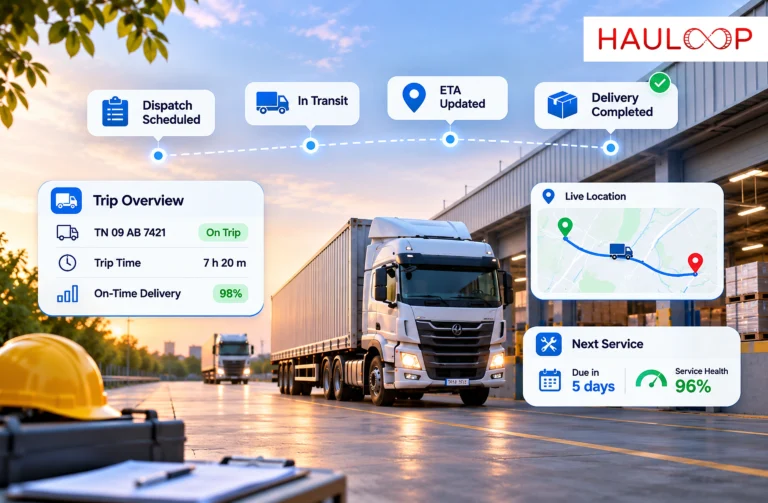
A fleet manager begins the day with three issues. One truck is likely to miss a delivery window. Another has used more fuel than expected on a familiar route. A third has produced an engine warning before its next long-distance assignment.
The information sits across separate tracking, fuel and maintenance screens. Before responding, the manager must confirm which signal is reliable and who should act.
Adding an AI label to those screens does not solve the problem.
AI adoption is growing rapidly. Stanford’s 2025 AI Index reported that 78% of surveyed organisations used AI in 2024, compared with 55% in 2023. However, adoption does not prove that a platform can improve a fleet decision.
The best AI powered fleet management software in India should connect operational data, explain which issue matters and help the right person act earlier. It must also suit mixed vehicles, existing devices and changing network conditions.
Let’s examine what an Indian fleet should verify before accepting that any platform is the best fit for its operation.
Start with the Fleet Problem, Not the AI Feature List
The word “best” has no meaning without an operating requirement.
A transporter may prioritise fuel and trip costs, while a cold-chain operator needs temperature evidence and delivery exceptions.
Before comparing software, identify the three problems creating the most cost, delay or uncertainty. Use recent examples rather than broad goals such as “improve efficiency”.
The evaluation can then ask whether the software helps the fleet:
- Detect the event reliably
- Explain its operational consequence
- Assign an appropriate response
- Record what happened afterwards
- Compare the outcome with the previous process
This prevents a long feature list from hiding a weak operational fit.
Connected Data Must Come Before an Intelligent Recommendation
AI cannot understand an operation it can see only partially.
A late arrival may involve a deviation, loading delay, vehicle fault or unrealistic schedule. A rising trip cost may involve fuel, tolls, waiting or empty running. Separate systems reveal only fragments of the event.
The platform should connect supported trackers, fuel sensors, OBD-II devices, dashcams and business systems. Consistent vehicle, driver, trip and order identifiers prevent incorrect comparisons.
Supported system integrations matter when a fleet already owns working hardware. Compatibility should be verified by device model, protocol, available fields, provider permission and update frequency. “Works with GPS” is too broad to confirm an integration.
The Software Should Explain Why an Alert Matters
More notifications do not create better fleet control.
Suppose a vehicle stops outside its planned route for 35 minutes. A live map can show its reported location and stop duration. Useful intelligence should help answer further questions:
- Is the location current or a delayed upload?
- Was the stop authorised?
- Is the vehicle carrying a time-sensitive order?
- Did the driver or vehicle report a problem?
- Will the stop affect the next delivery?
The event could be an approved break, customer instruction, network gap or genuine exception. AI should validate the evidence rather than present every unusual event as a confirmed problem.
This is the difference between displaying fleet data and creating fleet intelligence.
One Platform Should Connect the Decisions Made Across a Trip
The best system should connect the areas affecting the same operating result.
| Operational area | What the platform should help the team decide |
| Tracking | Is the vehicle progressing normally, and does dispatch need to intervene? |
| Fuel | Is a variance explained by work, price, behaviour, vehicle condition or a possible loss? |
| Maintenance | Should the vehicle be inspected, serviced or restricted before another assignment? |
| Driver safety | Does the event show a recurring pattern that needs evidence-led coaching? |
| Delivery | What was delivered, who accepted it and was an exception recorded? |
| Compliance | Are the required records complete, current and retrievable for the applicable operation? |
| Cost | Did the vehicle, route, trip or order produce the expected commercial result? |
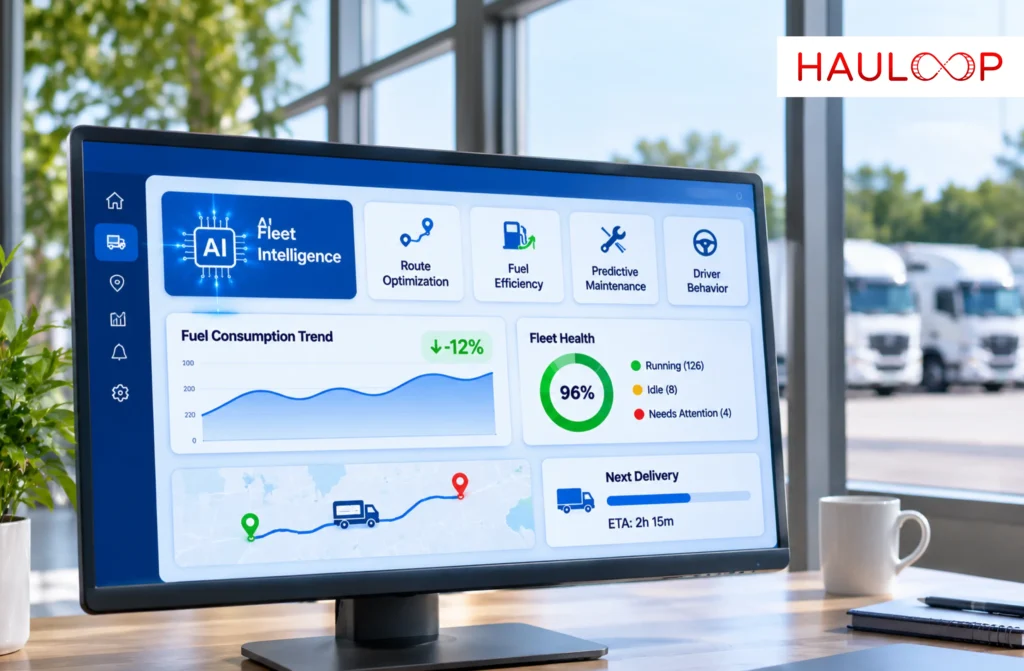
Hauloop’s fleet intelligence brings these operational signals into a connected view. The value comes from the relationships between them, not from placing several unrelated dashboards under one login.
Prediction Must Create Time to Act, Not False Certainty
Prediction is useful when it creates an earlier inspection or operating decision.
A diagnostic pattern may justify an inspection. Changes in route progress may indicate a delay, while declining fuel performance may identify a vehicle or route needing investigation.
These are risk signals, not guaranteed outcomes. A diagnostic code does not prove an exact component-failure date, and an ETA cannot promise an arrival time.
The software should show supporting evidence, confidence and a useful response window. The process behind a clear next action matters more than the number of predictions.
Indian Fleet Conditions Must Be Part of the Test
Indian operations may combine owned trucks, attached vehicles and subcontracted capacity under one customer contract. Older vehicles may provide only GPS data, while newer assets provide diagnostics and several sensor feeds.
Routes can pass through cities, highways, industrial sites, rural stretches and areas with inconsistent network coverage. A missing update may indicate lost connectivity rather than a stopped vehicle. Buffered events received later must not be presented as live activity.
The fleet should verify:
- Device and vehicle compatibility
- Data behaviour during network gaps
- Installation and calibration support
- Mobile access for field teams
- Language and training requirements
- Renewal, support and data-ownership terms
- The process for adding hired vehicles
The intelligence curve helps separate basic device installation from connected decision-making. A fleet should improve from its current stage rather than purchase capabilities it cannot yet support with reliable data or workflows.
Implementation Quality Matters as Much as the Software
A capable platform can fail when vehicle mapping is incorrect, sensors are not calibrated, alert owners are undefined or users are not trained.
Implementation should begin with representative vehicles and one measurable problem. The team should confirm data accuracy, responsibilities and exception closure.
The provider should explain who handles hardware faults, SIM issues, integration access and data mismatches. The fleet should understand setup, subscription, renewal and expansion costs.
A wider platform selection should consider usability, implementation, security, contract terms and support not only the number of advertised features.
Test the “Best” Claim with One Controlled Fleet Scenario
Choose a problem the fleet already understands, such as recurring fuel variance, missed service windows or delayed deliveries. Select representative vehicles and establish a reliable baseline.
During the pilot, measure:
- Whether the required data reached the platform correctly
- How many alerts were useful, misleading or missed
- Whether recommendations were understandable
- Whether the correct person received the action
- How quickly the team responded
- Whether the outcome improved cost, uptime, safety or service
The result should demonstrate a better operating process, not merely a more attractive dashboard.
Conclusion: The Best Software Makes the Next Decision Clearer
Return to the manager facing a possible delay, fuel variance and engine warning.
A basic system displays three separate events. A suitable AI-powered platform validates the signals, connects them with the relevant vehicles and trips, identifies which issue carries the greatest consequence and sends a practical recommendation to the person responsible.
That is what the best AI powered fleet management software in India should do. It should work with the fleet’s actual vehicles and data, explain why an event matters and support a measurable response without replacing human responsibility.
AI-powered fleet management software can connect tracking, fuel, maintenance, drivers, deliveries and cost within one operational environment. Book a Demo to evaluate the platform using your fleet’s vehicles, routes and operating priorities.
Frequently Asked Questions
Which AI powered fleet management software is best for an Indian transport fleet?
The best fit depends on the fleet’s main operating problem, existing devices and internal workflow. A 60-truck transporter struggling with fuel variance should test fuel, trip and cost analysis, while a delivery fleet should prioritise routing, ETA and proof-of-delivery workflows.
Can AI fleet software work with GPS devices that are already installed?
It may work when the model, protocol, provider permission and available data are compatible. A fleet using three tracker brands should test at least one vehicle from each source before assuming that every device can provide the same information.
Can AI fleet management software predict a vehicle breakdown?
It can identify patterns that suggest developing risk, but it cannot guarantee an exact failure date. If a fault repeatedly appears before long trips, the appropriate outcome is an earlier inspection—not an automatic claim that the component will fail.
Is AI fleet management software useful for a small fleet?
Yes, when it addresses a specific recurring problem. A 12-vehicle fleet losing margin through waiting and idling may gain value from trip-level analysis, even if it does not require every module available to a larger operator.
What should be included in a fleet software pilot?
Use representative vehicles, routes and users. Define a baseline, test device connectivity, review useful and false alerts, assign actions and compare response time and outcomes with the existing process before expanding the rollout.
How should a fleet compare software pricing in India?
Compare the complete cost: hardware, installation, SIM or connectivity, platform subscription, integrations, onboarding, support, renewals and device replacement. A lower monthly price may not be cheaper if essential capabilities require separate systems or repeated manual work.