At 9:00 AM, a fleet manager receives the previous day’s operations report. It shows 96% on-time deliveries, total vehicle utilization, fuel consumption, and the number of trips completed.
The numbers look good.
But at 9:15 AM, three vehicles are running behind schedule. One truck has been stationary for an unusually long period, another is approaching its delivery deadline, and a third has developed a problem that could affect its next assigned trip.
None of these situations appears in yesterday’s report.
The report is accurate. It simply answers a different question.
A scheduled report tells fleet managers how operations performed during a defined period. A live fleet control tower provides a continuously updated operational view that helps teams understand what is happening now, which activities are moving away from plan, and where intervention may still make a difference.
The distinction matters because fleet performance is not determined only by what happened yesterday. It also depends on how quickly teams recognise and respond to problems developing today.
What is a Fleet Control Tower?
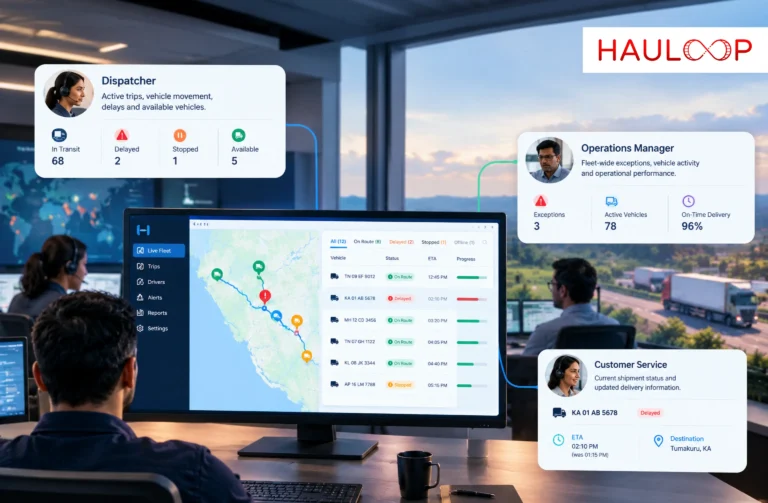
A fleet control tower is a centralized operational view that brings together information about active vehicles, drivers, trips, routes, and relevant fleet events.
Rather than reviewing individual reports or checking separate tracking systems, fleet managers can monitor connected operations from one environment.
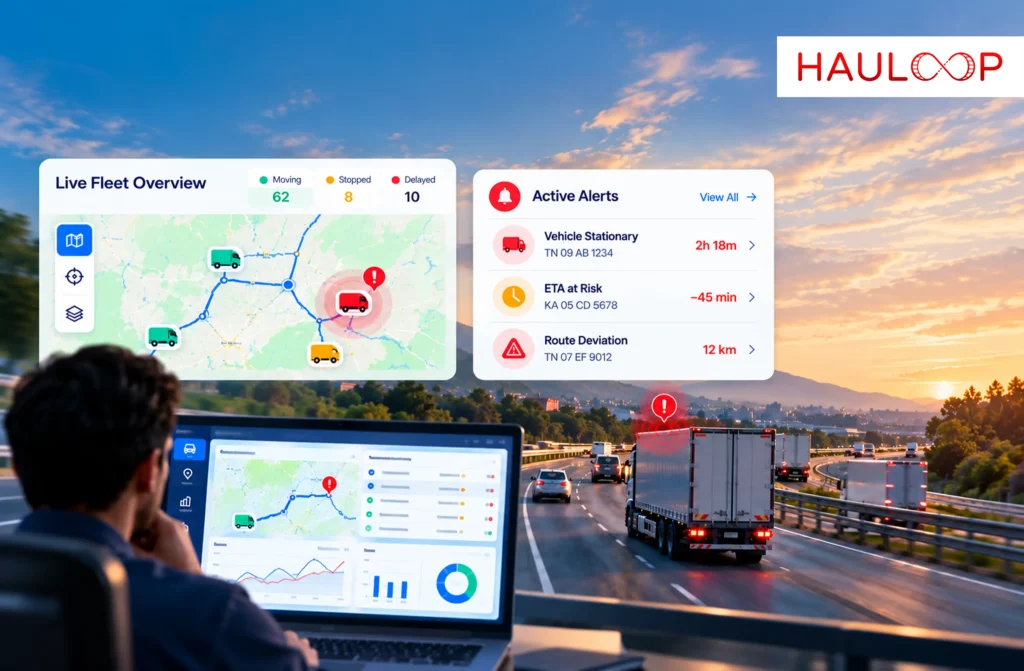
A control tower may combine live vehicle locations, trip progress, movement status, delays, operational alerts, and other available fleet information.
Its purpose is not simply to display more data.
It is to make the current operational situation easier to understand and help managers identify where attention is required.
Within Fleet Intelligence, this approach connects operational visibility with the decisions fleet managers make throughout the working day.
How is a Control Tower Different from a Scheduled Fleet Report?
Scheduled reports and control tower views both use fleet data, but they serve different operational purposes.
| Scheduled fleet report | Fleet control tower view |
| Shows performance for a completed reporting period | Shows the latest available operational conditions |
| Summarizes completed trips and historical KPIs | Monitors active trips and developing exceptions |
| Identifies past delays and performance trends | Helps identify delays while action may still be possible |
| Supports periodic management reviews | Supports decisions during daily operations |
| Provides consolidated results | Connects current status with available operational context |
| Helps explain what happened | Helps determine what needs attention now |
For example, a daily report may show that five deliveries were late yesterday.
A control tower can help identify vehicles at risk of missing their delivery windows today.
The first supports performance analysis. The second supports operational monitoring and timely intervention.
Both remain important.
What does a Live Control Tower Show About Active Vehicles?
A scheduled report can summarize vehicle activity over a day, week, or month.
A live control tower focuses on the current condition of vehicles and trips.
Depending on the connected data, fleet managers may be able to distinguish between vehicles that are moving, stopped, idling, or no longer reporting recent location information.
This makes it easier to identify vehicles requiring attention without contacting every driver individually.
Consider a fleet operating 80 trucks across multiple routes.
A traditional report might show total kilometers travelled and average vehicle utilization.
A live view can help the operations team identify which vehicles are currently active, which have stopped unexpectedly, and which may need further investigation.
That distinction becomes particularly valuable when dispatchers are coordinating multiple trips simultaneously.
Can a Control Tower Identify Delivery Delays Before They Happen?
One of the most useful differences between live monitoring and scheduled reporting is the visibility of developing delays.
A report generally confirms whether a delivery met its planned time after the relevant reporting data becomes available.
A control tower can show current trip progress and, when supported by ETA information, highlight deliveries that may be at risk.
For example, a vehicle may be scheduled to reach a customer at 2:00 PM.
At 11:30 AM, its progress indicates that the remaining journey could take longer than expected.
If the monitoring system provides updated arrival estimates, the fleet manager may recognise the risk before the delivery deadline passes.
The team can then investigate the situation, communicate with the driver, and determine whether the customer needs an updated arrival estimate.
This does not mean every delay can be prevented.
It means the operation may have more time to respond.
Why is Exception Visibility More Useful than Seeing Every Vehicle on a Map?
A map showing 100 vehicles provides location visibility.
But if 95 vehicles are operating normally and five require attention, the fleet manager needs to identify those five quickly.
This is where fleet exception monitoring becomes important.
A useful control tower should help distinguish normal operational activity from situations that deserve investigation.
Examples may include unexpected stops, route deviations, prolonged idling, developing delivery delays, or relevant vehicle and driver alerts.
The important question is not simply how many events occurred.
It is which events could affect safety, delivery commitments, or ongoing fleet operations.
For instance, a short planned stop may be routine. An extended unplanned stop on a time-sensitive delivery may deserve closer attention.
The ability to review these differences helps prevent fleet managers from treating every notification as equally important.
What Operational Context can a Control Tower Provide?
A single fleet event rarely tells the complete story.
Imagine a truck that has stopped moving.
A GPS location alone does not explain whether the driver is taking a scheduled break, waiting at a loading point, experiencing congestion, or dealing with a vehicle issue.
A control tower becomes more useful when it connects available vehicle information with trip details and operational context.
Depending on system integration, managers may review the vehicle’s assigned route, trip progress, recent movement, driver information, and relevant alerts.
This helps the team investigate the situation without immediately switching between several disconnected reports.
However, live visibility does not automatically identify the underlying cause of every problem.
Some situations still require driver confirmation, inspection, or additional operational information.
How does a Control Tower Help Dispatchers Make Faster Decisions?
Dispatch decisions depend on current conditions.
A vehicle that was available yesterday may be delayed today. A driver may be completing a trip later than planned. A delivery commitment may be approaching while the assigned vehicle remains at another location.
Scheduled reports can help managers understand historical capacity and utilization.
A control tower provides more immediate context for evaluating active operations.
For example, before assigning another delivery, a dispatcher may need to know which vehicles are approaching completion, which remain occupied, and which are experiencing delays.
When relevant trip and vehicle information is available in one place, the dispatcher can make a more informed decision.
The control tower does not necessarily make or execute that decision automatically.
Its value is in reducing the information-gathering work required before action can be taken.
Can a Fleet Control Tower Connect Safety and Vehicle Conditions with Trip Progress?
Fleet operations are affected by more than vehicle location.
Driver behavior, vehicle condition, and unexpected operational events can influence whether a trip continues safely and on schedule.
For example, a vehicle may be progressing toward its destination while a relevant safety or maintenance alert requires attention.
If the control tower is connected with those information sources, managers may be able to review the event alongside the vehicle’s current trip.
This provides a more complete operational picture than a location-only view.
A fleet manager can then determine whether the situation requires driver communication, maintenance investigation, or a change in the trip plan.
The availability of these combined views depends on the data sources and integrations supported by the platform.
Why does Information Freshness Matter in a Live Control Tower?
A control tower is only as useful as the information it receives.
A vehicle marker may appear on a map even when the last location update is several minutes old.
If the manager assumes that position is current, the resulting decision may be based on outdated information.
This is why a reliable control tower should make it possible to understand when information was last updated.
For example, a vehicle with a recent GPS update provides different confidence from one that has not communicated for an extended period.
The same principle applies to trip status, driver information, and other connected operational data.
Real-time visibility should not be confused with guaranteed continuous data availability.
Connectivity interruptions, device failures, delayed integrations, and incomplete information can all affect the accuracy of the displayed operational picture.
Fleet managers still need to consider data freshness before acting.
How does a Control Tower Improve Coordination Between Teams?
A developing fleet problem may affect several departments.
Consider a truck that is likely to miss its delivery appointment.
The dispatcher needs to understand the delay. The operations manager may need to assess its impact on other trips. Customer service may need to communicate an updated ETA.
If each team works from a different report, they may spend additional time confirming the same information.
A shared control tower view can provide a common operational reference.
The teams can review the available trip status, location, and exception information rather than independently reconstructing the situation.
However, shared visibility alone does not guarantee coordination.
The business still needs clear responsibilities for investigating events, communicating updates, and confirming that corrective action has been completed.
Why can’t a Scheduled Report Replace Live Exception Monitoring?
A scheduled report is designed to summarize information at a particular reporting interval.
That structure is useful for identifying historical trends, comparing performance, and evaluating results.
But it creates a gap between when an operational issue develops and when that issue appears in a report.
Consider a vehicle that experiences a prolonged delay at 10:00 AM.
If the fleet’s next scheduled report is generated at 6:00 PM, the issue may only appear after the delivery commitment has already been missed.
A live control tower can make the delay visible earlier, provided the necessary data is available.
That creates an opportunity to investigate while the trip remains active.
The key difference is the time available between identifying a problem and the point when intervention no longer helps.
Earlier visibility is valuable when the team has a practical action it can take.
Do Fleet Managers Still Need Scheduled Reports?
Yes.
A control tower should complement scheduled reporting rather than replace it.
Live operational monitoring helps teams manage active situations.
Scheduled reports help managers evaluate broader performance patterns over time.
For example, a control tower may help identify a vehicle experiencing repeated delays during the day.
A weekly report can reveal whether similar delays occur consistently on the same route or across multiple vehicles.
A monthly report can support decisions about route planning, fleet utilization, staffing, or operating costs.
This creates a useful relationship between monitoring and analysis.
The control tower helps teams respond to current conditions, while automated fleet reports can support structured performance reviews.
When used together, they help fleet managers connect daily operational decisions with longer-term improvements.
What should Fleet Managers Expect from a Useful Control Tower View?
A useful control tower should make important operational information understandable without overwhelming the user.
Fleet managers should be able to identify active vehicles, review relevant trip progress, recognise exceptions, and investigate available supporting information.
The view should also help users distinguish current data from outdated updates.
Where alerts are available, they should be meaningful enough to support prioritization rather than simply increasing notification volume.
Most importantly, the control tower should fit the fleet’s actual operating responsibilities.
A dispatcher may need a different level of detail from a fleet owner or senior operations manager.
The objective is not to display every possible metric on one screen.
It is to make the information needed for the next operational decision easier to find.
Conclusion
Scheduled reports remain essential for understanding fleet performance, identifying trends, and reviewing results.
But they cannot always show how an active operation is changing between reporting periods.
A fleet control tower helps close that visibility gap by bringing current vehicle activity, trip progress, operational exceptions, and available supporting information into one view.
Its value is not simply knowing where vehicles are. It is recognizing which situations require attention while there is still an opportunity to respond.
For fleets managing multiple vehicles, routes, and delivery commitments, AI Fleet Management Software can help connect operational visibility with day-to-day fleet decisions. Book a demo with Hauloop to explore how a Live Control Tower can support more informed fleet monitoring and operational coordination.
Frequently Asked Questions
What is a fleet control tower?
A fleet control tower is a centralized operational view that brings together available information about active vehicles, trips, routes, and fleet events. It helps managers monitor current conditions and identify situations requiring attention.
How is a fleet control tower different from a scheduled report?
A scheduled report summarizes fleet performance over a defined reporting period. A control tower focuses on current operational conditions, including active trips, vehicle movement, developing delays, and relevant exceptions.
Can a fleet control tower identify delays before delivery deadlines are missed?
A control tower can help identify developing delays when it receives current trip information and supports ETA monitoring. This gives fleet managers an opportunity to investigate and respond before a scheduled delivery time passes.
What KPIs should a fleet control tower display?
Relevant information may include active trips, vehicle movement status, current delays, ETA risks, idle activity, and unresolved operational exceptions. The most useful KPIs depend on the fleet's operations and the responsibilities of the user.
Does a fleet control tower replace GPS tracking?
No. GPS tracking provides vehicle location and movement information. A control tower can use that data alongside trip details, alerts, and other operational information to provide a broader view of fleet activity.
Does a fleet control tower replace scheduled fleet reports?
No. Control towers support ongoing operational monitoring, while scheduled reports support historical analysis and periodic performance reviews. Both help fleet managers make decisions at different stages of fleet operations.