A customer reports that several cartons are missing. Dispatch checks the tracking screen and confirms that the truck followed its route, reached the customer, and returned to the depot as planned.
The trip looks normal. Yet the map cannot answer the question that matters: when did the cargo become incomplete, and who controlled it at that moment?
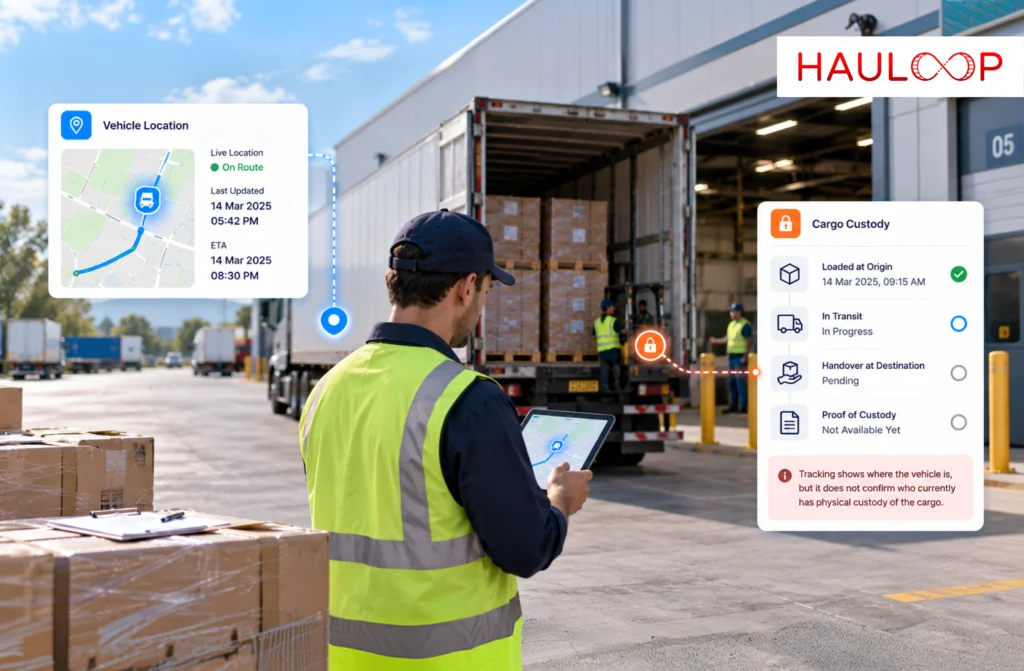
Vehicle visibility and cargo accountability are related, but they are not the same. A truck can be tracked continuously while the custody of the goods inside it remains unclear.
This is why cargo tracking must go beyond watching a vehicle move across a map. To support a custody investigation, the operation needs a connected record of loading, access, transfers, delivery, and exceptions.
What does Cargo Tracking Actually Confirm?
Cargo tracking can show where a consignment or its vehicle is expected to be. Depending on the system, it may display route progress, current location, stops, arrival and departure times, delays, and deviations.
It helps dispatch monitor journeys, communicate better estimates, and respond to route deviations. Trip replay can also reconstruct the vehicle’s movements after an incident.
However, location data primarily describes movement. It does not automatically establish who loaded the goods, who opened the cargo area, what was removed at each stop, or who accepted responsibility during a transfer.
What does Cargo Custody Mean?
Cargo custody identifies who is responsible for the goods at a particular stage. It can pass several times during a routine delivery.
Warehouse staff may release the consignment to a driver. Another team may unload or sort it before a customer representative accepts it. Every transfer creates a point at which responsibility should be recorded.
A useful custody record therefore needs to answer four questions: who released the cargo, who received it, when and where the transfer occurred, and what condition or quantity was acknowledged.
Without those details, teams may know the route perfectly but still struggle to identify where accountability changed.
Why can the Vehicle and Cargo Tell Different Stories?
Most tracking devices are attached to the vehicle, not to every package. The system knows where the truck is, but it may not know whether a particular carton is still inside it.
A vehicle may arrive at the correct customer site while part of the consignment remains at the depot. Goods may be unloaded at the wrong bay, transferred between vehicles, or released at an unauthorized stop. The truck’s route can remain completely normal through all of these events.
A map can create a strong sense of certainty. GPS fleet data provides important evidence, but it must be connected with shipment references and handover events before supporting a cargo-level conclusion.
Where do Gaps in the Chain of Custody Appear?
Custody gaps usually appear at transition points rather than while the truck is moving.
Loading is one risk point. If a manifest lists 40 cartons but no one records the physical count loaded, a later shortage cannot easily be assigned to loading or transit.
Multi-stop routes create another gap. Cargo doors may be opened repeatedly, and several consignments may be handled in a confined space. If the system records only vehicle stops, it cannot confirm which goods were removed at each location.
Transfers between drivers, vehicles, depots, or subcontractors add complexity. A verbal handover may leave no reliable timestamp showing when responsibility changed. Cargo visibility becomes stronger when every transition is recorded.
How do Access Events Strengthen Custody Evidence?
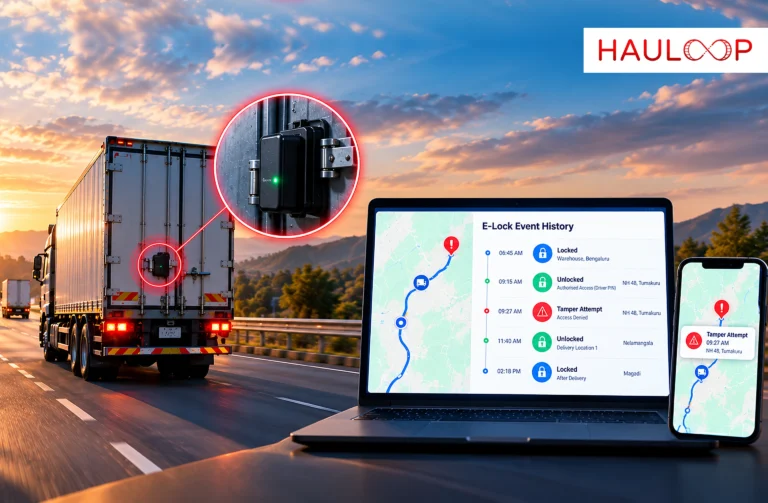
Knowing where and when the cargo area was opened can connect vehicle movement with cargo access. A planned opening inside an authorized customer zone supports a normal delivery sequence. An opening at an unplanned location creates an exception that may require investigation.
A digital cargo lock can record lock and unlock activity and help identify unauthorized access. The event becomes more useful when linked to the vehicle, driver, trip, consignment, time, and location.
A door opening does not prove that goods were removed, just as a closed door does not prove the correct cargo was loaded. Access activity should be combined with the manifest, stop sequence, and handover acknowledgement.
This is the practical value of digital lock intelligence: it adds a new layer of evidence between departure and final acceptance.
What should be Recorded at Every Custody Transfer?
Each handover should connect the shipment to the people involved and the condition accepted. The record should include:
- The consignment or manifest reference
- The releasing and receiving parties
- The date, time, and verified location
- The quantity or units transferred
- Seal, lock, or package condition
- Any shortage, damage, refusal, or discrepancy
- Signatures, scans, or photographs where required
These details should be captured during the workflow, not assembled after a problem appears. When real-time location is linked with custody records, teams can see where movement occurred and who acknowledged responsibility.
How does a Connected Record Resolve Disputes Faster?
When evidence sits in separate systems, investigations become slow. Dispatch checks the map, the warehouse searches for a manifest, and the driver looks for a photograph.
A connected record places those events in sequence. It may show that the planned quantity was loaded, the lock remained secure, the vehicle reached the correct site, and the recipient acknowledged the final count.
If the sequence contains a gap, the team knows where to focus. If every stage is supported, the fleet can respond to the claim with a coherent record instead of several disconnected screenshots.
The same data can identify locations with frequent shortages, routes with unexplained access, or transfer points where acknowledgements are regularly missing.
Conclusion
Cargo tracking answers an essential question: where did the vehicle or shipment go? Cargo custody answers a different one: who was responsible for the goods at each point in the journey?
A map cannot prove custody by itself. Fleets need loading confirmation, manifest references, access events, transfer records, exception notes, and final acceptance connected in one timeline. That chain makes cargo movement easier to verify and responsibility easier to establish.
Hauloop connects cargo security, vehicle movement, and delivery records through an AI Powered Fleet Management Platform. To see how your fleet can create a clearer chain of custody from loading to delivery, Book a Demo.
Frequently Asked Questions
What is cargo tracking?
Cargo tracking is the process of monitoring a consignment’s location, movement, status, and progress through its journey. It may use vehicle GPS, shipment references, scans, sensors, geofences, and delivery events to provide operational visibility.
What is a chain of custody in delivery operations?
A chain of custody is the chronological record of who controlled the cargo at each stage. It documents releases, receipts, transfers, access events, conditions, quantities, locations, and times from loading through final delivery.
Can GPS prove that cargo was delivered?
GPS can confirm that a vehicle reached or remained near a delivery location. It cannot independently prove that the correct goods were unloaded, counted, and accepted. A recipient acknowledgement and cargo-level record are still required.
How can a digital lock support cargo security?
A digital lock can record when and where a cargo area was locked or unlocked and alert teams to possible tampering. When linked to the trip and consignment, those events provide useful context for custody investigations.
Why should custody be recorded during vehicle transfers?
When cargo moves between vehicles, drivers, depots, or subcontractors, responsibility changes. Recording each transfer prevents uncertainty about who last confirmed the quantity and condition before a shortage or damage report appeared.
What is the difference between cargo tracking and vehicle tracking?
Vehicle tracking follows the truck’s location and movement. Cargo tracking connects those movements to a specific consignment and its delivery status. Neither proves custody fully unless handovers, responsible parties, quantities, and exceptions are also recorded.