A truck leaves a distribution centre carrying 840 cartons for delivery to three locations. The shipment is checked, the cargo door is secured, and the driver begins the journey.
By the end of the day, the deliveries are completed, and the paperwork is signed.
Two days later, the customer reports that 42 cartons are missing.
The warehouse confirms that the shipment was dispatched. The driver maintains that the cargo was delivered. The receiving team says the quantity was short.
Now the fleet manager has a question that the delivery documents cannot answer:
Was the cargo compartment opened anywhere between dispatch and delivery?
A conventional padlock cannot provide that information. It may still be locked when the truck arrives, but it cannot explain what happened during the journey.
An E-Lock (electronic cargo lock) adds another layer of information by recording cargo access events. Depending on the system, those records can show when a lock was opened, where the vehicle was, how access was authorised, and how long the compartment remained accessible.
That event history is what makes an E-Lock valuable beyond simply securing the cargo door.
What does an E-Lock Actually Record?
An E-Lock is an electronically controlled cargo security device that can record and communicate information about locking, unlocking, and other supported security events.
Unlike a conventional lock, a connected digi-lock can provide a digital history of activity during transportation.
Depending on the device and its integration with a tracking platform, recorded information may include:
| E-Lock record | What it tells the fleet operator |
| Lock engagement | When the cargo compartment was secured |
| Authorised unlocking | When access was granted and the associated authorisation |
| Denied access attempts | Whether an attempted unlocking action was rejected |
| Door-open duration | How long the cargo compartment remained accessible |
| Tamper events | Whether supported sensors detected possible interference |
| Device removal or power loss | Whether the monitoring device was disconnected or lost power |
| Device health | Battery condition and other supported operating information |
| GPS location | Where the vehicle or connected device was during a recorded event |
Not every electronic lock supports all these functions. Some information may come from connected GPS hardware or additional door sensors.
The key difference is that E-Lock event tracking provides information about cargo access throughout the journey, not just the lock’s current condition.
Why are E-Lock Timestamps Important?
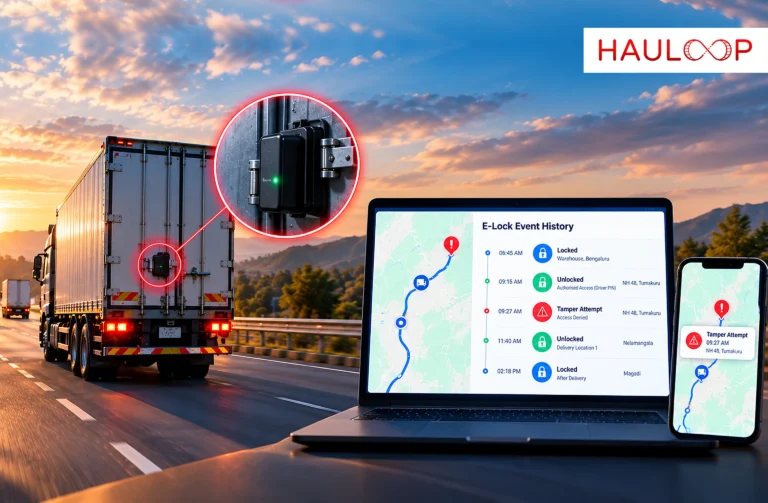
Consider a truck that leaves the warehouse at 6:45 AM and reaches its first delivery point at 11:40 AM.
The cargo compartment is expected to remain secured throughout that journey.
If the E-Lock records an unlocking event at 9:15 AM, the fleet operator now has a specific point to investigate.
The timestamp can be compared with the trip schedule, vehicle location, planned stops, and driver communication.
It does not automatically mean cargo was stolen.
The event may have occurred during an authorised inspection or another legitimate activity.
However, the timestamp helps establish when access was recorded, allowing the operator to investigate the circumstances rather than rely entirely on recollection.
This is particularly useful when delivery disputes are raised days after the shipment was completed.
How does GPS Location Add Context to Cargo Access?
Knowing when the cargo compartment was opened is useful.
Knowing where it happened can be even more important.
Suppose an E-Lock records an unlocking event at 12:30 PM.
If the vehicle was inside the receiving warehouse, that activity may match the delivery process.
If the vehicle was stopped at an unexpected highway location, the same event could require closer investigation.
When electronic lock data is integrated with GPS fleet tracking, access events can be associated with vehicle location information.
This helps operators compare recorded activity with approved depots, customer locations, and planned stopping points.
For fleets transporting high-value goods, pharmaceuticals, or sensitive cargo, that location context can support more effective cargo security monitoring.
Who Authorised the Unlocking Event?
An important part of electronic cargo security is understanding how access was granted.
Depending on the system, an E-Lock may support different authorisation methods, including:
- PIN-based access
- One-time passwords (OTPs)
- Mobile application commands
- Authorised user accounts
- Location-based unlocking permissions
When supported, the system can record the authorisation associated with an unlocking event.
For example, an event log may show that the lock was opened using a code issued to an approved user.
That provides more information than a simple unlocked status.
However, an authorised code does not necessarily prove which person physically opened the cargo compartment. Codes and devices can sometimes be shared or misused.
The authorisation record should therefore be reviewed alongside operational procedures and other available evidence.
What is Geofenced Unlocking in Cargo Transportation?
A geofence is a virtual boundary created around a specific location.
In cargo security, geofenced unlocking can restrict electronic lock access to approved areas, such as warehouses, distribution centres, or customer delivery points.
For example, a transport operator may configure an E-Lock to allow unlocking only when the vehicle reaches a designated delivery location.
If someone attempts to unlock it outside the approved area, a suitably configured system may deny the request and record the attempt.
Some systems can also require an OTP after the vehicle enters the authorised zone.
This creates two levels of access control: location and user authorisation.
The concept is similar to geofencing and zone alerts, except the defined location is used to control cargo access rather than simply monitor vehicle movement.
Geofenced unlocking is not available on every E-Lock, so fleets should confirm the device’s supported access-control functions.
Why does Door-Open Duration Matter?
Two cargo access events can have very different operational meanings.
Imagine a vehicle arriving at an approved delivery point.
The cargo door is opened, goods are unloaded, and the compartment is secured again.
Now imagine the same vehicle stopping unexpectedly during transit, with the cargo compartment remaining open for several minutes.
Both situations involve an unlocking event.
But the duration and location provide important differences.
An E-Lock system with suitable door-status monitoring can record when access begins and ends.
Fleet operators can then compare the duration with expected delivery or handling activities.
An unusually long opening event may justify investigation, especially if it occurred outside an approved location.
However, duration alone cannot establish whether goods were removed or whether the activity was unauthorised.
It provides another piece of information that helps reconstruct the shipment journey.
Can an E-Lock Detect Tampering or Forced Entry?
Some electronic cargo locks include mechanisms designed to detect interference with the device or its locking components.
Depending on the hardware, supported events may include attempted tampering, shackle interference, forced opening, device removal, or unexpected power loss.
These events can provide an earlier indication that cargo security may have been compromised.
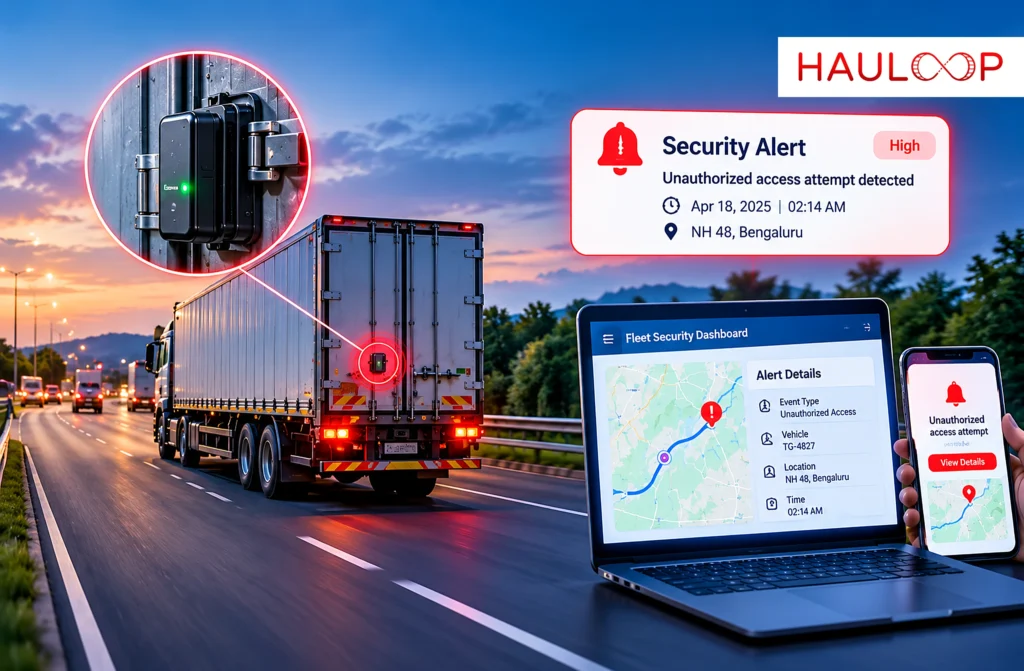
For example, if a connected device detects physical interference during transit, the monitoring platform may generate an alert.
The fleet operator can then review the event, check the vehicle’s location, and contact the relevant personnel.
However, tamper detection has limitations.
A device cannot necessarily identify every possible method of cargo access, and an alert does not independently prove that theft occurred.
The monitoring capability depends on the E-Lock’s sensors, installation, communication availability, and configuration.
How can E-Lock Records Help Resolve Cargo Delivery Disputes?
Return to the shipment involving 840 cartons.
The customer reports a shortage of 42 cartons.
Without cargo access records, the transport operator may struggle to determine whether the discrepancy occurred during loading, transportation, unloading, or receiving.
An E-Lock event history provides another source of evidence.
The fleet manager can investigate whether the cargo compartment was secured at dispatch, whether opening events were recorded during transit, and whether those events occurred at approved locations.
The information can then be compared with vehicle tracking, loading records, delivery documentation, and receiving counts.
For example, if no opening event was recorded during the journey, that may support the operator’s investigation into whether the shortage occurred before loading or during unloading.
But it does not conclusively prove that the cargo was untouched.
A complete investigation still needs to consider monitoring gaps, device condition, possible unrecorded access, and the accuracy of the original cargo count.
This is why electronic lock records work best alongside digital proof of delivery and other shipment documentation.
What can an E-Lock Record Prove, and What are its Limitations?
Understanding the limits of E-Lock data is essential for using it responsibly.
| What E-Lock data can help establish | What it cannot establish on its own |
| When locking and unlocking events were recorded | Whether the correct cargo quantity was loaded |
| Where recorded access events occurred | Whether goods were removed during an authorised opening |
| Which credentials authorised access | Who physically handled the cargo in every situation |
| Whether supported tamper sensors generated alerts | Whether every possible access attempt was detected |
| The recorded sequence of cargo access events | Whether the receiving team counted the goods correctly |
An E-Lock is therefore best understood as a cargo access monitoring and documentation tool.
It strengthens the evidence available during shipment investigations, but it does not replace cargo inspections, loading verification, secure handling procedures, or accurate delivery records.
Why should Fleet Operators Monitor Device Health?
An electronic lock record is only useful when the monitoring device is functioning correctly.
If the battery fails or connectivity is interrupted, some events may not be transmitted immediately.
Certain devices can store records locally and upload them when connectivity returns, but that capability depends on the system.
Fleet operators should therefore understand whether their E-Lock provides battery alerts, device health information, connectivity status, and offline event storage.
They should also distinguish between a confirmed locked status and a status that has not been updated recently.
For example, a dashboard showing the last known locked state does not necessarily confirm that the device is currently communicating.
Monitoring device health helps operators assess how complete and reliable the event history may be.
How does E-Lock Data Support Cargo Custody Visibility?
Cargo custody involves understanding how a shipment is controlled and handled from dispatch through delivery.
An E-Lock contributes to that process by documenting recorded cargo access events.
When connected with shipment information, GPS tracking, and delivery records, it can help fleet operators understand when access occurred and whether it aligned with the planned transport process.
For example, a shipment record may include the dispatch time, initial locking event, vehicle movement history, approved delivery location, unlocking event, and final delivery confirmation.
Each record contributes a different part of the journey.
The E-Lock does not replace the other records.
It helps fill the gap between the cargo being secured at dispatch and the shipment being accepted at delivery.
This makes it particularly relevant for fleets where cargo accountability, controlled access, and delivery verification are important.
Conclusion
The real value of an E-Lock is not simply knowing whether a cargo compartment is locked or unlocked.
It is having a record of the events surrounding cargo access.
Timestamps help establish when activity occurred. GPS information provides location context. Authorisation records help explain how access was granted. Door-open duration, tamper events, and device health information can add further detail when supported by the system.
Together, these records help fleet operators investigate unusual activity, review cargo handling, and support delivery dispute resolution.
The objective is not to assume that every unlocking event indicates a security problem. It is to understand what happened during the shipment journey and have the information needed to investigate when something does not match expectations.
For transport operators looking to strengthen cargo visibility, AI Fleet Management Software can bring cargo security and shipment monitoring into a more connected operational environment. Book a demo with Hauloop to explore how Digi Lock (E-Lock) can support your cargo and delivery operations.
Frequently Asked Questions
What does an E-Lock record beyond locked and unlocked?
Depending on its capabilities, an E-Lock can record access timestamps, GPS-linked locations, unlocking authorisations, denied access attempts, door-open duration, tamper events, and device health information. These records help operators understand cargo access activity throughout transportation.
Can an E-Lock show who opened a cargo compartment?
Some E-Lock systems record the PIN, OTP, user account, or command associated with an unlocking event. This identifies the recorded authorisation method, although it may not conclusively establish who physically opened the compartment.
What is geofenced unlocking in an E-Lock?
Geofenced unlocking restricts electronic cargo lock access to predefined locations. Depending on the system, unlocking attempts outside approved areas can be denied and recorded. Some configurations also require an OTP or another authorisation method.
How does E-Lock event history help with cargo disputes?
E-Lock event history helps operators review when and where cargo access occurred during transportation. These records can be compared with GPS tracking, loading documentation, and proof of delivery to investigate shortages or unexpected cargo handling.
Can an E-Lock prevent cargo theft?
An E-Lock can strengthen access control and provide monitoring information that may help detect suspicious activity. However, it cannot guarantee theft prevention. Effective cargo security also depends on operational procedures, physical safeguards, and accurate shipment verification.
Does an E-Lock continue recording events without network coverage?
Some E-Locks can store events locally and transmit them when connectivity returns. This depends on the device and configuration. Fleet operators should confirm offline recording, battery monitoring, and connectivity capabilities before relying on the system for continuous cargo monitoring.