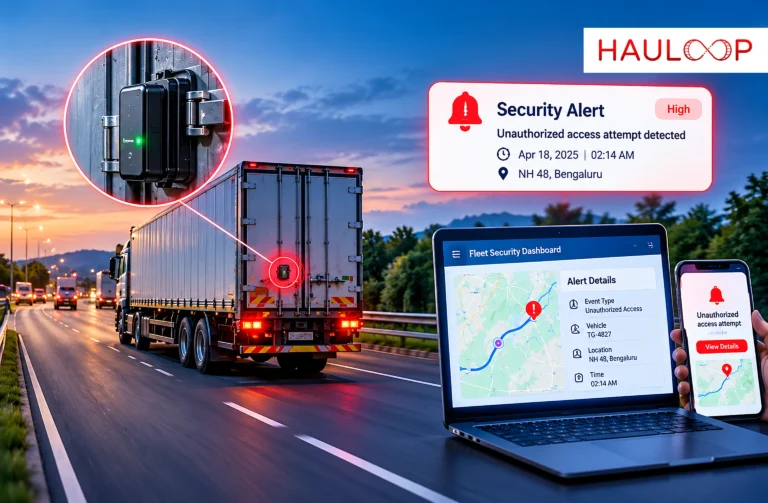
A truck carrying high-value goods is parked overnight at a highway rest stop. The driver is resting, the cargo compartment is secured, and the operations team expects the vehicle to resume its journey the following morning.
At 2:14 AM, someone attempts to interfere with the cargo lock.
With a conventional padlock, the fleet manager may not discover anything unusual until the truck reaches its destination. If goods are missing, the team must reconstruct what happened several hours earlier.
A connected Digi Lock (E-Lock) can change that timeline.
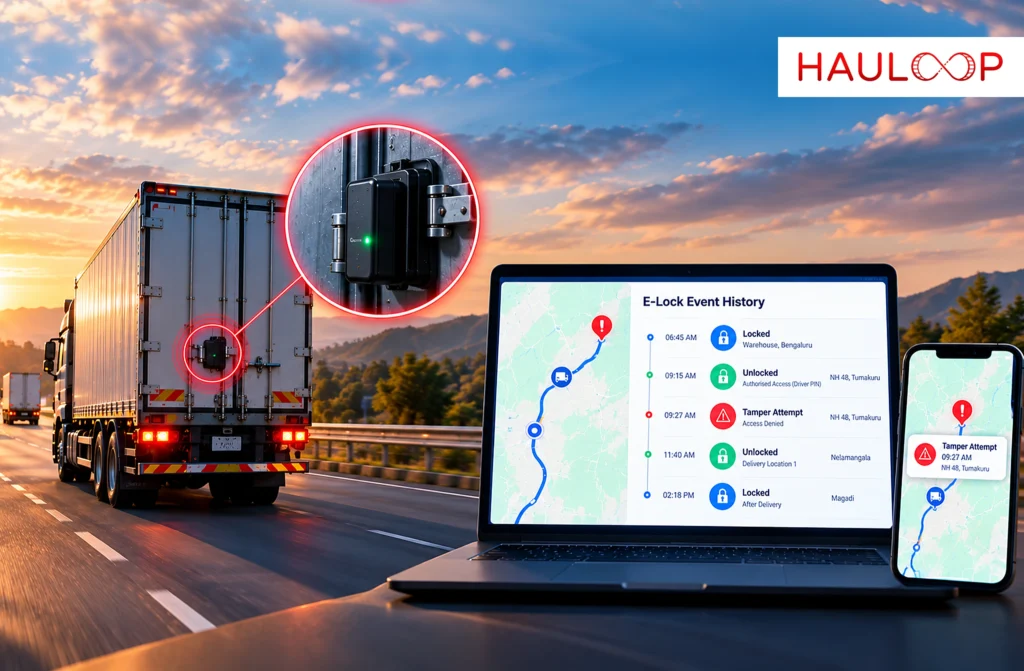
When supported sensors detect an unauthorized access attempt or physical interference, the device can record the event and transmit a security notification to a remote monitoring system.
Instead of discovering a possible custody breach at delivery, the fleet operator may have an opportunity to investigate while the shipment is still in transit.
But how does a physical event at the cargo door become an alert on a fleet manager’s phone?
What Happens When Cargo Custody is Broken?
Cargo custody refers to the responsibility and control maintained over goods as they move between locations.
When a truck leaves the warehouse, the cargo compartment may be expected to remain secured until it reaches an authorized delivery point.
Any unexpected access or interference during that period may represent a possible breach of the planned custody process.
Depending on the electronic lock’s capabilities, relevant events may include:
- Unauthorized unlocking attempts
- Forced opening or shackle interference
- Unlocking outside an approved location
- Unexpected device removal
- Loss of device power
- Supported tamper or communication-security events
These events are not identical.
An unsuccessful unlocking attempt does not mean the cargo compartment was opened. Similarly, a power failure does not automatically indicate theft.
The purpose of Digi Lock security monitoring is to identify these exceptions and provide information that helps the fleet operator determine what happened.
How does a Digi Lock Detect a Custody-Break Event?
A connected Digi Lock uses electronic components to monitor the status of its locking mechanism.
Depending on the hardware, additional sensors may detect physical interference, movement, or changes in the device’s condition.
For example, a system may identify that the lock was opened without a valid authorization command.
Another device may use supported tamper sensors to detect interference with its shackle or housing.
Some advanced electronic locks also provide monitoring for device removal, power interruption, or communication anomalies.
When a monitored condition meets the configured detection criteria, the device creates an event record.
This is the first stage of remote cargo security monitoring.
The device must recognize a relevant event before the system can communicate it to the operations team.
How does a Digi Lock Alert Travel from the Cargo Door to a Phone?
A remote alert generally follows five connected stages.
1. Event Detection
The electronic lock detects a supported event, such as unauthorized unlocking, tampering, or unexpected interference.
2. Event Recording
The device creates a digital record containing available information such as the event type, timestamp, and device identity.
GPS coordinates may also be included when location information is available.
3. Data Transmission
The lock or connected communication unit sends the event to a remote monitoring platform using an available cellular network or other supported communication method.
4. Event Processing
The platform evaluates the incoming event against its configured rules.
It may associate the event with the relevant vehicle, shipment, location, or trip information when those integrations are available.
5. Remote Notification
When the event meets the notification criteria, the platform sends an alert through its supported channels, such as a dashboard notification, mobile application, SMS, or email.
The exact channels depend on the system configuration.
This process explains how a physical cargo security event can become information available to someone managing the fleet remotely.
Under suitable connectivity conditions, notifications may arrive quickly. However, the time required depends on device hardware, communication availability, and platform processing.
What Information should a Remote Digi Lock Alert Include?
An alert is more useful when it explains the event rather than simply stating that something is wrong.
For example, a generic message saying Security Alert may force the fleet manager to investigate several systems before understanding the situation.
A more informative alert can include:
| Alert detail | Why it matters |
| Event type | Identifies the detected activity |
| Timestamp | Shows when the event was recorded |
| Vehicle or device ID | Identifies the affected vehicle or lock |
| GPS coordinates | Provides location context when available |
| Authorization status | Indicates whether access met configured permissions |
| Trip information | Helps connect the event to an active shipment |
| Device health | Provides context about battery or connectivity conditions |
Consider the difference between these notifications:
Alert A: Cargo lock opened.
Alert B: Unauthorized unlocking event recorded at 2:14 AM, associated with a vehicle stopped outside its planned delivery location.
The second message provides more information for deciding what should happen next.
This is why the event metadata behind an alert matters as much as the alert itself.
How does GPS Tracking Help Verify a Cargo Security Alert?
An unexpected unlocking event becomes more meaningful when the fleet operator knows where it occurred.
Imagine a shipment travelling from Chennai to Bengaluru.
The cargo compartment is expected to remain secured until the vehicle reaches the receiving warehouse.
If an unlocking event is recorded at the destination, it may be part of the normal delivery process.
If the same event occurs at an unexpected highway stop, it deserves closer attention.
When Digi Lock information is connected with GPS fleet tracking, operators can compare the event location with the planned route, approved stops, and delivery destination.
That helps answer three practical questions:
Where was the vehicle? Was it supposed to stop there? Was cargo access authorized at that location?
The answers help the fleet manager determine whether the event is consistent with normal operations or requires investigation.
How does Geofenced Unlocking Trigger an Unauthorized Access Alert?
A geofence is a virtual boundary around a designated location.
In cargo transportation, compatible electronic locks may use geofencing to control where unlocking is permitted.
For example, a fleet operator may define approved unlocking zones around warehouses and distribution centers.
If someone attempts to unlock the cargo compartment outside those zones, the system may reject the request and record an unauthorized access event.
Some systems also require a PIN, one-time password, or approved user command before unlocking.
This creates an additional security control.
The vehicle must be in the appropriate location, and the access request must satisfy the configured authorization rules.
The principle is similar to geofencing and zone alerts, but instead of monitoring only vehicle movement, the location boundary can become part of cargo access control.
Geofenced unlocking and denied-attempt alerts depend on the specific E-Lock configuration.
What Happens When the Digi Lock Loses Network Coverage?
Remote cargo monitoring depends on communication between the device and the monitoring platform.
This becomes important during long-distance transportation, particularly when vehicles travel through areas with limited cellular coverage.
Suppose an electronic lock detects tampering while the truck is passing through an area without a usable network connection.
The device may recognize the event immediately, but the notification cannot necessarily reach the fleet manager at that moment.
Some electronic locks support store-and-forward functionality.
This means the device records an event locally and transmits it after connectivity returns.
When supported, this can preserve useful information such as the event timestamp and available location data.
However, the notification may arrive after the incident.
Similarly, communication loss or power interruption may be monitored as separate device-health events, but detection and reporting depend on the hardware and whether communication remains possible.
An event detected immediately is not always an alert delivered immediately.
Fleet operators should confirm offline event storage, reconnection behavior, and device-health monitoring before relying on an E-Lock for time-sensitive security response.
Why does Alert Timing Matter for Cargo Security?
The difference between discovering an event during transportation and discovering it after delivery can be significant.
Consider a shipment that experiences an unauthorized opening attempt during an overnight stop.
If the fleet manager receives the alert while the vehicle is still at that location, the team may be able to investigate promptly.
They can check the vehicle’s position, contact the driver through an established safe communication procedure, and escalate the situation if necessary.
If the same event is discovered only when the shipment reaches the warehouse, the investigation begins much later.
The opportunity for an immediate response may already have passed.
This is the practical value of remote cargo security alerts.
They can reduce the delay between a recorded security event and the point at which the responsible team becomes aware of it.
However, faster notification does not guarantee that theft will be prevented or that missing goods will be recovered.
What should Fleet Managers do After Receiving a Digi Lock Alert?
A remote alert should initiate a clear response process.
The first step is to identify the event and verify the available information.
The manager should check which vehicle is involved, where the event occurred, and whether the activity matches the planned shipment process.
If the event appears suspicious, the team can contact the appropriate personnel and follow its established cargo security procedures.
For a potentially serious incident, it may be required to notify the control room, customer, security provider, or relevant authorities.
A practical response sequence is:
Receive → Verify → Locate → Assess → Escalate → Document
The final step is important.
Recording the response creates an operational history of what the team knew, what action was taken, and when the situation was reviewed.
The objective is not simply to receive more alerts. It is to ensure that meaningful alerts reach someone who can respond appropriately.
Can Digi Lock Alerts Help with Cargo Theft and Delivery Disputes?
Remote alerts have value beyond immediate security monitoring.
They can also contribute to shipment investigations.
Suppose a customer reports missing cartons after delivery.
The transport operator may review the electronic lock’s recorded events to determine whether unexpected unlocking or supported tamper activity occurred during the journey.
The available records can be compared with vehicle location history, dispatch documents, cargo counts, and digital proof of delivery.
For example, a recorded unauthorized opening event at an unexpected location may provide a specific point for investigation.
However, the absence of such an event does not prove that cargo remained untouched.
A shortage could originate during loading or unloading, and device limitations may affect the completeness of the record.
Digi Lock information is therefore best used as supporting cargo custody evidence rather than conclusive proof of theft or delivery accuracy.
What are the Limitations of Remote Digi Lock Alerts?
A connected electronic lock strengthens cargo monitoring, but it does not eliminate every security risk.
Its effectiveness depends on the events the device can detect, the reliability of its communication, and the fleet’s ability to respond.
| What remote alerts can support | What they cannot guarantee |
| Earlier visibility into detected security events | Prevention of every cargo theft |
| Location-linked investigation | Accurate identification of every person involved |
| Notification of supported unauthorized access events | Detection of every possible physical breach |
| Historical event records | Immediate communication without network coverage |
| Faster operational escalation | Successful recovery of stolen goods |
For this reason, electronic locks should complement secure parking, route planning, cargo verification, and established security procedures.
The alert provides information. The operational team determines the response.
Conclusion
A Digi Lock’s value extends beyond electronically securing a cargo door.
When supported by appropriate sensors, connectivity, and monitoring software, it can turn a detected cargo security event into a digital record and remote notification.
The process begins with event detection, continues through data transmission and platform processing, and ends with an alert that helps the fleet manager understand what happened.
GPS context, access authorization, and event history can make that information more useful during both active transportation and later investigations.
The objective is to reduce the time between a possible cargo custody breach and an informed operational response.
For fleets transporting high-value or sensitive goods, an AI Fleet Management Software can help connect cargo access monitoring with wider shipment visibility. Book a demo with Hauloop to explore how Digi Lock (E-Lock) can support more informed cargo security decisions.
Frequently Asked Questions
How does a Digi Lock send a remote tamper alert?
A compatible Digi Lock detects a supported tamper or unauthorized access event, records relevant details, and transmits the information to a monitoring platform. The platform then generates a notification according to its configured alert rules.
What events can trigger a Digi Lock security alert?
Depending on the device, events may include unauthorized unlocking, denied access attempts, physical tampering, device removal, power interruption, or other supported security conditions. The available triggers vary by hardware and configuration.
How quickly can a Digi Lock alert reach a fleet manager?
A connected system may deliver notifications quickly when network coverage and device communication are available. Actual delivery time depends on connectivity, hardware, platform processing, and notification configuration.
Can Digi Lock alerts work in areas without network coverage?
Some devices can record events locally and transmit them when connectivity returns. This preserves information for later review but does not guarantee immediate remote notification while the device is offline.
Can someone disable a Digi Lock alert by cutting power or interfering with the signal?
Some electronic locks monitor power loss, device removal, or communication anomalies. However, these capabilities are device-specific, and an interruption may prevent immediate reporting. No system can guarantee detection or transmission under every interference scenario.
Do remote Digi Lock alerts prevent cargo theft?
Remote alerts can provide earlier visibility into detected security events and support faster investigation. They cannot guarantee theft prevention or cargo recovery and should be used alongside physical security, shipment controls, and appropriate response procedures.