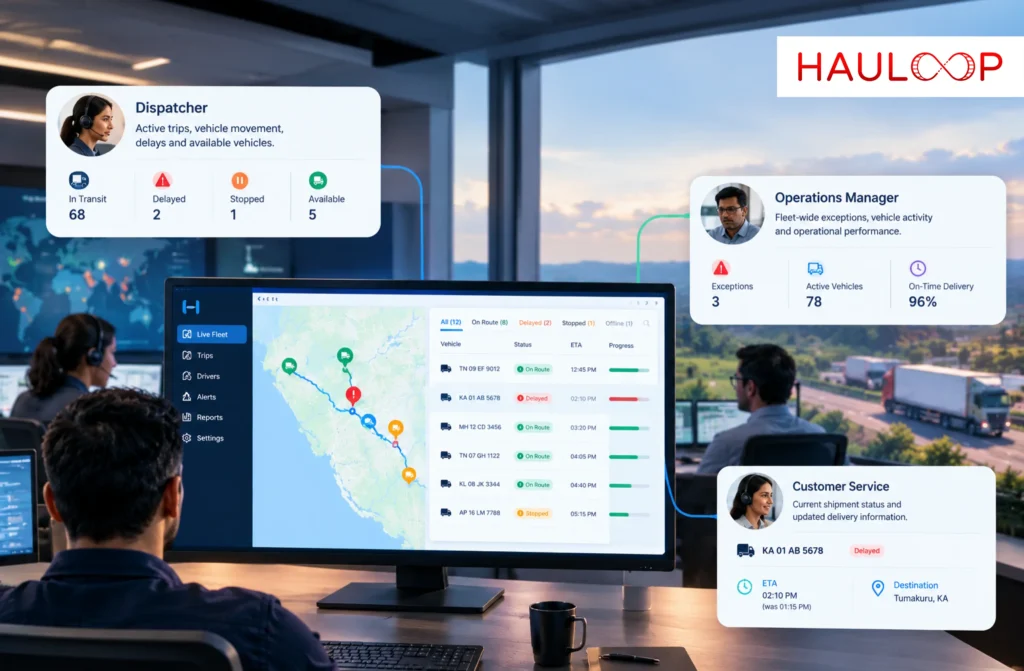
A truck is running 45 minutes behind schedule. The dispatcher knows the vehicle is delayed, but the customer service team is still working with the original delivery time. The operations manager is reviewing an earlier status report, while the customer has already called twice asking for an update.
Everyone is discussing the same shipment, but nobody has the same information.
The problem isn’t necessarily a lack of fleet data. It’s that operational information reaches different teams at different times.
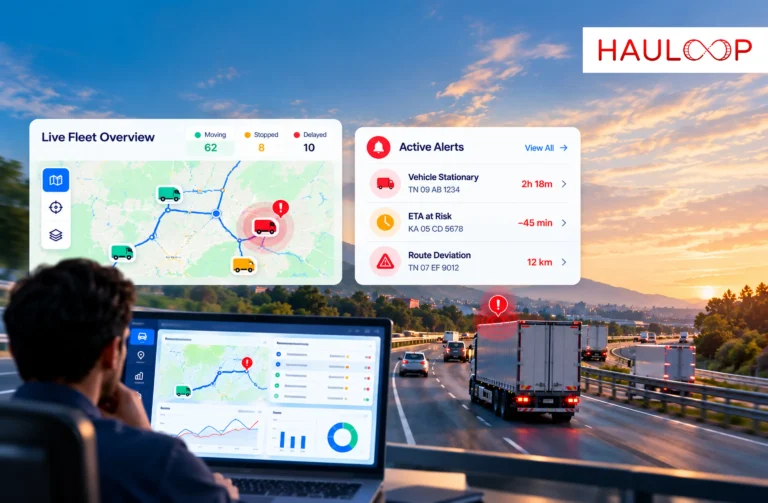
A live fleet control tower helps address this problem by bringing current vehicle activity, trip progress, delivery status, and relevant operational alerts into one centralized view.
Instead of relying on separate spreadsheets, phone calls, and periodic updates, authorized stakeholders can work from a shared source of operational information.
But giving everyone access to the same data is only part of the solution. The real value comes from making sure each stakeholder understands what has changed, how it affects their responsibilities, and what action needs to happen next.
What does a Shared Live Control Tower View Mean?
A shared control tower view is a centralized operational environment where different teams can access information from the same connected fleet data sources.
For example, a dispatcher may need to know whether a vehicle is moving toward its next delivery. An operations manager may want to understand how many trips are running behind schedule. Customer service may need the latest available arrival estimate.
Although their responsibilities differ, the underlying shipment information should remain consistent.
A shared view helps reduce situations where one department is working with an updated trip status while another is relying on yesterday’s report.
Within Fleet Intelligence, centralized visibility can help connect vehicle activity and operational performance with the people responsible for fleet decisions.
Why do Fleet Stakeholders End Up Working with Different Information?
Fleet information often moves through several systems and communication channels.
Vehicle locations may be available in a GPS tracking platform. Delivery schedules may be maintained in a transport management system. Driver updates may arrive through phone calls or messaging applications.
Meanwhile, management reports may be generated at scheduled intervals.
Each source provides useful information, but the timing and context can differ.
Consider a delivery that was originally scheduled for 3:00 PM.
The dispatcher learns that the vehicle is delayed and updates the estimated arrival time to 4:00 PM.
If that change remains within the dispatch team’s communication channel, customer service may continue telling the customer to expect delivery at 3:00 PM.
The information exists, but it has not reached everyone who needs it.
A control tower helps reduce this fragmentation by providing a common operational reference.
How does a Live Control Tower Bring Fleet Information Together?
A live control tower depends on data collected from connected fleet systems.
These may include vehicle tracking devices, trip management tools, driver information, and operational event sources.
The platform organizes the available information into a centralized view where users can monitor active operations.
A typical information flow involves five stages:
- Collect operational data: Receive vehicle locations, trip updates, and relevant fleet events from connected sources.
- Associate data with operations: Connect available information to the relevant vehicles, drivers, and trips.
- Update the control tower: Display the latest available status and operational changes.
- Provide stakeholder access: Allow authorized users to review the information relevant to their responsibilities.
- Support operational response: Help teams investigate exceptions, communicate changes, and coordinate appropriate action.
The exact data sources, update frequency, and access options depend on the platform’s configuration.
The important principle is that stakeholders are working from a common operational picture rather than maintaining separate versions of the same trip information.
Does Every Stakeholder Need to See the Same Dashboard?
Not necessarily.
Sharing a common source of information does not mean every user needs an identical screen.
Different fleet stakeholders have different responsibilities.
| Stakeholder | Information they typically need |
| Dispatcher | Active trips, vehicle movement, delays, and available vehicles |
| Fleet manager | Fleet-wide exceptions, vehicle activity, and operational performance |
| Operations manager | Delivery progress, unresolved issues, and their impact on daily operations |
| Customer service | Current shipment status and updated delivery information |
| Senior management | Operational performance, major disruptions, and business impact |
| Customer or transport partner | Relevant shipment progress and permitted delivery updates |
A dispatcher may need detailed vehicle-level information, while a senior manager may prefer a broader operational overview.
The objective is to maintain consistent underlying data while presenting information in a way that supports each user’s work.
Where role-based access and dashboard configuration are supported, this can also help prevent users from receiving information that is unrelated to their responsibilities.
How does a Shared Control Tower Reduce Status Update Delays?
Consider a vehicle that encounters heavy congestion while approaching a delivery location.
The delay affects the estimated arrival time.
Without shared visibility, the dispatcher may need to contact the driver, update a spreadsheet, inform customer service, and separately notify the operations manager.
Each communication introduces another opportunity for delay or misunderstanding.
With a connected control tower, the latest available trip information can be visible to the teams that have access to it.
The dispatcher can investigate the delay, while customer service can refer to the updated operational status.
This reduces dependence on repeated manual status checks.
However, a shared dashboard does not automatically guarantee that every stakeholder has seen or acknowledged a change.
Notification settings, user access, communication procedures, and team responsibilities still matter.
How can a Live Control Tower Improve Exception Coordination?
A fleet exception becomes more difficult to manage when different teams respond without understanding what others are doing.
Suppose a delivery vehicle breaks down during an active trip.
The dispatcher may need to investigate whether another vehicle can complete the delivery.
The maintenance team may need to assess the vehicle problem.
Customer service may need to communicate a revised delivery expectation.
The operations manager may need to evaluate the effect on other scheduled trips.
A shared control tower can help these teams refer to the same available vehicle and trip information.
That common visibility reduces the need to reconstruct the situation independently.
But the control tower is not automatically an exception-management workflow.
For effective coordination, the business still needs to establish who investigates the issue, who communicates with the customer, and who confirms that the situation has been resolved.
Why is a Single Operational View Important for Multi-Branch Fleets?
Fleet coordination becomes more complex when vehicles operate across multiple depots, branches, or regions.
A branch manager may understand the vehicles assigned locally but have limited visibility into operations elsewhere.
This can create problems when vehicles move between regions or when delivery responsibilities overlap.
For example, a truck may complete a trip in one region before being assigned to another branch’s operation.
If each branch relies on separate reports, the receiving team may not have the latest information about the vehicle’s progress or availability.
A centralized control tower can help authorized teams review connected operations across locations.
This supports a more consistent understanding of active trips, developing delays, and available vehicle information.
The value comes from reducing operational information gaps between teams that depend on one another.
Can a Control Tower Keep Customers Updated Automatically?
A control tower can provide the operational information needed for more accurate customer communication.
For example, when a vehicle’s arrival estimate changes, customer service can use the latest available information to provide an updated delivery expectation.
Some fleet platforms also support automated notifications or customer-facing tracking access.
However, these are separate capabilities that depend on the platform’s integrations, notification rules, and access controls.
A shared internal control tower does not necessarily mean customers can directly access the dashboard or automatically receive updates.
For fleets, the first requirement is to establish a reliable internal source of shipment information.
Customer communication can then be connected to that information through supported processes.
What Happens When Different Stakeholders Interpret the Same Alert Differently?
Shared data does not automatically produce shared understanding.
Imagine a control tower showing that a vehicle has remained stationary for 30 minutes.
The dispatcher may assume the driver is waiting for loading.
The operations manager may suspect an unexpected delay.
Customer service may worry that the delivery deadline will be missed.
All three users are looking at the same event, but they are interpreting it differently.
This is why a useful control tower needs operational context.
Trip schedules, vehicle location, movement history, and available driver updates can help teams understand whether the stop is expected.
Where that information is unavailable, someone may still need to contact the driver or verify the situation.
The objective is not to eliminate human judgment. It is to give teams a more consistent basis for making decisions.
How does Real-Time Visibility Support Better Stakeholder Decisions?
Different fleet decisions depend on different types of information.
A dispatcher may need to identify which vehicle can take another assignment.
An operations manager may need to decide whether a developing delay requires escalation.
Customer service may need to determine when to notify a customer about a revised arrival time.
These decisions become harder when the underlying information is inconsistent.
A live control tower can support better coordination by making relevant operational changes visible from a common source.
For example, if an active trip is delayed, the dispatcher and operations manager can review the same available status instead of comparing separate updates.
This can reduce the time spent establishing what happened before deciding what to do.
However, visibility alone does not guarantee a faster or better decision.
Teams still need accurate data, clear responsibilities, and practical response procedures.
What is the Difference Between Shared Control Tower Visibility and Scheduled Reports?
Scheduled reports remain useful for reviewing fleet performance over a defined period.
They can show completed trips, delivery performance, vehicle utilization, and operational trends.
But they do not always reflect changes happening between reporting intervals.
A shared control tower focuses on the latest available operational information.
| Scheduled report | Shared live control tower |
| Provides periodic performance summaries | Provides an updated operational view |
| Supports historical analysis | Supports monitoring of active operations |
| May require separate distribution | Can provide authorized users access to a common information source |
| Helps teams review completed activity | Helps teams investigate developing situations |
| Supports management reviews | Supports day-to-day coordination |
A report may show that several deliveries were delayed yesterday.
A control tower can help relevant teams identify which active deliveries are currently at risk and coordinate their response.
Both have value, but they serve different stages of fleet management.
What should Fleet Managers Consider Before Sharing a Control Tower Across Teams?
A shared operational view needs more than a dashboard accessible to multiple users.
Fleet managers should consider which information each stakeholder requires, how frequently it is updated, and who is responsible for responding to different events.
Data freshness is particularly important.
A vehicle’s last reported position may not reflect its current location if connectivity has been interrupted.
Stakeholders should be able to distinguish recent information from outdated updates.
Access control also matters.
Internal teams, external transport partners, and customers may require different levels of information.
A well-designed shared view should support operational collaboration without exposing unnecessary driver, customer, or business data.
Finally, teams need agreed procedures for investigating exceptions and communicating decisions.
A common view is most valuable when it supports a common understanding of the operation.
Conclusion
Fleet operations become harder to coordinate when dispatchers, managers, customer service teams, and other stakeholders work from different versions of the same shipment information.
A live control tower helps address this problem by bringing connected fleet activity, trip progress, and relevant operational events into a centralized view.
The value is not that every stakeholder sees an identical dashboard.
It is that authorized teams can work from consistent information while focusing on the details relevant to their responsibilities.
This helps reduce repeated status checks, improve communication, and support more coordinated responses to developing fleet issues.
For transport businesses managing multiple vehicles, branches, and delivery commitments, AI Fleet Management Software can help connect operational visibility across teams. Book a demo with Hauloop to explore how a Live Control Tower can support better fleet coordination.
Frequently Asked Questions
How does a live fleet control tower share information across stakeholders?
A live control tower brings information from connected fleet systems into a centralized operational view. Authorized users can access the latest available vehicle, trip, and event information according to the platform's access and configuration options.
Can different fleet teams use the same control tower?
Yes. Dispatchers, fleet managers, operations teams, and other authorized stakeholders can use a shared operational view. The information displayed to each team may differ depending on their responsibilities and the platform's role-based capabilities.
Does a control tower automatically notify every stakeholder about delays?
Not necessarily. Automatic notifications depend on the platform's alerting capabilities, user permissions, integrations, and configured communication rules. A shared dashboard alone does not guarantee that every stakeholder receives a notification.
How does a shared control tower improve communication between dispatch and customer service?
It gives both teams access to a common source of available trip and delivery information. This can reduce conflicting updates and help customer service communicate more accurately when delivery status changes.
Can customers and transport partners access a fleet control tower?
Some fleet platforms support external tracking access or stakeholder-specific views. Whether customers and partners can access Hauloop's Live Control Tower depends on its supported sharing and permission capabilities.
Is a shared control tower better than sending scheduled fleet reports?
Some fleet platforms support external tracking access or stakeholder-specific views. Whether customers and partners can access Hauloop's Live Control Tower depends on its supported sharing and permission capabilities.