Two trucks leave Chennai for Bengaluru on the same morning. Both carry similar cargo, travel approximately the same distance, and use vehicles from the same fleet.
Yet when the trips are completed, one has consumed noticeably more fuel.
The first question a fleet manager might ask is whether the driver took a longer route. But the distance travelled is nearly identical.
So where did the additional fuel go?
The answer may lie in how the journey unfolded. One vehicle spent longer in traffic, another waited with its engine running, and their driving conditions may have differed throughout the trip.
These differences matter because route fuel costs are influenced by more than kilometres travelled.
For transport businesses operating repeated routes, understanding what changes fuel consumption from one trip to another can reveal opportunities to control operating expenses without compromising delivery commitments.
Why can the Same Fleet Route have Different Fuel Costs?
A route may have a fixed origin and destination, but the operating conditions are rarely identical on every journey.
Traffic congestion, vehicle load, road conditions, driving behaviour, idling, and unexpected stops can all affect fuel consumption.
Consider a truck that completes a 350-kilometre journey on Monday and travels the same route again on Thursday.
The Monday trip takes seven hours, while Thursday’s journey takes nine.
The additional time may include congestion, waiting at delivery locations, or extended engine idling.
Even though the distance remains similar, fuel consumption may change.
Vehicle condition and loading differences can also contribute.
This is why measuring fuel efficiency using distance alone does not provide the complete picture.
Fleet managers need to understand the operating conditions behind each completed trip.
How does Route Selection Affect Fuel Consumption?
The shortest route is not always the most fuel-efficient route.
A shorter journey may involve congested city roads, frequent traffic signals, steep gradients, or repeated acceleration and braking.
A slightly longer route with steadier traffic flow may sometimes consume less fuel.
For example, a truck travelling through a busy urban corridor may spend considerable time accelerating, slowing down, and waiting.
Another route may offer more consistent movement despite covering additional kilometres.
The difference depends on the vehicle, load, road conditions, and journey timing.
Fleet operators should therefore compare more than the distance between two locations.
Recorded travel time, fuel consumption, stopping patterns, and actual route movement can help determine which route performs better under comparable conditions.
Using live vehicle tracking alongside fuel information can help operators understand how a journey developed rather than evaluating only its starting point and destination.
How Much does Engine Idling Contribute to Route Fuel Costs?
Idling is one of the operating conditions fleet managers can investigate when fuel consumption increases.
A truck may spend time waiting at a warehouse gate, standing in a loading queue, or stopping during an unexpected delay.
If the engine continues running, fuel may be consumed without additional distance being covered.
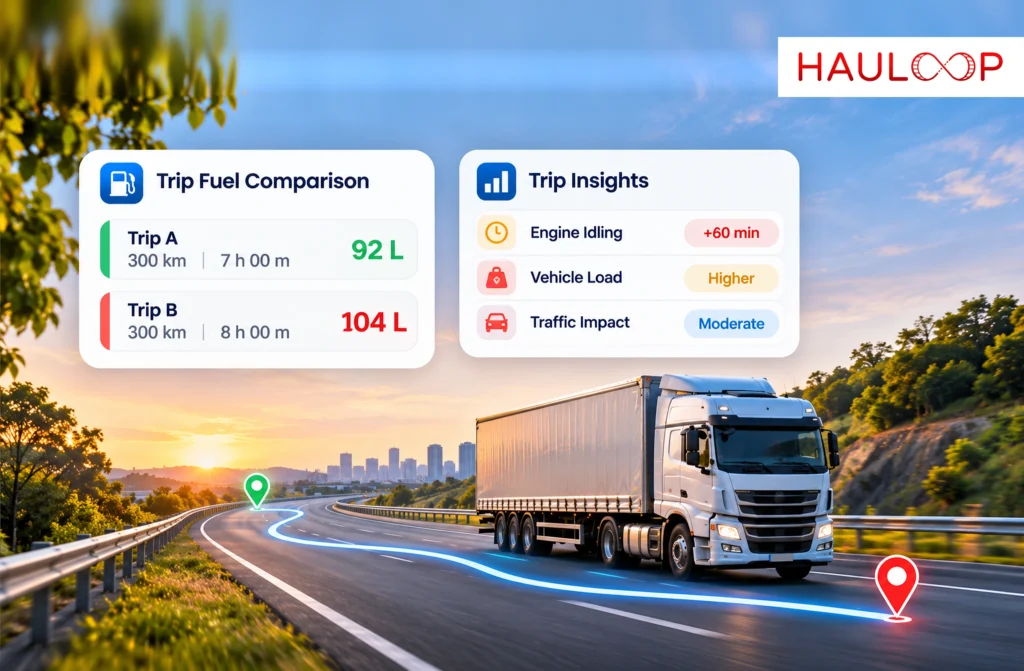
Consider two trucks completing the same route.
| Trip detail | Truck A | Truck B |
| Distance travelled | 300 km | 300 km |
| Total trip duration | 7 hours | 8 hours |
| Engine idling | 35 minutes | 95 minutes |
| Fuel consumed | 92 litres | 104 litres |
Truck B consumed 12 additional litres despite covering the same distance.
The difference cannot automatically be attributed entirely to idling, but the longer idle period provides a useful starting point for investigation.
Fleet managers can examine whether extended engine running was necessary, avoidable, or associated with repeated delays at particular locations.
Why do Vehicle Loads Change Fuel Efficiency on the Same Route?
The amount and distribution of cargo can influence fuel consumption.
A heavily loaded vehicle generally requires more energy to accelerate and move than the same vehicle carrying a lighter load under otherwise comparable conditions.
This becomes important when comparing trips on a route that carries different shipment volumes each day.
For example, a truck transporting a full load of industrial materials should not automatically be expected to match the fuel consumption of a lightly loaded vehicle.
Other factors, including terrain, tyre condition, and vehicle configuration, also matter.
Fleet managers should therefore consider payload differences when reviewing route fuel performance.
Otherwise, a necessary increase in fuel consumption could be mistaken for operational inefficiency.
Where payload information is available, comparing fuel use against the work performed can provide a more meaningful measure than litres consumed alone.
How do Traffic and Delivery Schedules Influence Fuel Spend?
A route’s fuel cost can change depending on when the vehicle travels.
A truck entering a major city during peak traffic may experience frequent stopping and slower movement.
The same route at another time may allow steadier travel.
Delivery schedules can also influence fuel consumption.
For example, a vehicle may reach a customer location early but remain waiting for its unloading appointment.
If that waiting period involves unnecessary engine idling, it can increase fuel usage.
Repeated delays at the same delivery location may indicate an opportunity to review appointment planning or dispatch timing.
However, changing departure times is not always practical.
Driver working hours, customer receiving windows, road restrictions, and safety requirements must also be considered.
The objective is to identify avoidable fuel consumption without creating new operational problems.
Which Route-Level Fuel Cost Factors can Fleet Managers Control?
Not every factor affecting fuel consumption is within the transport operator’s control.
Traffic congestion, weather, and unexpected road closures may be unavoidable.
Other factors can be influenced through planning and operational decisions.
| Fuel cost factor | Potential management action |
| Repeated engine idling | Review unnecessary engine-running periods |
| Inefficient route selection | Compare historical route performance |
| Poor departure timing | Examine congestion patterns and delivery windows |
| Vehicle maintenance condition | Investigate servicing and mechanical issues |
| Inconsistent driving practices | Review driver performance and provide coaching |
| Extended customer waiting | Coordinate loading and unloading appointments |
| Unnecessary route deviations | Examine recorded trip movement and explanations |
The priority should be factors that repeatedly affect fuel performance and can realistically be improved.
A single unusual trip may not justify changing the entire route plan.
Consistent patterns across several comparable journeys provide a stronger basis for action.
How can Fleet Managers Compare Fuel Costs Across Routes?
Comparing total fuel expenditure alone can be misleading.
A longer route will often require more fuel simply because the vehicle travels farther.
A useful comparison may include fuel consumed, kilometres travelled, trip duration, load, and operating conditions.
For example, two routes can be compared using litres per 100 kilometres.
A transport business can also examine fuel cost per trip or per delivery, depending on its operating model.
Consider the following illustrative figures:
| Route | Distance | Fuel used | Fuel per 100 km |
| Route A | 280 km | 84 L | 30 L |
| Route B | 320 km | 88 L | 27.5 L |
Route B uses more fuel in total but less fuel per 100 kilometres.
This does not automatically make Route B the better option.
The fleet manager must also consider delivery requirements, travel time, tolls, vehicle utilization, and other costs.
Fuel efficiency is one part of route profitability, not the only measure.
How does Trip-Level Fuel Data Reveal Repeated Cost Patterns?
A single journey provides a snapshot.
Several completed journeys can reveal a pattern.
Suppose a fleet operates the same route 20 times each month.
If fuel consumption regularly increases during afternoon departures, the manager can investigate whether congestion, waiting time, or another recurring condition is involved.
Similarly, if one delivery location consistently contributes to longer stationary periods, the operator may review its scheduling arrangements.
Combining fuel information with Trip History & Replay can help teams examine recorded movement, stops, and journey timing when investigating route performance.
The value comes from connecting fuel consumption with what happened during the trip.
However, the data must be sufficiently accurate and comparable.
Differences in vehicles, payloads, fuel measurement, and operating conditions should be considered before drawing conclusions.
Why should Route Fuel Analysis Go Beyond Cost per Kilometre?
Fuel cost per kilometre is useful, but it does not fully explain the profitability of a transport operation.
For example, a route with relatively low fuel consumption may still involve excessive waiting, poor vehicle utilization, or limited delivery capacity.
Another route may consume more fuel but carry a larger payload or support more profitable deliveries.
Fleet managers therefore need to understand fuel costs in the context of the work completed.
Useful questions include:
- How much fuel did the trip consume?
- What was the fuel cost relative to the distance travelled?
- How much time was spent moving versus waiting?
- Was the vehicle carrying a comparable load?
- Did the trip meet its delivery commitments?
- How did the fuel cost affect the trip’s overall operating margin?
This helps prevent fuel reduction from becoming an isolated target that conflicts with the broader transport operation.
Conclusion
Fuel costs on a fleet route are influenced by more than the distance between two destinations.
Traffic conditions, idling, vehicle loads, route selection, scheduling, and driving practices can all affect the amount of fuel consumed during a journey.
The opportunity for fleet managers lies in identifying which factors repeatedly increase consumption and which can be addressed through practical operational changes.
By reviewing route-level fuel information alongside trip movement and operating conditions, transport businesses can make more informed decisions about where fuel savings may be achievable.
Hauloop’s AI Fleet Management Software helps bring fleet operating information into a more connected view. Book a demo to explore how fuel and trip data can support better route-level cost decisions.
Frequently Asked Questions
What factors affect fuel costs on a fleet route?
Route fuel costs can be affected by distance, traffic, engine idling, vehicle load, road conditions, driving behaviour, vehicle condition, and journey timing.
Why does the same truck consume different amounts of fuel on the same route?
The truck may encounter different traffic, payloads, stopping patterns, weather, or driving conditions. These factors can change fuel consumption even when the distance remains similar.
How can fleet managers reduce route-level fuel costs?
Fleet managers can review repeated idling, route performance, dispatch timing, vehicle maintenance, and driving practices to identify avoidable fuel consumption.
Is the shortest route always the most fuel-efficient?
No. A shorter route with heavy congestion or frequent stopping may consume more fuel than a slightly longer route with steadier movement.
What is the best metric for comparing fleet route fuel efficiency?
Litres per 100 kilometres is a useful starting point. Fuel cost per trip, payload, delivery volume, and operating conditions should also be considered.
How does fleet management software support route fuel analysis?
Fleet management software can help operators review available fuel and trip information, compare completed journeys, and investigate operating conditions associated with higher consumption.