Vehicle T-28 is carrying four time-sensitive orders when its coolant temperature begins rising. At the same time, its expected arrival is slipping, the remaining route includes two restricted delivery windows and the nearest workshop is not on the planned path.
A tracking alert shows the delay. A diagnostic system reports the temperature. A delivery platform holds the customer commitments. The fleet manager must still connect those facts and decide whether the vehicle continues, stops for inspection or transfers the remaining orders.
The 2025 Stanford AI Index found that 78% of surveyed organisations reported using AI in 2024, compared with 55% the previous year. Yet using AI does not automatically coordinate a complex fleet decision.
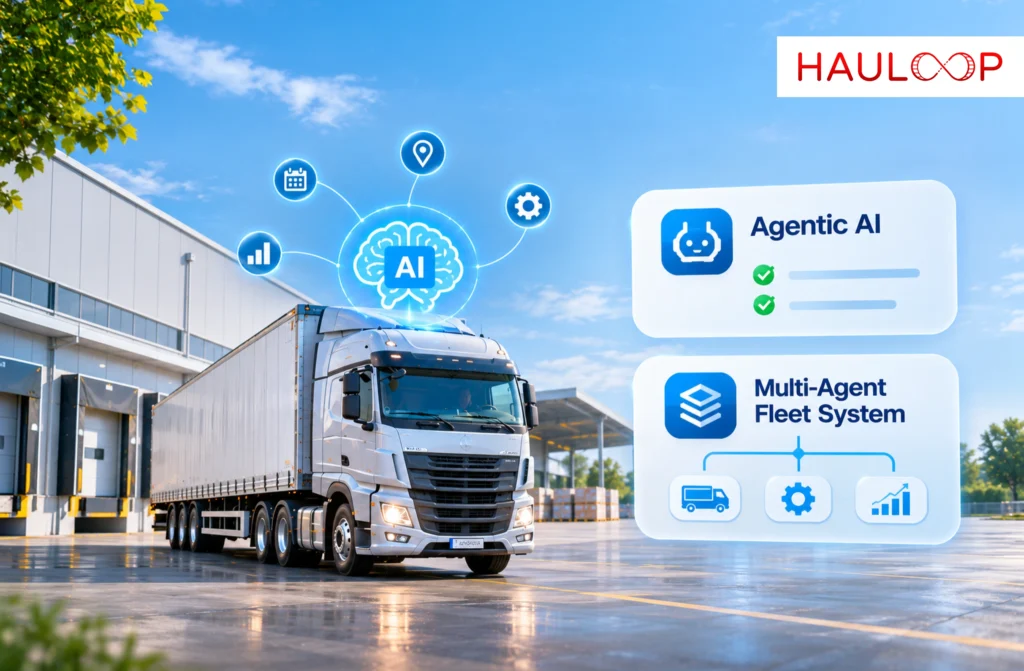
Agentic AI in fleet management is intended to close that gap. Instead of producing one alert or answer, specialised agents can investigate different parts of the event, share their findings and help form a practical response within defined permissions.
Let’s examine what makes a fleet system agentic, how multiple agents work together and where human approval must remain part of the process.
What Does Agentic AI Mean in Fleet Management?
Agentic AI works towards an assigned goal through several steps. It can interpret available information, use approved tools, evaluate options and recommend or perform permitted actions.
In a fleet, the goal might be to protect a delivery commitment without sending an unsafe vehicle further into its route. Reaching that goal may require vehicle-health data, location, ETA, cargo priority, workshop availability and replacement capacity.
Unlike a chatbot answering one question or a rule sending one alert, the agent continues until it reaches an allowed outcome, encounters uncertainty or requires approval.
Hauloop’s fleet intelligence environment brings operational, vehicle and cost signals into a connected decision view. Agentic operation builds on that foundation by organising how specialised reasoning and actions could work together.
Why One Fleet Problem Needs More Than One Agent?
Most fleet exceptions cross departments. A developing fault affects maintenance, dispatch, delivery, customer communication and trip cost.
Giving one general agent access to every system creates weak ownership and broad permissions. A multi-agent AI system divides the work into specialised roles, each with the data and tools required for its responsibility.
For T-28, the vehicle-health agent should not contact the customer, and the delivery agent should not decide whether the truck is mechanically safe. Each contributes evidence to a shared operational decision.
Meet the Agents Behind the Fleet Decision
The exact design will vary by fleet and platform, but a practical multi-agent workflow could include:
| Agent role | What it examines | What it contributes |
| Vehicle-health agent | Diagnostic signals, temperature trend and repair history | Fault severity and inspection need |
| Trip agent | Position, route progress, traffic and available service locations | Delay impact and safe route options |
| Delivery agent | Orders, time windows, cargo priority and customer commitments | Which deliveries are at risk |
| Resource agent | Nearby vehicles, capacity, driver availability and planned work | Feasible transfer or replacement options |
| Coordinating agent | Findings, policies, cost and approval rules | Ranked response with supporting evidence |
These roles do not make every task autonomous. Some agents may only analyse and recommend, while predefined rules permit selected low-risk actions.
Historical patterns can also support the process. Relevant predictive insights may show whether the temperature change resembles previous faults or whether the route regularly creates the same delay.
Follow the Decision from Signal to Response
- Detect the event: The system receives the rising-temperature signal and updated arrival estimate.
- Validate the evidence: Device status, timestamps and supporting readings are checked before the event is treated as current.
- Request specialist findings: The appropriate agents assess vehicle condition, route impact, delivery exposure and available resources.
- Resolve competing priorities: The system compares safety, service, cost and time consequences instead of optimising one metric alone.
- Propose the response: The coordinating agent presents the recommended action, confidence, evidence and alternatives.
- Obtain approval: A responsible person confirms or changes any action outside the system’s permitted scope.
- Record the outcome: The decision, action and result are retained for review.
For T-28, the response may be to complete the nearest safe stop, divert to an approved workshop and transfer the remaining orders to T-14. It explains the plan—not merely that the engine is hot.
This extends the idea of an operational next action by allowing several specialised assessments to contribute to the same decision.
Shared Context Prevents Each Agent from Optimising the Wrong Result
Agents need a common operating picture. If the maintenance agent sees only the fault, it may recommend stopping immediately. If the dispatch agent sees only the schedule, it may recommend continuing. Both answers can be reasonable within incomplete context.
Shared context should include vehicle and trip identifiers, timestamps, driver status, load, customer commitments, alternatives and fleet policy. The coordinating layer must distinguish confirmed information from predictions and manual updates.
A fleet dashboard can provide the human team with the same evidence, allowing them to understand why the agents reached their recommendation.
Human Approval Still Owns the High-Impact Decision
Agentic does not have to mean uncontrolled autonomy. The appropriate level of authority depends on the consequence of the action.
An agent may collect records, group alerts, calculate ETA impact, draft a task or notify an internal owner. Removing a vehicle from service, changing a committed delivery, making a compliance submission or recording disciplinary action should follow the fleet’s approval policy.
Every agent also needs a defined identity, limited system access and an audit trail. Current AI guidance highlights traceable identities, scoped access and human decision authority as important considerations for agentic systems.
When data conflicts or confidence is low, the correct agent action may simply be to escalate the case with the available evidence.
A Multi-Agent System is Only as Reliable as Its Connections
Fleet agents cannot reason reliably from disconnected or poorly identified data. The system needs consistent vehicle, driver, trip, order and asset identifiers across its sources.
It also depends on compatible devices, APIs, timestamps, network availability and documented rules. A delayed GPS point is not a live location, and a historical diagnostic code is not a current failure.
Before implementation, the fleet should define:
- Which data each agent may read
- Which tools and records it may change
- What confidence level permits a recommendation
- Which actions require approval
- Who owns an escalated case
- How decisions and overrides are recorded
This is why fleets usually progress from connected data to intelligence before introducing broader agentic workflows. The intelligence maturity of the operation determines whether agents receive enough reliable context to be useful.
Measure the Decision, Not the Number of Agents
The number of agents is not a performance outcome. Measure whether the system shortens response time, reduces repeated exceptions and improves action completion.
Useful measures include time from event to decision, false-alert rate, percentage of recommendations accepted, manual overrides, task completion time, repeat faults, delivery recovery and operating cost after intervention.
Scheduled automated reports can review those outcomes without rebuilding the evidence manually. Rejected recommendations may expose missing context, unsuitable rules or weak data.
Conclusion: Several Agents Should Produce One Accountable Fleet Decision
Return to T-28. The temperature alert alone could not protect the vehicle, the delivery or the customer commitment. The fleet needed vehicle-health evidence, route impact, order priority and available capacity to be considered together.
A multi-agent fleet system divides that work between specialists and forms one coordinated recommendation. A useful answer identifies what should happen, why, who must approve it and how the outcome will be recorded.
That is the practical role of agentic AI in fleet management: not replacing the fleet manager, but reducing the manual effort required to move from several disconnected signals to one controlled operational response.
AI-powered fleet management software can connect fleet data, predictive insights and operational workflows within one environment. Book a Demo to explore how your existing fleet data can support more coordinated decisions.
Frequently Asked Questions
Is agentic AI the same as fleet automation?
No. Fleet automation normally follows a predefined trigger and action. For example, a low-fuel alert may automatically notify the assigned manager. Agentic AI can investigate related information, evaluate options and continue through several approved steps towards an operational goal.
Can fleet AI agents make decisions without a manager?
They can perform low-risk actions when the fleet has explicitly authorised them. A vehicle-health agent may create a draft inspection task, but removing a truck from a time-sensitive assignment should normally require approval from the responsible operations or maintenance manager.
How does a multi-agent system handle conflicting recommendations?
A coordinating layer compares the evidence, operating policies and consequences behind each recommendation. If the maintenance agent advises stopping while the delivery agent identifies an urgent order, safety policy should govern the available options rather than allowing the delivery priority to override vehicle risk.
What fleet data does agentic AI require?
The required inputs depend on the use case. Coordinating a delayed delivery may need location, ETA, order milestones and vehicle availability, while a maintenance decision may require diagnostics, service history, mileage and current trip information.
Can agentic AI work with existing fleet hardware?
It may use data from compatible GPS trackers, telematics devices, fuel sensors, dashcams and business systems. Device protocol, data quality, permissions, update frequency and integration support must be confirmed before relying on the information operationally.
How should a fleet begin using multiple AI agents?
Start with one controlled workflow that has reliable data and a measurable outcome. A fleet might begin by coordinating a developing maintenance alert with the active trip schedule, while keeping final approval with the maintenance manager. Expand only after the team can review the evidence, overrides and results.