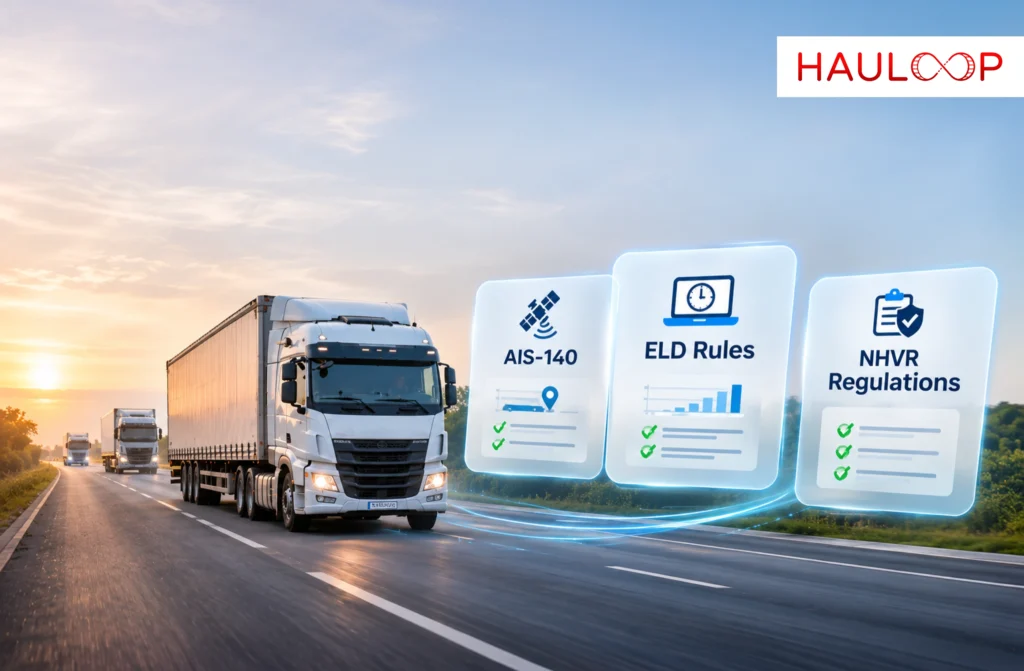
A transport company operates passenger vehicles in India, long-haul trucks in the United States and heavy vehicles in Australia. Each group uses connected technology and produces digital records.
At first glance, the requirements appear similar because each one uses digital vehicle or driver data.
But these systems do not prove the same thing.
An AIS-140 device cannot automatically satisfy the US ELD rule. An ELD registered with the Federal Motor Carrier Safety Administration does not become an NHVR-approved Electronic Work Diary. Even within one country, applicability can change according to the vehicle, driver, operation and available exemption.
Device status also needs continuing attention. In May 2026, the FMCSA removed another 12 devices from its registered ELD list, taking removals since January 2025 to 79. Buying a device is not the end of compliance control.
Fleet compliance requirements must therefore be understood by their purpose, jurisdiction and evidence not grouped together because they all involve connected vehicles.
Let’s examine what AIS-140, US ELD rules and NHVR requirements actually address, and what a fleet must verify before operating in each market.
Start with the Requirement, Not the Device Name
Compliance technology is usually introduced to satisfy a defined legal or operational requirement. The device is only one part of that process.
A fleet must first determine:
- Which authority governs the operation
- Which vehicles and drivers fall within scope
- What activity and evidence must be captured
- Which equipment or record format is accepted
- How records must be stored, transferred and presented
- Which exemptions or special operating conditions apply
Hauloop’s compliance overview brings driver records, vehicle documents, inspection information and local requirements into one operational environment. The fleet must still verify the exact rules applying to its vehicle, route and date of operation.
AIS-140, ELD and NHVR Requirements Solve Different Problems
The three names are often placed in one technology conversation, but they do not represent equivalent regulatory instruments.
| Market framework | Primary purpose | Typical evidence or capability |
| AIS-140 in India | Defines technical requirements for vehicle-location tracking and emergency communication used in applicable transport operations | Approved device details, location reporting, communication with designated systems and emergency features where required |
| US ELD rule | Records driving time and supports Hours of Service records for drivers who fall within the rule | Engine-synchronised driving records, duty status, required data elements, edits, certification and record transfer |
| NHVR environment in Australia | Administers heavy-vehicle obligations under the applicable national-law framework, including fatigue and work-diary requirements | Work and rest records, approved Electronic Work Diary use where selected, record accessibility and fatigue-management evidence |
Applicability, exceptions and operating details must still be confirmed with the responsible authority.
Our guide to regional fleet compliance explains why a vehicle cannot carry one permanent “compliant” status into every jurisdiction.
AIS-140 Connects Applicable Vehicles with Approved Tracking Infrastructure
AIS-140 is an Indian automotive-industry standard associated with intelligent transport systems and vehicle-location tracking requirements.
Where the relevant rules require AIS-140 equipment, the fleet should confirm the approved manufacturer and model, correct installation, active communication, vehicle mapping and connection with the designated backend or government system.
The Indian Ministry of Road Transport and Highways maintains information about approved tracking-device manufacturers. State-level onboarding, activation and operating processes may still affect how a vehicle is connected.
A location appearing in a vendor application does not by itself prove that the required authority is receiving the data. The device may be working while the vehicle number is mapped incorrectly, the SIM is inactive or the authorised system connection is incomplete.
AIS-140-related readiness should therefore be checked as a full chain: approved equipment, installation, identity, connectivity, activation and continuing reporting.
A US ELD Creates a Driver-Hours Record, Not Merely a Vehicle Trail
The US ELD framework addresses records of duty status for applicable commercial drivers. The FMCSA states that an ELD synchronises with the vehicle’s engine to record driving time and support Hours of Service recording.
The record needs more than a moving vehicle icon. It connects driving activity with the authenticated driver, vehicle, carrier and required duty-status data.
Drivers and carriers must also manage logins, annotations, certification, unidentified driving, edits and malfunction procedures correctly.
Hauloop’s electronic logs can organise supported driver-hour and duty-status information. The configured system, device and operating process must still meet the FMCSA requirements applying to the carrier.
The article on electronic driver logbooks explains why a digital record is stronger when it preserves vehicle activity, driver identity and later corrections.
NHVR Requirements Use Their Own Fatigue and Work-Diary Framework
Australia does not simply rename a US ELD as an EWD.
The NHVR describes an Electronic Work Diary as an electronic device or system approved to monitor and record work and rest times. It can be used as an alternative to a written work diary under the applicable framework.
The fleet needs to understand the fatigue-management option under which the driver operates, the applicable work and rest rules, diary obligations, required records and any exemptions. An EWD also needs to be recognised under the relevant approval process; a digital logbook is not automatically an approved EWD.
This is why the system must distinguish jurisdictional rules instead of displaying one generic remaining-hours number. The calculations, record format and inspection process must match the operating environment.
Our guide to Hours of Service tracking explains how remaining driving time should influence dispatch before another job is assigned.
The Same Hardware Does Not Create the Same Compliance Outcome
A device may contain GPS, mobile communication, vehicle connectivity and a driver interface. Those shared components do not make its regulatory use interchangeable.
Important differences can include:
- Approval or registration process
- Required data fields
- Engine synchronisation
- Driver identification
- Editing and certification controls
- Data transfer and retention
- Malfunction and inspection procedures
A fleet expanding into a new market should therefore assess the device, software and operating process separately. Reusing compatible hardware may be possible, but only after confirming that the complete solution supports the new requirement.
The driver mobile app can give drivers access to supported trips, alerts and tasks. It should not be presented as a substitute for an approved regulatory device or record where specific approval is required.
Verify Market Readiness Before the Vehicle is Dispatched
Compliance checking should happen before the driver begins the assignment.
Before dispatch, the fleet should confirm:
- The correct rule set has been selected for the driver, vehicle and trip.
- The required device or record system is active and accepted.
- Current logs, permits and supporting documents are available.
- Any exemption is documented for this operation.
- Data gaps and the inspection method have been reviewed.
This produces a specific answer: ready for this assignment under the requirements applying here not an unexplained green status.
Conclusion: Compliance Must Match the Market and the Operation
Return to the fleet operating in India, the United States and Australia. Each group uses connected technology, but the records serve different regulatory purposes.
AIS-140 addresses approved tracking capabilities for applicable Indian operations. The US ELD rule focuses on engine-connected duty records for drivers within scope. NHVR requirements use Australian work-and-rest rules and an approved EWD framework where electronic diaries are selected.
The correct question is not whether the fleet owns a compliance device. It is whether the device, software, driver process and retained evidence satisfy the requirement applying to that exact operation.
That is how fleets avoid treating three different frameworks as one interchangeable technology category. AI-powered fleet management software can help connect market-specific records with the drivers, vehicles and trips to which they apply. Book a Demo to see how Hauloop can support clearer multi-market compliance control.
Frequently Asked Questions
Is an AIS-140 device the same as an ELD?
No. For example, an Indian passenger vehicle may use an AIS-140 tracking device for applicable location and emergency requirements. A US interstate truck driver may require an ELD that records engine-synchronised driving time and duty status. One does not automatically satisfy the other.
Can a US-registered ELD be used as an NHVR-approved EWD?
Not automatically. An Australian operator must verify whether the electronic system is approved for the applicable EWD framework. A device designed for US Hours of Service records may use different rules, fields, calculations and inspection procedures.
What should an Indian fleet check after installing an AIS-140 tracker?
Consider a bus visible in the vendor’s application but missing from the designated government system. The fleet should verify the approved model, vehicle mapping, SIM, activation, server connection and continuing data flow rather than accepting one map location as proof of readiness.
Do all US commercial drivers need an ELD?
No. The rule applies to most drivers required to maintain records of duty status, but defined exceptions exist. A short-haul driver, an older qualifying vehicle or another exempt operation should be assessed against the current FMCSA requirements before the fleet decides what record is required.
Does electronic logging automatically prevent an Hours of Service violation?
No. If dispatch assigns a job that exceeds the driver’s available hours, recording the violation accurately does not prevent it. The value comes from checking remaining time before assignment and changing the plan where necessary.
What should a fleet verify before entering a new compliance market?
The fleet should identify the authority, vehicles and drivers in scope, accepted device or record, required data, retention period, roadside-access method, exemptions and local support. The complete operating process should be tested before the first assignment.