A 12-wheeler completes its trips without an obvious tyre problem. The tyres look usable, yet several have been operating below the recommended cold pressure.
The fleet will never receive an invoice labelled “low tyre pressure”. The loss appears as extra diesel, earlier tyre replacement, roadside assistance and delayed deliveries. These costs sit in different records, so their common cause can remain hidden.
The North American Council for Freight Efficiency reports that operating all tyres 10 psi low may increase fuel use by 0.5%–1%, while an individual tyre at that deficit may experience 5%–12% greater wear.
A tyre pressure monitoring system can expose pressure loss between manual checks. However, the financial return depends on the truck’s present tyre condition, the quality of the readings and what happens after an alert.
Let’s examine where TPMS cost savings come from, how they change across different fleet conditions and when the investment can realistically pay for itself.
Understand What TPMS Can and Cannot Tell Your Fleet
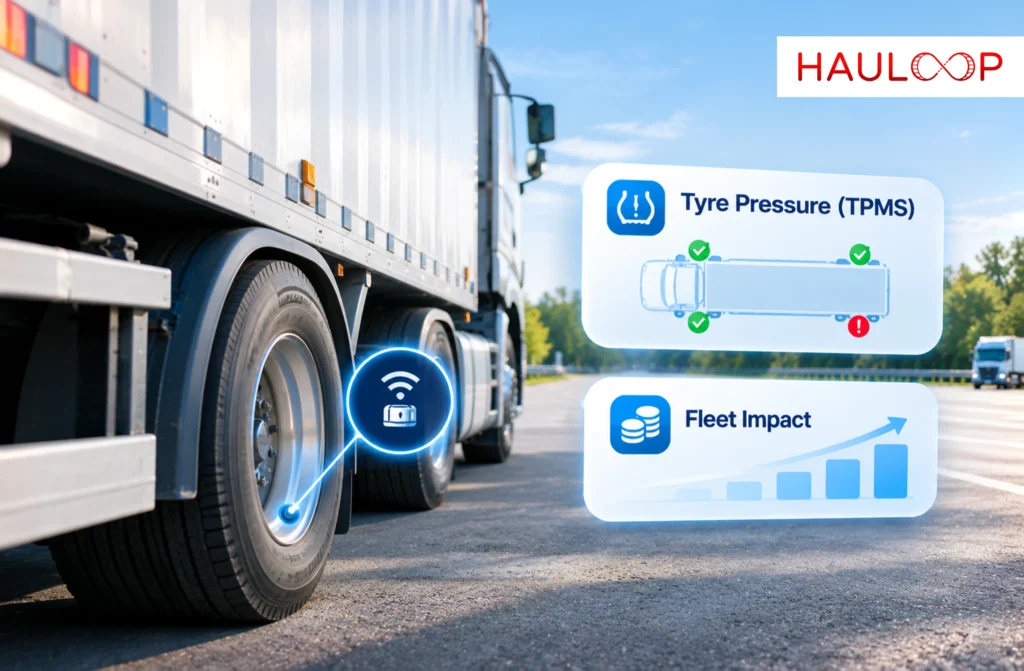
A TPMS uses compatible wheel sensors to monitor pressure and, depending on the hardware, temperature. It can expose slow leaks, pressure imbalance and developing heat conditions before the tyre appears flat. These problems can be missed during a visual tyre check, especially before the tyre begins to look flat.
TPMS does not measure tread depth, alignment, casing damage or load distribution. It also cannot prevent every sudden cut or impact failure. The system strengthens daily inspection; it does not replace it.
Hauloop’s fleet maintenance capabilities can connect supported tyre alerts with maintenance records. Results still depend on compatible sensors, correct installation, suitable thresholds and an accountable response.
Start with the Truck’s Real Operating Baseline
TPMS ROI should begin with the fleet’s own records. The following example uses one Indian 12-wheeler and illustrative October 2026 inputs.
| Model input | Illustrative value |
| Annual distance | 84,000 km |
| Fuel economy | 3.75 km/l |
| Diesel price | ₹95.20/l |
| Road tyres, excluding the spare | 12 |
| Average tyre price | ₹30,000 |
| Expected tyre life at correct pressure | 1,00,000 km |
The truck consumes approximately 22,400 litres of diesel a year, costing about ₹21.3 lakh. Its annualised tyre requirement at the correct pressure costs approximately ₹3,02,400.
These figures are not Hauloop benchmarks. Route, load, axle configuration, tyre policy and driving conditions will change the result.
Low Pressure Takes Money from Fuel and Tyre Life
An underinflated tyre flexes more, creating heat and rolling resistance. The engine then uses additional fuel to complete the same work.
Using a conservative fuel penalty of 0.9% for a 10% average pressure shortfall:
Additional annual fuel cost = annual fuel consumption × fuel penalty × fuel price
For the example truck, 22,400 litres × 0.9% × ₹95.20 produces approximately ₹19,192 in additional annual fuel cost.
Low pressure can also create uneven shoulder wear and damage the casing. If tyre life falls from 1,00,000 km to 90,000 km, annualised tyre expenditure rises from ₹3,02,400 to ₹3,36,000 an additional ₹33,600.
Fuel and tyre wear create a combined loss of ₹52,792 before breakdowns. Connecting pressure readings with fuel management data can help determine whether higher consumption occurred alongside tyre condition, route, load or idling.
A Roadside Tyre Event Costs More Than the Repair
A roadside event may include a replacement tyre, technician attendance, driver waiting, recovery and delivery disruption. A missed customer slot can cost more than the repair itself.
The model assumes an average event cost of ₹30,000, 0.6 incidents per 1,00,000 km and that timely pressure monitoring can help prevent half of applicable events. For the example truck, the estimated avoidable roadside cost is ₹7,560 a year.
This is a planning assumption. TPMS may warn about a slow leak or abnormal heat, but it cannot stop instant road-debris damage.
Tyre failure also creates safety exposure. A blowout can cause a severe incident, but reliable Indian per-truck accident frequency and cost data are not strong enough to place a defensible accident-saving figure inside the ROI. Safety should remain a reason to act—not a convenient number used to shorten payback.
More Air is Not Always the Safer Answer
Under-inflation is not the only pressure problem. Excessive pressure can reduce the tyre’s contact patch, concentrate wear in the centre of the tread, reduce grip and increase vulnerability to impact damage.
Pressure rises as a tyre heats. A tyre set to 100 psi at 25°C may read about 115 psi at 65°C. Releasing air until it returns to 100 psi while hot could leave it close to 86 psi after cooling.
Drivers should follow the tyre manufacturer’s cold-pressure guidance.
Temperature data can provide useful context, but thresholds must match the tyre, axle, load and duty cycle. TPMS should help the team distinguish a developing fault from a normal temperature-related pressure change.
See How Present Tyre Discipline Changes the Payback
The same TPMS investment will not produce the same return in every fleet. The model compares three pressure conditions and applies an 85% response factor to fuel and tyre savings because no fleet corrects every alert immediately.
Accident savings are excluded. The calculation uses an illustrative ₹40,000 hardware investment and ₹6,000 annual subscription; these are placeholders, not a Hauloop quotation.
| Present pressure condition | Fuel loss | Tyre-life loss | Avoidable roadside cost | Estimated annual operating benefit | Net benefit after example subscription | Indicative payback |
| Well-kept: 5% low | ₹9,596 | ₹15,916 | ₹3,780 | ₹25,465 | ₹19,465 | 24.7 months |
| Typical: 10% low | ₹19,192 | ₹33,600 | ₹7,560 | ₹52,433 | ₹46,433 | 10.3 months |
| Neglected: 20% low | ₹38,385 | ₹1,00,800 | ₹12,600 | ₹1,30,907 | ₹1,24,907 | 3.8 months |
The pattern matters more than the headline figure. A fleet already maintaining pressure consistently will usually have a longer financial payback. A fleet with frequent pressure loss and poor tyre-life records has a larger recoverable gap.
Scale the Result Only After Checking Each Vehicle Group
At the typical-condition estimate, ten comparable trucks could produce approximately ₹4.64 lakh in net annual benefit after the example subscription. Twenty-five could produce about ₹11.6 lakh, and fifty about ₹23.2 lakh.
Do not multiply these figures blindly across mixed fleets. Long-haul tractors, mining tippers and urban delivery trucks have different distances, loads and failure exposure.
Run the calculation separately by vehicle class and duty cycle. A fleet cost calculator can keep tyre, fuel, downtime and other operating costs within the same period and vehicle group.
The Alert Must Become a Maintenance Action
A warning creates no saving if it remains on a dashboard. The fleet needs a rule covering when the driver stops, who checks the tyre and how the result is recorded.
Repeated pressure loss should create an inspection task for the correct vehicle and wheel position. Maintenance may need to check the valve, rim, puncture, casing or wheel assembly instead of repeatedly adding air.
A clear maintenance schedule gives the signal an owner, deadline and completed record. Hauloop’s vehicle cost analysis can then connect supported tyre, fuel and maintenance expenses with the asset creating them.
Know What the Model Leaves Out
A useful business case should state its limits.
- Retreading: The model uses new-tyre replacement cost. Retreading may lower replacement expenditure, while pressure damage that makes a casing unsuitable for retreading can increase the loss.
- Manual checking time: Driver and technician time spent checking multiple tyres is not assigned a value.
- Local evidence: Much of the published pressure research comes from North America and Europe. Indian fleets should validate the result through comparable before-and-after records.
- Changing operating conditions: Load, terrain, weather, alignment and driving behaviour can affect fuel use and tyre life independently of pressure.
- Safety value: The model recognises the risk but excludes an accident-saving estimate from the financial return.
The starting inputs were also kept conservative: annual distance was reduced from 1,00,000 km to 84,000 km, fuel sensitivity from 1% to 0.9%, and assumed event cost from ₹45,000 to ₹30,000. Those changes move the typical payback from an aggressive seven-month estimate to approximately ten months.
Conclusion: TPMS Pays Back When the Fleet Closes the Pressure Gap
Return to the 12-wheeler from the beginning. Its tyres did not look flat, but the pressure gap was already increasing diesel use, shortening tyre life and raising the chance of a roadside interruption.
TPMS makes that hidden condition visible. Its value comes when the fleet verifies the alert, corrects the pressure and investigates repeated loss before more trips carry the same cost.
For the illustrative truck operating around 10% below the recommended pressure, the model estimates ₹52,433 in annual operating benefit before subscription and an indicative hardware payback of 10.3 months. A well-maintained fleet may take longer; a neglected fleet may recover the investment much sooner.
The defensible answer is therefore not that TPMS always pays back within one fixed period. It pays back according to the pressure loss already present, the kilometres travelled, the cost of tyres and fuel, and the fleet’s ability to act on the warning.
AI-powered fleet management software can connect supported tyre alerts with fuel, maintenance and vehicle-cost records in one operational view. Book a Demo to evaluate TPMS savings using your fleet’s own operating data.
Frequently Asked Questions
Can TPMS reduce fuel consumption in a commercial fleet?
TPMS can help a fleet identify under-inflation that increases rolling resistance. For example, if a truck’s fuel use rises on a recurring route, pressure history can show whether tyre condition contributed to the change. The saving occurs only when the fleet corrects the issue.
How should a fleet calculate TPMS ROI?
Estimate the recoverable fuel, tyre-life and roadside savings, subtract recurring costs and compare the net annual benefit with hardware and installation expenditure. A fleet with strong pressure discipline should use the well-kept scenario rather than assuming the return of a neglected fleet.
Does TPMS prevent every commercial tyre blowout?
No. It may warn about supported pressure and temperature changes that develop over time, such as a slow leak. It cannot prevent an immediate cut or impact failure and does not replace tread, casing and wheel inspections.
Should a driver release air when a truck tyre reads high during a trip?
Not automatically. A higher reading after extended driving may result from normal heat. Releasing air from a hot tyre can leave it underinflated after cooling. The driver should follow the manufacturer’s cold-pressure procedure and the fleet’s escalation rule.
How can a fleet verify whether TPMS is saving money?
Compare kilometres per tyre, fuel economy, tyre-removal reasons, roadside events and alert-response times before and after installation. Use vehicles completing similar work so differences in load, route and duty cycle do not distort the result.
What should happen after the same wheel reports repeated low pressure?
The fleet should create an inspection task instead of repeatedly adding air. For example, a drive-axle tyre losing pressure after each long-haul trip may require a valve, rim, puncture, casing or wheel-assembly check, with the confirmed cause recorded against the vehicle.