The fuel invoice arrives with every purchase listed clearly.
The dates are there. The quantities are there. The amounts paid are there. Yet when the total is higher than expected, finding the reason is rarely straightforward.
Finance can confirm what was purchased. Drivers can explain where they refuelled. Dispatch can show which journeys were completed. Maintenance can identify vehicles that may be consuming more fuel than usual.
But none of these records, when viewed alone, reveals the complete story.
Fuel moves through several stages between purchase and productive use. It can be lost through idling, unnecessary mileage, route changes, vehicle condition, inaccurate records, unauthorised activity, leakage, or theft. Most of these losses do not create one obvious incident. They become hidden inside normal fleet consumption.
That is why fuel is one of the easiest operating costs to lose and one of the hardest to trace.
Why can Fuel Disappear without One Clear Incident?
Fuel loss does not always mean that a large quantity has suddenly gone missing from a tank.
It often develops through small events across the working day.
A vehicle waits longer than planned with its engine running. Another travels farther because of a route change. A driver makes an additional stop. A delivery finishes without any return work, leaving the vehicle to travel back empty. One vehicle gradually begins consuming more fuel than others completing similar work.
Each event may appear too small to investigate. Together, however, they can steadily increase operating costs.
The difficulty is that most of these activities can also occur for legitimate reasons. A driver may idle because loading is delayed. A detour may be required because of road conditions. An empty return may be unavoidable when no suitable work is available.
This makes the loss difficult to separate from normal fuel use.
By the time the monthly total reveals a problem, the individual journeys, stops, and decisions responsible for it may have already been forgotten.
Why does a Fuel Purchase Lose Context so Quickly?
A receipt or fuel-card statement creates a financial record.
It may show the transaction time, station, fuel type, litres purchased, price, driver, vehicle number, or odometer reading. These details confirm that money was spent, but they do not confirm how the fuel was used afterwards.
The purchase and the consumption happen at different points.
Fuel may be purchased in the morning and used across several trips. It may remain in the tank overnight. Part of it may be consumed while the vehicle is moving, while another part is burned during idling. Some may support productive delivery work, while the rest covers empty kilometres or unnecessary travel.
This separation makes direct tracing difficult.
Even a valid transaction can raise questions. Was the assigned vehicle actually at the station? Did the quantity fit the available tank capacity? Was the fuel type correct? Did the odometer reading match the vehicle’s journey history?
Connecting the transaction with live vehicle tracking gives managers the location and movement context needed to answer these questions.
Without that connection, teams may confirm that fuel was purchased without being able to verify which vehicle received it or what work it supported.
Where does Fuel Cost Become Hidden During Operations?
Once fuel enters the tank, its cost begins to spread across different operating activities.
Some of that fuel directly supports productive work. It moves a vehicle from collection to delivery, powers necessary equipment, and helps the business complete customer commitments.
Other consumption is less productive.
A vehicle may spend extended time waiting at a customer site. Poor scheduling may create unnecessary travel between jobs. A driver may take a longer route, or an unsuitable vehicle may be assigned to work that it cannot perform efficiently.
Repeated dwell time at depots, loading points, borders, or customer premises can increase fuel use when engines remain running. The delivery may still be completed successfully, so the additional cost is absorbed into the trip instead of being recognised as a separate loss.
Vehicle condition can also hide fuel cost.
Incorrect tyre pressure, wheel alignment problems, engine faults, clogged filters, or delayed servicing can increase consumption gradually. Because the vehicle continues to operate, the change may look like normal variation rather than a developing maintenance issue.
This is what makes fuel leakage difficult to see. The litres are not always missing. They may simply be supporting inefficient activity.
Why is there No Single “Normal” Fuel Figure?
A fixed fuel target can be useful, but it does not explain every operating condition.
Two similar vehicles may consume different quantities because they are completing different work. One may carry a heavier load, travel through urban traffic, face steep terrain, or spend longer at delivery points. The other may operate mainly on open roads.
Drivers also encounter different conditions. Traffic, weather, site restrictions, road quality, route changes, and customer delays can all influence consumption.
This means a vehicle should not be judged from one isolated result.
A more useful approach is to establish a normal operating range for each vehicle and type of work. Current performance can then be compared with previous journeys completed under similar conditions.
If consumption begins to rise across comparable trips, the pattern becomes more meaningful.
The reason may be linked to driving behaviour, route planning, workload, vehicle condition, or a change in operating circumstances. For example, Hauloop’s article on tyre inspection shows how under-inflation can affect fuel performance even when a tyre appears normal.
The question is therefore not simply whether a vehicle used more fuel. It is whether the increase can be reasonably explained by the work it completed.
Where does Fuel Accountability Break Between Teams?
Fuel information is commonly divided between several people.
Finance manages invoices and fuel-card statements. Drivers hold receipts and record odometer readings. Dispatch knows which routes and assignments were planned. Fleet managers monitor vehicle activity, while maintenance teams understand asset condition.
Each team sees one part of the cost.
Finance may identify an unusual purchase but lack access to the vehicle’s location. Dispatch may notice additional mileage without seeing the related fuel expense. Maintenance may recognise declining vehicle performance without knowing its impact on trip cost.
When these records remain separate, tracing the cause becomes a manual exercise.
Teams begin comparing receipts, spreadsheets, GPS histories, driver explanations, and workshop records. Missing identifiers, delayed entries, incorrect vehicle numbers, or inconsistent odometer readings make the process even harder.
Accountability can then turn into blame.
The driver may be questioned about higher consumption when a mechanical problem is responsible. Maintenance may be blamed for the vehicle condition when inefficient scheduling created most of the loss. A suspicious transaction may be treated as theft when the card was simply assigned to the wrong vehicle.
Real accountability is not about identifying someone to blame. It is about identifying which transaction, vehicle, journey, decision, or operating condition created the additional cost.
When does Fuel Activity Become Suspicious?
Not every unexpected fuel event indicates theft or misuse.
A tank-level drop may be caused by fuel movement on a slope, road conditions, temperature changes, sensor noise, delayed data, or genuine engine consumption. A larger-than-usual refuelling transaction may be reasonable if the vehicle began with a low tank level or was preparing for a longer assignment.
An event becomes more suspicious when several pieces of information do not match.
For example:
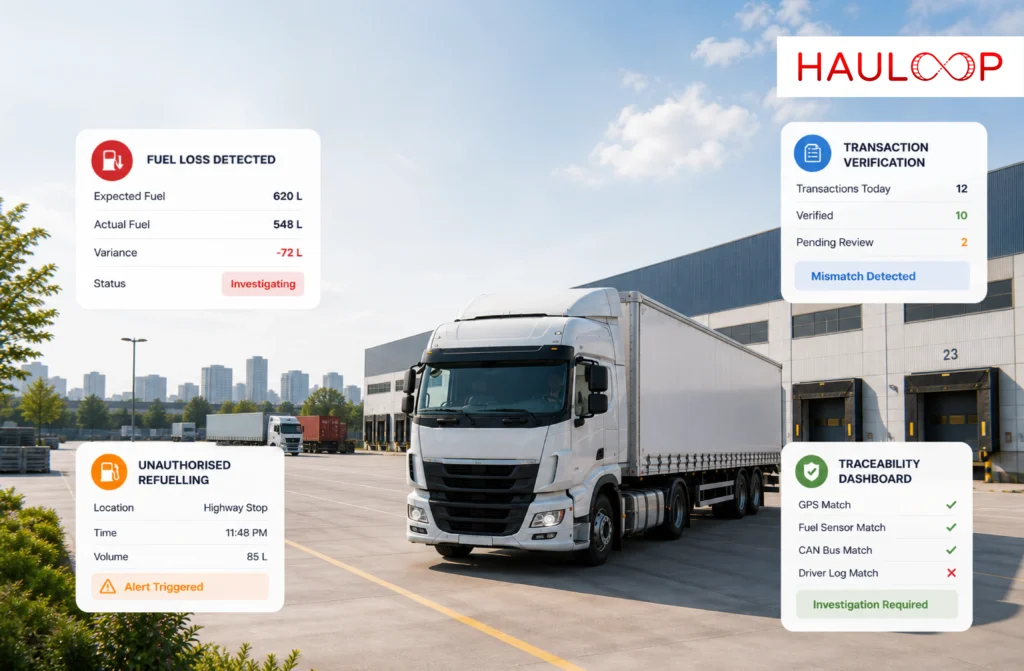
- A fuel card is used while the assigned vehicle is elsewhere.
- The quantity purchased exceeds the vehicle’s available tank capacity.
- A sharp tank-level drop occurs while the vehicle is stationary with its ignition off.
- Fuel is purchased outside approved hours or locations.
- Mileage and fuel records repeatedly fail to align.
- Consumption increases without a related change in route, workload, or conditions.
These events provide a reason to investigate. They do not independently prove wrongdoing.
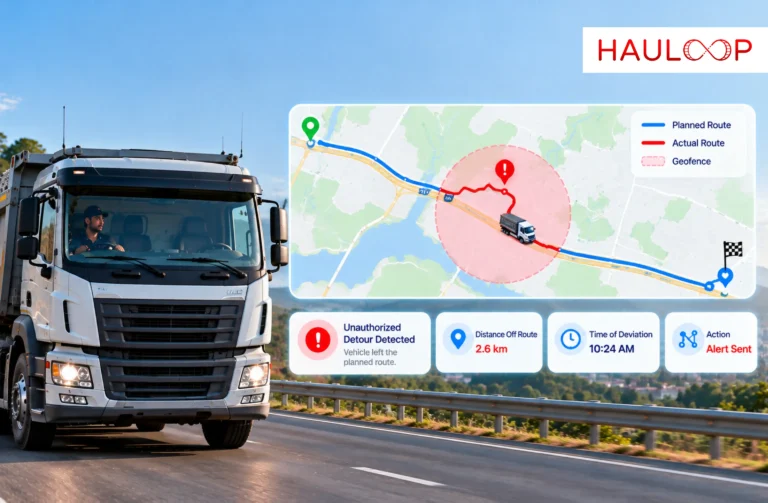
Reliable fuel theft detection compares tank-level changes with location, movement, ignition status, refuelling activity, time, and expected consumption. The surrounding evidence helps managers distinguish a credible loss from an inaccurate or misleading reading.
How can Fleets Build a Traceable Fuel Record?
Fuel becomes easier to trace when the business can follow it through one connected sequence:
Purchase → vehicle → driver → location → journey → activity → cost
The transaction identifies when and where the fuel was purchased. The vehicle and driver records establish responsibility. Location confirms whether the transaction matches actual movement. Journey information shows what work was completed. Operational data explains how the vehicle used the fuel, and cost allocation reveals whether the activity was productive.
If any part of this chain is missing, the record becomes harder to verify.
A purchase without a matching vehicle location requires attention. A valid transaction followed by unusual consumption may point to an operating or maintenance issue. A vehicle with repeated idling, detours, or empty travel may have a planning problem rather than a purchasing problem.
Connected fuel management helps bring these records together so managers do not need to reconstruct every journey manually.
The goal is not to track every litre individually. It is to maintain enough reliable context to explain where the cost went and whether the business received reasonable operational value from it.
What should Fleet Managers Investigate First?
Reviewing every fuel transaction is neither practical nor necessary.
Fleet managers should begin with exceptions that fall outside normal operating patterns. Priority areas may include mismatched locations, excessive quantities, repeated idling, unexplained mileage, unusual tank-level changes, off-route purchases, and vehicles consuming more fuel than expected on comparable work.
Repeated patterns should receive more attention than isolated events.
A single long stop may have a reasonable explanation. Regular delays at the same customer location may indicate a scheduling or dwell-time problem. One high-consumption journey may result from traffic or load. Consistently poor performance from the same vehicle may justify a mechanical inspection.
The team should then identify which action fits the cause.
The response may involve correcting a fuel-card assignment, reviewing a route, changing a vehicle allocation, coaching a driver, scheduling maintenance, adjusting customer appointment times, or strengthening fuel-purchase controls.
This focused approach turns fuel control into an operational process rather than a monthly attempt to explain an increased bill.
Conclusion
Fuel is easy to lose because its cost passes through purchases, vehicles, drivers, journeys, operating conditions, and different business teams before the final result appears.
It may be physically lost through leakage or theft. It may also be consumed through idling, unnecessary mileage, poor scheduling, inefficient routes, mechanical problems, or inaccurate records.
The hardest part is not recognising that fuel spending has increased. It is finding the event, decision, or condition responsible.
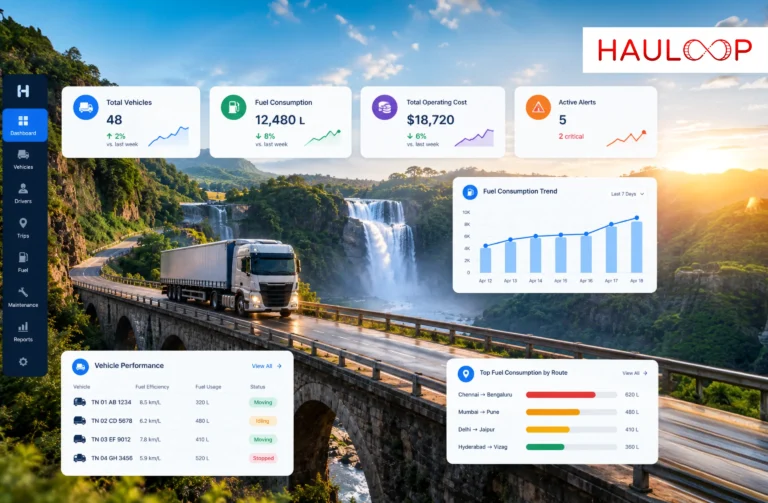
That becomes possible when fuel purchases are connected with vehicle location, driver assignments, tank activity, routes, completed work, and operating costs.
Hauloop’s AI Fleet Management System Platform brings this information into one connected view, helping fleets trace fuel from purchase to purpose. Book a Demo to identify where fuel costs are being created and which exceptions need attention.
Frequently Asked Questions
What counts as fuel loss in a fleet?
Fuel loss includes theft, leakage, unauthorised purchases, unnecessary idling, inefficient routing, empty mileage, mechanical inefficiency, and inaccurate records. The fuel may not physically disappear; it may be consumed without contributing reasonably to productive fleet work.
Why can’t fuel receipts identify the cause of fuel loss?
Receipts confirm where, when, and how much fuel was purchased. They do not show how the vehicle used it afterwards. Journey, location, mileage, driver, idling, tank-level, and vehicle-condition data are needed to explain the complete cost.
How can a fleet establish normal fuel consumption?
Managers should compare each vehicle with its own previous performance on similar routes, workloads, and operating conditions. Vehicle type, traffic, terrain, load, idling, weather, and maintenance condition should be considered before defining a reliable consumption range.
Does higher fuel consumption always indicate driver misuse?
No. Increased consumption may result from traffic, heavier loads, inefficient routes, extended waiting, tyre pressure, engine condition, or unsuitable vehicle allocation. Driver behaviour should be reviewed alongside operational and mechanical information before reaching a conclusion.
What makes a fuel transaction suspicious?
A transaction may require investigation when it occurs away from the assigned vehicle, outside approved hours, exceeds expected tank capacity, involves the wrong fuel type, or does not align with mileage, journey, driver, and tank-level records.
What is the best way to trace fleet fuel costs?
Connect each purchase with the assigned vehicle, driver, location, journey, mileage, tank activity, and work completed. This creates an evidence trail that helps managers distinguish productive consumption from waste, record errors, misuse, leakage, or theft.