Two drivers can complete the same delivery route, arrive on time, and return without an accident.
But that does not mean they drove with the same level of safety.
One driver may maintain a steady speed, accelerate gradually, and brake smoothly. The other may repeatedly accelerate aggressively, brake suddenly, or take corners too sharply.
Both trips are completed, but the driving behavior behind them tells a different story.
For fleet managers, harsh driving detection helps make these differences visible. Instead of relying entirely on complaints, incident reports, or occasional observations, fleets can monitor driving events and understand how vehicles are being operated during everyday trips.
What is Harsh Driving Detection in Fleet Management?
Harsh event detection is a vehicle monitoring capability that identifies driving behaviors associated with increased safety risk.
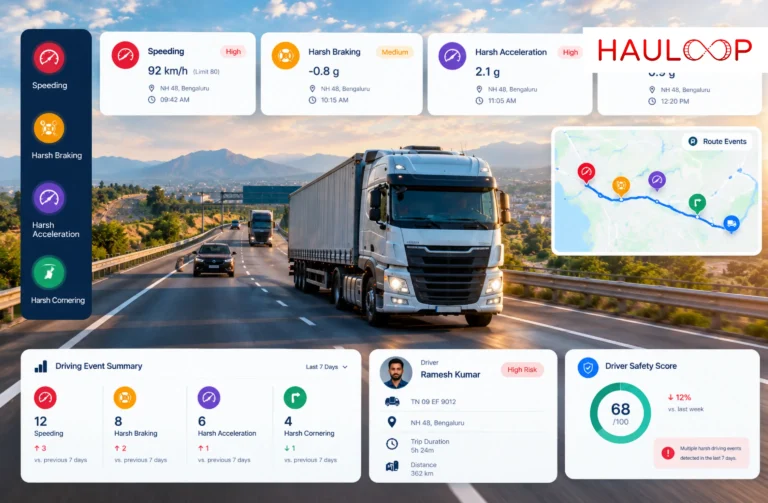
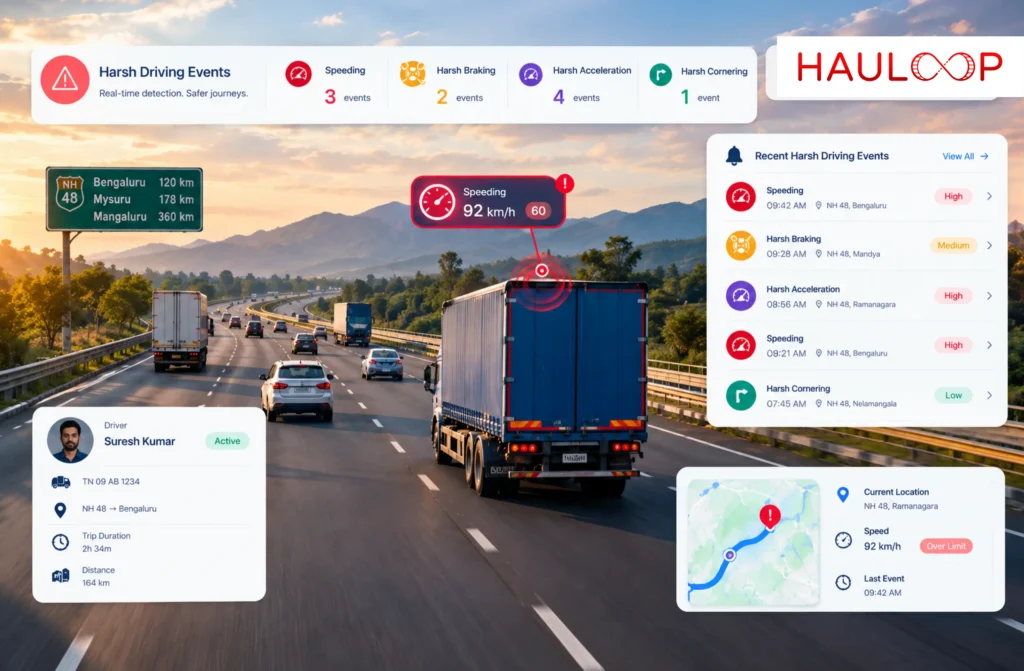
It monitors vehicle movement and driving data to recognise events such as harsh braking, sudden acceleration, sharp cornering, and speeding.
When a monitored event meets the system’s detection criteria, it can be recorded and reported to the fleet management team.
This gives managers information that basic vehicle location tracking cannot provide.
GPS tracking may show that a truck travelled from one location to another. Harsh driving detection provides additional context about how the vehicle was driven during that journey.
The purpose is to identify potentially unsafe behavior early enough for managers to investigate and respond.
What Types of Harsh Driving Events can be Detected?
Harsh driving events generally involve sudden or excessive changes in vehicle movement.
Hauloop’s detection capability focuses on four important driving behaviors.
Harsh braking: Sudden or forceful deceleration that may indicate abrupt stopping, insufficient following distance, or a reaction to an unexpected road situation.
Rapid acceleration: Aggressive increases in speed that may indicate unnecessarily forceful driving or inconsistent vehicle control.
Harsh cornering: Sharp turning movements that may increase vehicle instability, particularly when carrying heavy or sensitive cargo.
Speeding: Driving above a configured speed threshold, creating additional safety concerns depending on the vehicle, road, and operating conditions.
Each event provides a different piece of information about driving behavior.
However, detecting an event does not automatically explain why it happened.
Does Every Harsh Braking Event Mean Unsafe Driving?
Not necessarily.
Imagine a truck travelling along a busy highway when another vehicle suddenly enters its lane.
The driver brakes sharply to maintain a safe distance.
The monitoring system may record a harsh braking event, but the driver’s response could have prevented an accident.
Now consider another driver who repeatedly brakes aggressively because they follow vehicles too closely.
The recorded event may look similar, but the circumstances are different.
This is why fleet managers should review harsh braking events alongside available information about location, timing, driving conditions, and previous behavior.
A single event provides a warning signal. Repeated events can reveal a more meaningful pattern.
Why is Sudden Acceleration Important for Fleet Safety?
Rapid acceleration can reveal how aggressively a vehicle is being operated.
Repeated forceful acceleration may contribute to unnecessary vehicle stress, increased fuel consumption, and less controlled driving.
For commercial fleets, this matters because driving behavior can affect more than road safety.
It can also influence operating costs, vehicle wear, and the consistency of trip performance.
However, acceleration should be evaluated in context.
A vehicle merging into traffic may accelerate differently from one moving through a depot or residential area.
The objective is not to treat every acceleration event as a violation. It is to identify unnecessary or recurring aggressive behavior.
How can Harsh Cornering Affect Commercial Vehicles?
Cornering behavior deserves particular attention in commercial transport.
Vehicle weight, load distribution, center of gravity, road conditions, and turning speed can influence stability.
A sudden or aggressive turn may create additional risk, especially for vehicles carrying heavy loads.
Harsh cornering detection helps identify movements that may deserve investigation.
For example, repeated sharp cornering events along a particular route could indicate aggressive driving, challenging road geometry, or another operational factor.
The fleet manager can then examine whether the behavior is associated with a particular driver, vehicle, or route.
That is more useful than simply recording that a turn occurred.
How does Real-Time Harsh Driving Detection Work?
The process begins with continuously monitoring vehicle speed, braking, acceleration, and movement patterns.
When the system identifies a driving event that meets its detection criteria, it records the event and can generate an alert.
Hauloop’s real-time harsh event detection workflow connects six stages:
- Monitor driving data throughout the trip.
- Detect harsh braking, acceleration, cornering, or speeding.
- Generate an alert when the event occurs.
- Capture relevant driver, location, and event context.
- Analyse repeated events and driving patterns.
- Support corrective action where necessary.
This allows driving events to become part of everyday fleet monitoring rather than information reviewed only after an incident.
Why is Driver-Specific Event Information Important?
A fleet-wide event total can indicate how often certain driving behaviors are occurring.
But it does not show who needs attention.
Suppose a fleet records 120 harsh driving events during one reporting period.
If those events are spread evenly across many vehicles, the situation may require a different response than if most events are associated with a small number of drivers.
Driver-specific event insights help managers identify where repeated behavior is concentrated.
They can review individual driving histories, compare events over time, and determine whether coaching or closer monitoring is appropriate.
This makes the information more useful for targeted safety improvement.
Why should Fleet Managers Review Historical Driving Events?
Real-time detection shows what is happening now.
Historical event tracking helps explain whether the behavior is becoming a recurring issue.
For example, one harsh braking event during an unusual traffic situation may not indicate a continuing problem.
But repeated harsh braking across several trips may justify further investigation.
Historical information can also reveal whether behavior changes after driver coaching.
Fleet managers can compare event patterns before and after intervention to understand whether the issue is improving.
The important distinction is between an isolated event and a repeated behavior that may increase risk.
How does Harsh Driving Detection Support Driver Safety Scores?
Individual harsh driving events can provide useful inputs for evaluating driver performance.
For example, repeated speeding, harsh braking, aggressive acceleration, and sharp cornering may contribute to a lower driver safety score when those behaviors are included in the scoring rules.
A driver safety score can summarize multiple driving behaviors into a broader performance indicator.
However, the score should not replace reviewing the actual events.
A percentage may indicate that a driver needs attention, but the underlying event history helps explain what behavior needs improvement.
This makes event detection and driver scoring complementary parts of fleet safety management.
Conclusion
Knowing where a vehicle travelled is useful. Understanding how it was driven provides another level of safety information.
Harsh driving detection makes sudden braking, aggressive acceleration, sharp cornering, and speeding visible during everyday fleet operations.
The greatest value comes from reviewing these events in context, identifying repeated behavior, and using the information to support practical driver safety improvements.
An isolated event may require investigation. A recurring pattern may require coaching or a change in operating practices.
If your fleet needs better visibility into unsafe driving behavior, an AI Fleet Management Platform can connect driving events, alerts, and driver-specific insights in one place. Book a demo with Hauloop to understand how harsh event detection supports fleet safety monitoring.
Frequently Asked Questions
What is harsh driving detection?
Harsh driving detection monitors vehicle movement and identifies behaviors such as sudden braking, rapid acceleration, sharp cornering, and speeding. It helps fleet managers recognise potentially risky driving events and review how vehicles are being operated during trips.
What causes a harsh braking event?
Harsh braking occurs when a vehicle decelerates rapidly enough to meet the system's detection criteria. It may result from sudden traffic changes, emergency situations, close following distances, or aggressive driving.
Can harsh driving detection identify speeding?
Yes. Hauloop includes speeding among the driving events it monitors. When the configured detection criteria are met, the system can record the event and generate an alert.
Does every harsh driving event indicate a dangerous driver?
No. Individual events can result from road conditions, traffic situations, or necessary defensive driving. Fleet managers should review event context and recurring behavior before making conclusions about driver performance.
How does harsh driving detection differ from GPS tracking?
GPS tracking primarily identifies vehicle location and movement. Harsh driving detection examines driving behavior, including braking, acceleration, cornering, and speeding, to provide additional information about potential safety risks.
Can harsh driving events affect driver safety scores?
Yes. When included in a fleet's scoring rules, repeated harsh driving events can influence driver safety scores. Reviewing the underlying events helps managers understand which driving behaviors require improvement.