A truck completes its delivery without an accident.
During the trip, however, the monitoring system records several speeding events, two instances of harsh braking, and repeated aggressive acceleration.
The delivery was successful, but the driving behavior raises questions.
Was this an unusual trip? Is the same behavior happening regularly? Does the driver need coaching? Are certain routes contributing to the problem?
These are the questions harsh driving alerts can help fleet managers investigate.
The value of an alert is not simply that a notification appears. It is what the fleet does with that information.
When driving events are monitored, prioritised, and reviewed consistently, managers can identify risky patterns and intervene before those behaviors contribute to a serious incident.
Why do Fleet Managers Need Real-Time Driving Alerts?
Many driving behaviors happen within seconds.
A driver brakes aggressively, accelerates suddenly, or exceeds a configured speed threshold. By the time the vehicle returns to the depot, the event may no longer be obvious.
Without monitoring, fleet managers may only learn about unsafe driving through customer complaints, driver reports, or incidents.
Real-time alerts provide another source of information.
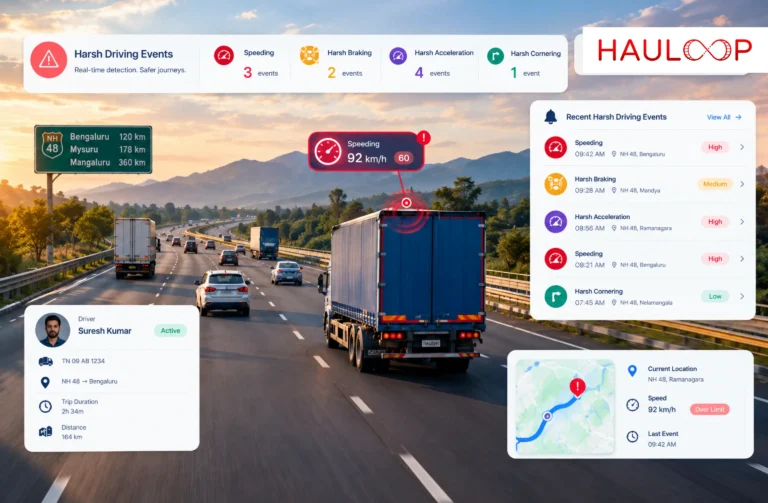
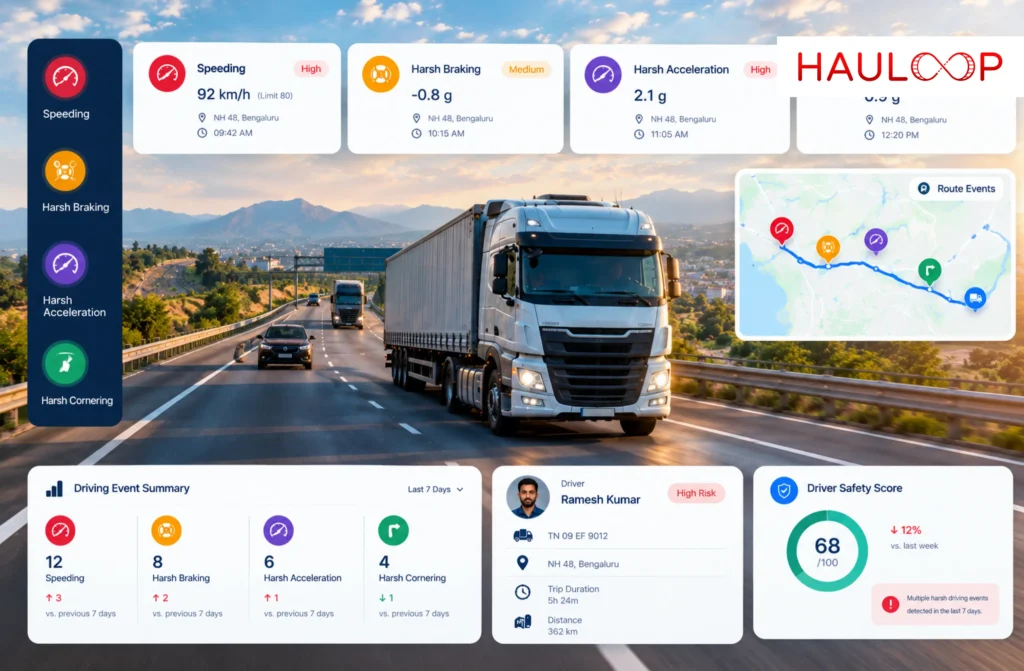
Hauloop monitors braking, acceleration, cornering, and speeding events and can notify fleet teams when the relevant detection criteria are met.
This allows managers to recognise potentially unsafe behavior during an active trip instead of relying entirely on retrospective reporting.
However, receiving the alert is only the first step.
What should Fleet Managers do When an Alert Appears?
Not every harsh driving alert requires the same response.
A single harsh braking event may result from an unexpected traffic situation. Repeated speeding events may indicate a more persistent safety concern.
When an alert appears, the fleet manager should first understand what happened.
That means reviewing the event type, driver, location, timing, and available driving context.
The manager can then determine whether the situation requires immediate communication, later investigation, or continued monitoring.
A practical response follows four questions:
- What driving event occurred?
- Where and when did it happen?
- Is there an immediate safety concern?
- Has similar behavior occurred before?
This prevents fleet teams from reacting to every notification without understanding its significance.
How can High-Risk Event Prioritisation Improve Response?
A fleet operating dozens of vehicles may generate multiple driving alerts throughout the day.
Treating every event as equally urgent can overwhelm the operations team.
High-risk event highlighting helps managers focus on events that deserve greater attention.
For example, repeated speeding or a combination of aggressive driving behaviors may warrant closer investigation than an isolated harsh braking event.
The actual priority should depend on the event details, severity, available context, and the fleet’s safety policies.
Hauloop’s harsh event detection functionality is designed to highlight higher-risk events and provide a centralized view of active and recent driving activity.
This helps managers spend more time investigating meaningful risks and less time sorting through routine notifications.
Why is Event Context Important Before Contacting a Driver?
Consider a harsh braking alert recorded near a busy intersection.
The event could have resulted from the driver approaching traffic too quickly.
It could also have been a necessary response to another road user.
Without context, the fleet manager cannot reliably distinguish between those situations.
Hauloop captures event information such as driver, location, and driving conditions to support investigation.
This information helps managers ask more relevant questions when following up.
Rather than immediately accusing the driver of unsafe behavior, the manager can review the circumstances and determine whether the event reflects a driving habit, a road condition, or an isolated situation.
The objective is an accurate safety assessment, not simply responding to the alert count.
How can Repeated Alerts Reveal Unsafe Driving Patterns?
A single event shows what happened at one moment.
Repeated events can reveal how a driver normally behaves.
Suppose a driver records several aggressive acceleration events across multiple trips.
If the same behavior continues over time, it may indicate a habit that deserves attention.
Similarly, repeated harsh cornering or speeding events may suggest that a driver needs additional coaching or closer monitoring.
Behavior pattern recognition helps managers move beyond individual alerts.
Hauloop analyses repeated driving events to identify recurring unsafe behavior and drivers who may require attention.
This allows safety teams to focus on consistent patterns rather than isolated incidents.
How should Fleet Managers Use Alerts for Driver Coaching?
Driver coaching works best when the feedback is specific.
Telling a driver to “drive more safely” provides little guidance about what should change.
Event information allows managers to discuss identifiable behaviors.
For example, if a driver repeatedly accelerates aggressively, coaching can focus on smoother acceleration and more controlled driving.
If speeding events occur regularly, the discussion can focus on speed management and the conditions under which those events happen.
The manager can then review subsequent driving events to determine whether the behavior improves.
This creates a practical coaching cycle:
Identify behavior → Review context → Discuss improvement → Monitor future events
The purpose is to help drivers improve their performance rather than simply record violations.
Can Harsh Driving Alerts Help Identify Route-Related Risks?
Driver behavior is not the only factor worth investigating.
Sometimes the location of repeated events provides useful information.
Imagine several drivers recording harsh braking events near the same junction.
That pattern may deserve a route-level review.
The cause could involve traffic conditions, road design, operating schedules, or another factor affecting vehicle movement.
Likewise, repeated sharp cornering events along a particular route may indicate an area where drivers need additional guidance.
Location-based event information can therefore help managers distinguish individual driving habits from broader operational conditions.
The next step is to verify the circumstances before changing routes or operating procedures.
How can Historical Event Tracking Measure Improvement?
Corrective action should not end with a coaching conversation.
Fleet managers need to know whether the behavior changes afterward.
Historical event tracking provides a way to review driving behavior across different periods.
Suppose a driver previously recorded frequent harsh acceleration events.
After coaching, the manager can examine subsequent trips to see whether those events have become less frequent.
However, comparisons should consider factors such as trip volume, distance, and operating conditions.
A driver completing twice as many trips may naturally generate more recorded events than someone driving less frequently.
Reviewing patterns in appropriate context produces a more meaningful assessment of improvement.
Why is Centralized Event Monitoring Important?
When driving events are scattered across separate reports or systems, fleet managers may struggle to identify which alerts are current, which have already been reviewed, and which drivers need attention.
A centralized harsh event monitoring system brings active alerts, historical events, and driver-specific information into one environment.
This makes it easier to review the fleet’s overall driving behavior without repeatedly switching between different sources.
For a larger fleet, this can support more consistent safety monitoring.
Managers can focus on recurring behaviors, investigate significant events, and maintain a clearer understanding of where driver coaching may be required.
Can Harsh Driving Alerts Prevent Fleet Accidents?
Harsh driving alerts cannot guarantee that an accident will be prevented.
Road incidents can involve traffic conditions, weather, road users, vehicle condition, and many other factors.
However, repeated aggressive driving behavior can be a useful warning sign.
By identifying those behaviors earlier, fleet managers have an opportunity to investigate and address them.
The value lies in moving from incident-only reviews toward ongoing driver safety monitoring.
Instead of waiting for a collision or complaint to reveal a problem, the fleet can use recorded driving events to identify patterns that deserve attention.
Conclusion
Harsh driving alerts are most valuable when they lead to informed action.
Real-time detection makes potentially unsafe behavior visible. Event context helps managers understand the circumstances. Historical tracking reveals repeated patterns. Driver-specific insights make coaching more targeted.
Together, these capabilities help fleet managers approach safety as an ongoing operational responsibility rather than something reviewed only after an incident.
The objective is not to eliminate every driving alert. It is to understand which behaviors create concern, investigate them fairly, and support measurable improvement over time.
If your fleet needs to identify unsafe driving behavior earlier and respond with greater context, an AI Fleet Management Platform can connect real-time alerts, driver insights, and historical driving patterns in one place. Book a demo with Hauloop to see how harsh event detection can support safer fleet operations.
Frequently Asked Questions
What are harsh driving alerts?
Harsh driving alerts are notifications generated when a monitoring system detects driving events such as sudden braking, aggressive acceleration, sharp cornering, or speeding according to configured detection criteria.
How quickly can fleet managers receive harsh driving alerts?
Hauloop is designed to generate alerts in real time when relevant driving events are detected. Actual notification timing may depend on vehicle connectivity and data transmission conditions.
What should a fleet manager do after receiving a harsh braking alert?
The manager should review the event's driver, location, timing, and available context. They can then determine whether the event requires immediate attention, later investigation, or monitoring for repeated behavior.
How can harsh driving alerts support driver coaching?
Alerts provide information about specific driving behaviors. Managers can review repeated events, discuss the circumstances with drivers, provide targeted coaching, and monitor subsequent performance for improvement.
Can harsh driving alerts identify high-risk drivers?
Repeated driving events can help identify drivers who may require closer attention. However, event counts should be interpreted alongside driving exposure, operating conditions, and the circumstances behind each event.
Do harsh driving alerts guarantee fewer accidents?
No. Alerts cannot eliminate road risks or guarantee accident prevention. They provide earlier visibility into potentially unsafe behavior, allowing fleet managers to investigate patterns and take appropriate corrective action.