A driver completes 200 miles without an accident. Another driver covers the same distance and also arrives without an incident. On paper, both trips look safe.
But the first driver maintained steady speeds, kept enough following distance, and avoided sudden maneuvers. The second repeatedly braked hard, accelerated aggressively, and exceeded the speed limit several times.
The outcome was the same. The driving risk was not.
That is what a driver safety score is designed to uncover. Instead of waiting for a collision or complaint to judge driving performance, fleets can use driving data to identify behaviors that may increase risk over time.
But a score by itself tells you very little. Fleet managers need to understand what goes into it, why one driver’s score changes, and whether the underlying events actually represent unsafe behavior.
What is a Driver Safety Score?
A driver safety score is a performance indicator calculated from driving behaviors and safety-related events recorded during vehicle operation.
Depending on the fleet safety system, the score may consider speeding, harsh braking, rapid acceleration, aggressive cornering, distraction, following distance, seat belt use, and other measurable behaviors. Some platforms may also incorporate video or additional telematics information.
The exact calculation is not universal. Different fleet management systems can use different events, thresholds, weightings, and scoring methods.
That is why fleet managers should never evaluate a driver based only on a number such as 72, 85, or 94. The useful information sits behind the score: which behaviors caused it and how often they occurred.
What Driving Behaviors can Affect a Safety Score?
Most driver safety scoring begins with events that can be detected through GPS, telematics, vehicle sensors, dashcams, or connected cameras.
Speeding is one example. A system may compare vehicle speed against configured limits and record repeated or prolonged speeding behavior.
Harsh braking and rapid acceleration can also be measured through changes in vehicle movement. Aggressive cornering may indicate that a vehicle is entering or exiting turns with excessive force.
Depending on the technology being used, a driver safety score may also consider:
- Speeding events
- Harsh braking
- Rapid acceleration
- Harsh cornering
- Distracted driving
- Unsafe following distance
- Seat belt behavior
- Fatigue-related events
The purpose is not to collect as many events as possible. It is to identify behaviors that may expose the driver, vehicle, cargo, and other road users to unnecessary risk.
How is a Driver Safety Score Calculated?
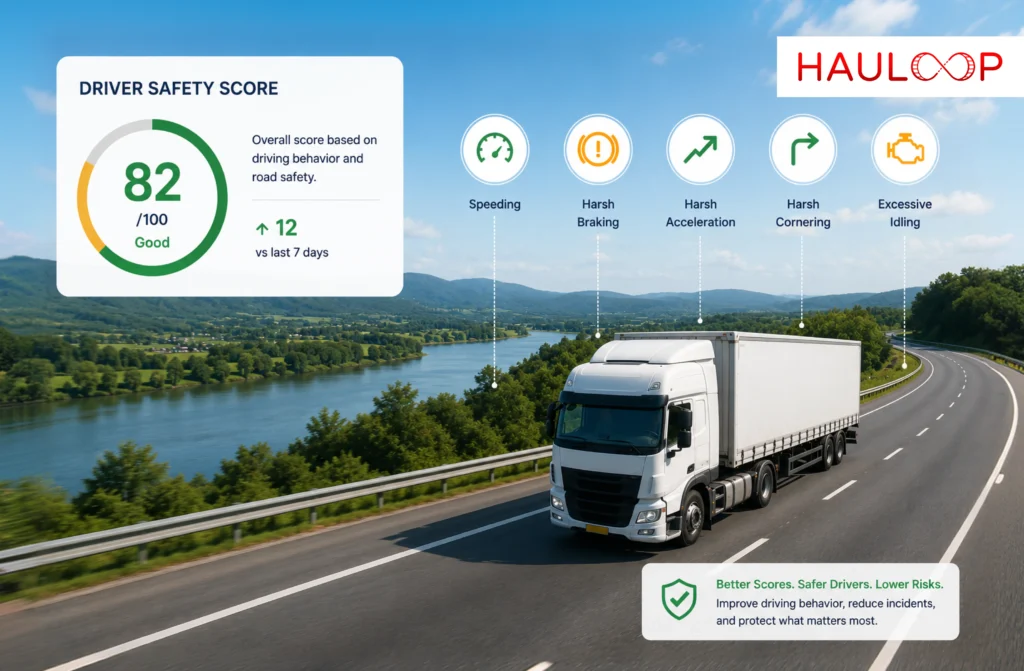
Drivers are monitored through a 100% safety scorecard, which reflects their driving performance. The percentage changes based on behaviors recorded during trips, including speeding, harsh braking, rapid acceleration, and aggressive cornering. Safe and consistent driving helps maintain a higher score, while repeated risky behavior can gradually reduce it.
When significant driving events occur, or a safety score drops, the relevant fleet owner, manager, or operator can be notified. This allows them to quickly understand the driver’s current safety status, review the behavior behind the change, and take appropriate action such as driver coaching or closer monitoring.
Does Harsh Braking Always Mean Unsafe Driving?
No, and this is where driver scoring needs careful interpretation.
A harsh braking event may indicate that a driver was following another vehicle too closely. But the driver may also have braked suddenly because a pedestrian entered the road, another vehicle cut across the lane, or traffic stopped unexpectedly.
The telematics event tells the fleet manager what the vehicle did. It may not always explain why it happened.
The same applies to acceleration and cornering. A recorded event should be treated as a signal worth reviewing rather than automatic proof of poor driving.
When available, trip information, location, vehicle data, and video context can help managers understand whether an event reflects risky behavior or an appropriate response to road conditions.
Why does Speeding Matter in Driver Safety Scoring?
Speeding deserves attention because both frequency and severity can matter.
A driver briefly exceeding a configured threshold is different from one repeatedly operating significantly above the limit across multiple trips.
Rather than treating every event as equal, fleet managers should look for patterns. Is speeding occurring on the same road? Is it associated with one driver? Does it happen at particular times? Is the behavior becoming more frequent?
Speed Alerts can make these events visible, while the safety score can help show whether they are part of a broader behavioral trend.
The objective is not simply to issue more warnings. It is to understand whether a recurring behavior is increasing fleet risk.
Why should Safety Scores be Reviewed Over Time?
A single score provides a snapshot. A trend provides a story.
Suppose a driver’s score falls from 91 to 84 during one week. That may deserve investigation, but it does not necessarily mean the driver has suddenly become unsafe.
Perhaps the driver was assigned an unfamiliar urban route with heavier traffic. Maybe one unusual trip produced several harsh events. Or perhaps the score has been declining gradually for several weeks because speeding and aggressive braking are becoming more frequent.
Looking at performance over time helps managers distinguish isolated events from recurring behavior.
It can also show whether coaching is working. If speeding events decrease and harsh braking becomes less frequent after a coaching conversation, the improving score provides evidence of behavioral change.
How can Driver Safety Scores Support Coaching?
A statement such as “drive more safely” gives a driver very little to work with.
A more useful conversation is specific.
If the data shows repeated harsh braking on urban routes, the discussion can focus on following distance and anticipating traffic changes. If speeding is the recurring issue, coaching can focus on where and when those events happen.
This makes Driver Coaching more evidence-based.
The score helps identify who may need attention, while the underlying events help determine what the coaching should address.
It also allows managers to recognize strong performance. Drivers who consistently demonstrate safer behaviors can be acknowledged rather than using safety data only when something goes wrong.
Can Driver Safety Scores be Compared Across Drivers?
They can, but comparisons need to be fair.
A long-haul driver covering open highways does not operate under the same conditions as a last-mile driver making dozens of stops in dense city traffic. Routes, mileage, vehicle type, traffic, weather, and job requirements can all influence recorded driving events.
Simply ranking every driver from highest to lowest can therefore produce misleading conclusions.
Fleet managers should consider exposure and operating conditions alongside the score. Comparing similar roles, routes, vehicle types, or driving patterns can provide a more useful benchmark.
A safety score should help explain performance, not turn different operating environments into an artificial competition.
What should Fleet Managers Look at Beyond the Score?
The overall number is useful for quickly identifying a change, but it should be the beginning of the investigation rather than the end.
When a score changes, fleet managers should ask:
- Which behaviors affected the score?
- How frequently are those events occurring?
- Are they becoming more severe?
- Do they happen on particular routes or trips?
- Is the pattern repeated over time?
- Is additional context available from telematics or video?
- Has previous coaching changed the behavior?
This approach turns a driver safety score from a dashboard metric into a practical safety-management tool.
How does Driver Safety Scoring Fit Into Fleet Operations?
Driver behavior does not exist separately from the rest of the fleet.
Aggressive acceleration can influence fuel consumption. Harsh driving may contribute to tire and component wear. Speeding can create safety and compliance concerns. A collision can affect the vehicle, cargo, delivery schedule, insurance process, and customer commitment at the same time.
Connecting driver safety information with trip, vehicle, maintenance, and operational data gives transport managers a more complete view of what is happening.
The goal is not constant surveillance or reducing every driver to a number. It is to identify preventable risk early enough for the fleet and driver to do something about it.
Conclusion
A driver safety score is useful because it turns repeated driving events into something fleet managers can monitor over time. But the score itself is not the final judgment on whether someone is a safe driver.
The real value comes from understanding what sits behind it: speeding, harsh braking, acceleration, cornering, distraction, following distance, and other measurable behaviors. Frequency, severity, exposure, trip conditions, and long-term patterns all matter when interpreting those events.
If your primary challenge is identifying driver risk earlier and turning safety data into practical coaching, an AI Fleet Management Platform can connect driver behavior with trip and fleet context. Book a demo with Hauloop to see how driver safety insights can support your fleet operations.
Frequently Asked Questions
What is a good driver safety score?
There is no universal good score because scoring scales and calculations vary between fleet platforms. Managers should understand the system's scoring methodology and focus on behavioral trends, risk events, and improvement over time rather than comparing numbers across different systems.
What lowers a driver safety score?
Depending on the system, repeated speeding, harsh braking, rapid acceleration, aggressive cornering, distraction, unsafe following distance, and other risk-related events may reduce a driver's score.
How often should driver safety scores be reviewed?
Fleet managers can monitor scores regularly for meaningful changes while reviewing longer-term trends for coaching and performance management. A sudden change may warrant investigation, but repeated behavior across multiple trips generally provides stronger evidence than one isolated event.
Can harsh braking affect a driver's safety score?
Yes, harsh braking is commonly used as a driver-behavior indicator. However, individual events should be interpreted carefully because emergency braking may sometimes be the safest response to an unexpected road situation.
Can driver safety scores help reduce accidents?
Safety scores cannot prevent accidents on their own. They can help fleets identify recurring risky behaviors earlier, giving managers an opportunity to provide targeted coaching and address preventable risk before it contributes to an incident.
Should fleet managers rank drivers only by safety score?
No. Driver comparisons should account for mileage, routes, vehicle types, traffic conditions, and job requirements. The score is most useful when combined with the events behind it and the operating context in which those events occurred.