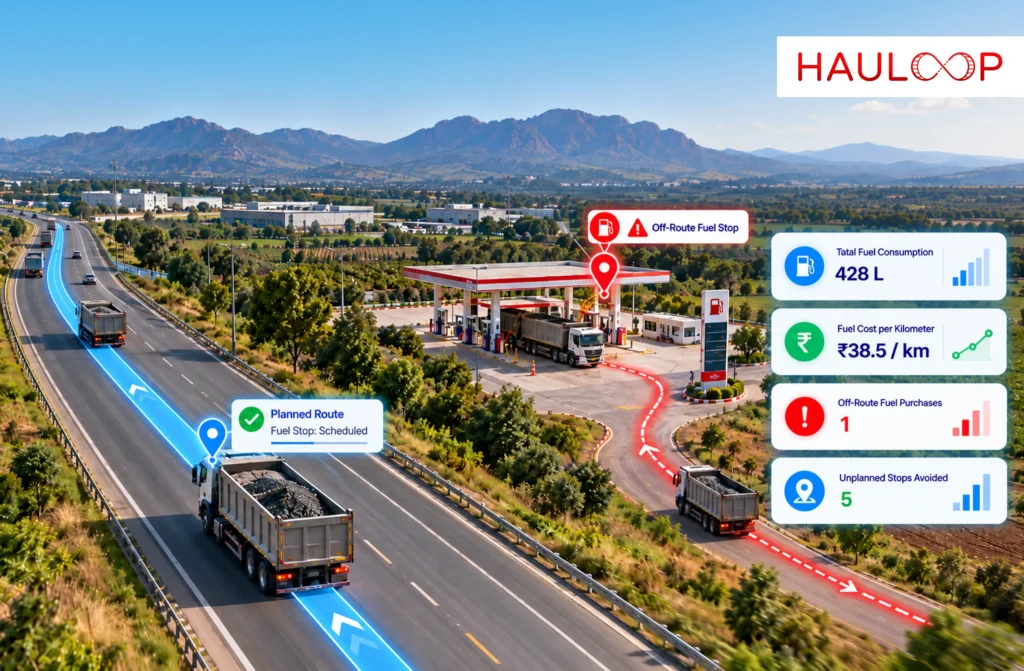
A truck leaves the depot with enough fuel to reach the customer. What the dispatcher does not account for is the return journey, an expected period of congestion and the operating reserve the vehicle should retain.
Later that day, the fuel level approaches its minimum. The driver leaves the assigned route to find an available station, waits for approval and purchases fuel at a location the operations team did not plan to use.
The vehicle receives the fuel it needs, but the trip has already absorbed an additional stop, extra distance and an unplanned transaction.
An NREL fleet study found that the diesel trucks it observed typically took less than ten minutes to refuel. That finding applies to the studied fleet rather than every operation, but it highlights an important distinction: the physical fill may be brief, while reaching the station, waiting, obtaining approval and returning to the route can create a much longer disruption.
Fleet refuelling management treats the fuel stop as part of the trip plan. It checks whether the vehicle has enough usable fuel, estimates the complete route requirement, identifies an appropriate station and verifies the purchase afterward.
Let’s examine how planning the refuelling decision before dispatch can prevent avoidable route changes and unclear fuel transactions.
Fleet Refuelling Management Begins Before the Vehicle Moves
Fleet refuelling management is the process of planning, authorising, monitoring and verifying when and where fleet vehicles receive fuel.
It connects four decisions:
- How much usable fuel the vehicle currently has
- How much the planned movement is expected to require
- Where and when the vehicle should refuel
- Whether the completed purchase matched the assigned vehicle and trip
Without this process, refuelling often becomes a driver-led decision made after the fuel level has already become urgent.
The driver may choose the nearest visible station, even if it requires leaving the route. Dispatch may approve the transaction without knowing how much the tank can accept. Finance receives the invoice later but cannot immediately explain why the vehicle used that station or quantity.
Hauloop’s fuel management capabilities can connect fuel activity with vehicle and trip information, helping operations review a fuel stop as part of the movement rather than as a separate expense.
Confirm the Usable Tank Level Before Dispatch
The fuel gauge showing half a tank does not provide a sufficiently precise trip plan.
Before dispatch, the team should identify:
- The vehicle’s usable tank capacity
- The available fuel level
- The distance to be covered
- The expected consumption for comparable work
- The required operating reserve
- Whether a planned fuel stop is necessary
Usable capacity may differ from the tank’s stated maximum. Fleets may retain a minimum level to prevent fuel-system problems, provide operational flexibility or meet an internal reserve policy.
Tank-level data also depends on the available device and integration. A compatible, correctly installed and calibrated sensor can provide a more precise reading than a dashboard gauge. The data should still be checked for reporting gaps, delayed uploads or unusual sensor behaviour before it determines the dispatch decision.
If reliable tank data is unavailable, the fleet should use its approved manual verification process rather than presenting an estimate as an exact measurement.
Estimate Fuel for the Complete Movement, Not Only the Delivery
The planned requirement should cover the full movement for which the vehicle remains responsible.
Assume a truck is assigned a 710-kilometre route, including the delivery and return. Comparable trips completed with the same vehicle type and load average 2.7 kilometres per litre.
The expected trip requirement is:
710 kilometres ÷ 2.7 kilometres per litre = approximately 263 litres
The fleet also requires a 55-litre operating reserve.
The total planned requirement becomes:
263 expected litres + 55 reserve litres = 318 litres
If the vehicle currently has 175 usable litres, the planned additional quantity is:
318 required litres − 175 available litres = 143 litres
This calculation gives dispatch a practical starting point. It does not guarantee that the trip will consume exactly 263 litres.
Traffic, load, route changes, terrain, weather, waiting and auxiliary-equipment use can affect the final result. The estimate should therefore come from comparable completed work and be adjusted when the current assignment differs.
The reserve should also follow the fleet’s operating policy. It should not be an arbitrary amount copied across every vehicle and route.
Choose a Station That Supports the Trip Plan
The nearest station is not always the best operational choice.
A suitable refuelling location should be assessed against:
- Distance from the assigned route
- Fuel type and availability
- Vehicle size and site access
- Opening hours
- Expected congestion or queueing
- Payment or fuel-card acceptance
- Approved supplier arrangements
- Fuel price
- Driver-hours and delivery-window impact
- Availability of a fallback station
A lower pump price can become a false saving when the vehicle travels several additional kilometres to obtain it.
The commercial team should also understand the fuel-price assumption used for the trip. Our guide to rising fuel prices explains why a route can lose expected contribution when the actual price differs from the value used in the rate.
Station selection should therefore consider the complete cost of the stop—not only the displayed price per litre.
Give the Driver a Clear Refuelling Instruction
A planned fuel stop should be communicated as a specific trip instruction.
The driver should know:
- The approved station
- The planned quantity or fill limit
- The expected point in the journey
- The assigned vehicle or fuel card
- What record must be captured
- Who to contact if the station is unavailable
- Whether another station is already approved as a fallback
This removes uncertainty during the trip.
A vague instruction such as “fill when needed” leaves the driver to decide how low the tank should fall, which station to use and how much to purchase. Those choices may be reasonable, but operations has no consistent basis for reviewing them afterward.
The instruction should still allow for a genuine exception. A station may be closed, unable to accommodate the vehicle or temporarily without the required fuel. The driver needs a defined escalation process rather than being forced to choose between delaying the trip and making an unauthorised purchase.
Respond to Fuel Exceptions While the Trip is Active
A fuel plan may need to change after dispatch.
Unexpected congestion can increase consumption. A diversion may add distance. A customer delay may keep auxiliary equipment operating longer than expected. A planned station may become unavailable.
The team should reassess:
- The current usable fuel
- The remaining route distance
- The reserve required at completion
- The vehicle’s recent consumption
- The nearest suitable approved station
- The effect of the stop on delivery timing
Active visibility matters because the decision is time-sensitive. Our guide to active trip tracking explains why vehicle movement becomes operationally useful when the team can respond before an exception affects the completed trip.
If the refuelling instruction changes, the new station, quantity, reason and approver should be recorded. That creates a clear explanation for finance and operations afterward.
Review Off-Route Purchases Before Treating Them as Misuse
An off-route fuel purchase deserves attention, but it does not automatically prove misuse.
The vehicle may have been diverted, the planned station may have been closed or dispatch may have given verbal approval that was never added to the trip record.
The review should compare:
- Transaction time
- Station location
- Vehicle position
- Assigned route
- Driver and vehicle identity
- Quantity purchased
- Tank capacity
- Fuel level before and after the stop
- Available approval or exception record
A purchase becomes more concerning when several details do not align. For example, the assigned vehicle may be far from the station when its card is used, or the quantity may exceed the available tank space.
These mismatches justify an investigation. They should not be treated as proof until the data, device status and operating context have been checked.
Confirm That the Fuel Reached the Assigned Vehicle
A receipt confirms that a transaction occurred. It does not independently confirm that the complete quantity entered the assigned vehicle.
Where compatible tank-level data is available, the team can compare:
- Fuel level before the stop
- Quantity purchased
- Fuel level after the fill
- Vehicle location
- Ignition and movement status
- Time between the transaction and sensor update
Suppose a vehicle has approximately 210 litres before refuelling and purchases 120 litres. The expected post-fill level is approximately 330 litres, subject to sensor accuracy, tank geometry and reporting timing.
If the recorded increase is materially lower, the fleet has a reason to review the transaction. The difference could come from an incorrect receipt, sensor behaviour, data delay, a leak or potential misuse.
Our guide to context-aware detection explains why a single tank reading should not be treated as proof of theft. The event should be supported by location, time, vehicle activity and sustained fuel-level evidence.
Use Completed Trips to Improve the Next Refuelling Plan
The refuelling process should not end when the receipt is approved.
After the trip, compare:
- Expected and actual fuel consumption
- Planned and actual fuel-stop locations
- Intended and purchased quantities
- Route distance and diversions
- Reserve remaining at completion
- Time added by the stop
- Exceptions raised during the journey
If the vehicle repeatedly finishes with far more fuel than the required reserve, the planned quantity may be unnecessarily high. If it regularly approaches the minimum level, the forecast or reserve may be too low.
A station that repeatedly creates delays may need to be removed from the preferred list. A route that consistently consumes more than expected may need a revised baseline.
This review turns each completed movement into a better plan for the next one.
Conclusion: Make Refuelling Part of the Route, Not an Interruption
Return to the vehicle from the beginning. It had enough fuel to reach the customer, but the plan did not account for the return journey, congestion or the required reserve.
The driver eventually found fuel, but only after leaving the route and creating an unplanned stop and transaction.
Fleet refuelling management prevents this situation by checking usable fuel before dispatch, estimating the complete requirement, selecting an appropriate station, giving the driver a clear instruction and verifying the purchase afterward.
The goal is not to eliminate every fuel exception. It is to ensure that when the plan changes, the team can see why it changed, approve the next action and retain a clear record of the decision.
AI-powered fleet management software can connect fuel activity with vehicle and trip information in one operational view. Book a Demo to see how better refuelling control can reduce unplanned stops and bring clearer accountability to fleet fuel purchases.
Frequently Asked Questions
What is fleet refuelling management?
Fleet refuelling management is the process of planning, authorising, recording and verifying when and where vehicles receive fuel. It connects available tank level, expected trip requirements, approved stations and completed transactions.
How do fleets estimate fuel requirements before dispatch?
Fleets can divide the complete route distance by the expected efficiency of a comparable vehicle and duty cycle. They should then add the required reserve and adjust for load, terrain, traffic, auxiliary use and expected operating conditions.
Should a driver always fill the tank completely?
Not necessarily. The quantity should reflect the trip requirement, reserve policy, tank capacity and future assignments. Unnecessary fuel adds weight, while insufficient fuel can create an unplanned stop. The fleet should define an appropriate quantity for the movement.
What should a driver do if the planned fuel station is unavailable?
The driver should follow the fleet’s escalation process and contact the responsible operations person. Dispatch can reassess the available fuel, remaining distance and approved alternatives before issuing a revised instruction.
Does an off-route fuel purchase prove fuel-card misuse?
No. A diversion, station closure or approved exception may explain the purchase. The fleet should review vehicle location, route, time, quantity, card assignment and approval records before reaching a conclusion.
Can tank-level monitoring confirm that purchased fuel entered the vehicle?
It can provide supporting evidence when compatible and properly configured devices are available. Sensor accuracy, tank geometry, vehicle angle and reporting delays should be considered before comparing the transaction quantity with the recorded tank increase.