
The fleet has been operating normally. Drivers are completing trips, vehicles are leaving on schedule, and no major compliance issue has been reported.
Then an auditor asks for the inspection record for one vehicle, the repair evidence for a defect reported six months ago, and the duty-status history of the driver assigned to it.
The information exists but not as one complete trail. The inspection is in a paper file, the repair invoice is with accounts, the driver report is in another system, and nobody can show exactly when the vehicle was cleared to return to service.
Official FMCSA data shows why audit readiness matters. Of 58,600 U.S. New Entrant Safety Audits completed in 2023, 8.7% resulted in failure, according to the agency’s industry statistics.
Hauloop’s inspection-ready mode is designed to keep critical documents and records accessible. But why do gaps remain invisible during daily operations and become obvious as soon as an audit begins?
What does a Fleet Compliance Audit Examine?
A fleet compliance audit examines whether an operator has effective controls for meeting the rules that apply to its drivers, vehicles, and operations.
The scope may include driver qualifications, duty records, vehicle inspections, defect repairs, maintenance history, insurance, permits, incidents, and other required documentation. The exact request depends on the authority, location, fleet type, and reason for the audit.
An auditor does not only ask whether a task was completed. The fleet may need to prove who completed it, when it happened, what action followed, and whether the evidence was retained correctly.
Daily Operations can Continue While Records Fall Behind
Compliance gaps are often administrative before they become operational. A vehicle can complete deliveries while an inspection document remains unsigned. A driver can continue working while an updated certificate has not been added to the central file.
Because nothing immediately stops, the missing record receives less attention than dispatching the next trip. Over time, small omissions accumulate.
An audit changes the test. Normal operations ask, “Can this vehicle work today?” An auditor asks, “Can you prove that this vehicle, driver, and decision met the requirement on a specific date?”
That difference is why a fleet can appear compliant until its evidence is examined.
Fragmented Records Break the Evidence Chain
The inspection may be recorded in one system, the defect in a driver message, the repair on an invoice, and the approval to return the vehicle to service in an email.
Each item may be genuine, but the fleet still has to connect them. If dates conflict, vehicle numbers are entered differently, or a document cannot be found, the evidence chain becomes difficult to defend.
This problem also appears in cargo operations. Our article on cargo custody explains why separate events do not prove responsibility until they are joined into a continuous record. Compliance evidence works in much the same way.
Unclosed Defects Become Audit Findings
Recording a defect is only the beginning of the process. The fleet must also show how the issue was assessed, what repair was completed, who verified it, and when the vehicle returned to service.
Digital inspections can link a driver’s report with the vehicle and inspection time. The repair and closure must then remain connected to that original finding.
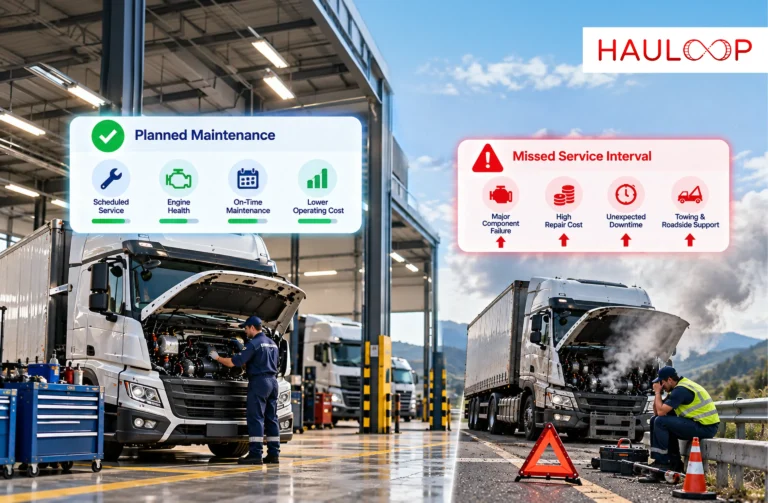
Maintenance data helps reveal whether the action was completed rather than merely scheduled. As discussed in planned fleet repairs, a maintenance signal has little value unless it becomes assigned work with a recorded outcome.
Missing Context can Make Accurate Data Look Unreliable
An electronic log, GPS record, workshop invoice, or inspection form may be accurate on its own. An audit problem arises when the records do not explain one another.
For example, a duty log may show that a driver stopped, while location history shows movement during the same period. A repair invoice may list a part but not the vehicle or defect to which it relates. An inspection may be dated correctly but lack the person who completed it.
Fault data creates the same challenge. OBD fault monitoring can identify a developing issue, but the compliance record also needs to show how the fleet responded when that issue affected roadworthiness.
Audit Readiness is Built During Daily Work
Preparing for an audit should not begin when the request arrives. By then, teams are often searching backwards through months of activity.
Audit readiness is created when every compliance action produces a complete record at the time it occurs. Required fields, named ownership, expiry alerts, exception workflows, and document-retention rules reduce the chance that evidence will be missed.
An immutable audit trail can preserve a time-stamped history of compliance actions and updates. This helps the fleet show not only the latest status, but also how that status was reached.
A Pre-Audit Review Should Test Retrieval, not Just Completion
Many internal checks ask whether inspections, licences, and permits are current. A stronger review asks whether the evidence can be retrieved quickly for a selected driver, vehicle, trip, or date.
Choose a small sample and reconstruct the full history. Can the team connect the inspection to any defect, the defect to the repair, and the repair to the return-to-service decision? Can it produce the driver’s qualification and duty records without searching several inboxes?
If the answer is no, the fleet has found a compliance gap before the auditor has. That gives the team time to correct the process and prevent the same gap from recurring.
The Audit Reveals What Daily Visibility Missed
Return to the opening request. The inspection, repair invoice, and driver record all existed, but the fleet could not connect them into a reliable timeline.
A centralized process changes the response. The team can retrieve the vehicle record, see the original inspection, follow the defect into a completed repair, identify who approved the return to service, and provide the related driver documentation.
That is why a fleet compliance audit exposes hidden gaps: it tests evidence and traceability, not just whether work appears to have been done.
Conclusion
Compliance gaps surface during an audit because daily operations can continue despite missing, scattered, or unclosed records. The solution is to create the evidence trail while the work happens and not reconstruct it after the request arrives.
Hauloop is an AI Powered Fleet Management Software that connects inspections, documents, actions, and audit history in one operational view. Make audit readiness part of daily fleet management—Book a Demo.
Frequently Asked Questions
What is a fleet compliance audit?
A fleet compliance audit reviews whether an operator has effective controls and supporting evidence for driver, vehicle, inspection, maintenance, safety, and recordkeeping requirements applicable to its operations.
Why do missing documents become serious during an audit?
Without the requested document, a fleet may be unable to prove that a required action occurred. Completion without retrievable evidence can still create an audit finding or require further investigation.
Which vehicle records should be audit-ready?
Depending on the applicable rules, fleets may need inspection reports, defect records, repair evidence, maintenance history, registration, permits, insurance, and documentation showing when a vehicle returned to service.
How should fleets prepare for an audit?
Fleets should identify applicable requirements, assign record owners, review expiry dates, close unresolved defects, test document retrieval, and sample complete driver and vehicle histories before an official request arrives.
What is an immutable audit trail?
An immutable audit trail is a protected chronological record of actions and changes. It helps show who created or updated compliance information, when the change occurred, and how the current status was reached.
Can compliance software guarantee that a fleet passes an audit?
No. Software can centralize records, automate reminders, and improve traceability, but the fleet remains responsible for following applicable rules, completing required actions, and ensuring its information is accurate.